Pugs
Old Possum's Book of Practical CatsThe Pugs are a group of dogs whose brief appearance in The Awefull Battle of the Pekes and the Pollicles turns a reputation for avoiding fights into comic participation in one. They first remain outside the confrontation, but when it swells they join in from balconies and a roof, their barking enlarging the din. Their part ends in the collective flight that follows the Great Rumpuscat’s leap.
Identity and Reputation
The Pugs are presented alongside the Poms as a group that, according to what most people say, does not like fighting. The poem immediately qualifies that reputation: both groups will nevertheless join a fray now and again. This contrast makes the Pugs’ later involvement less a reversal of character than an occasional exception to their public image. The account gives them no individual names or separate personalities; they act as a group within the broader dog gathering.
Joining the Fray
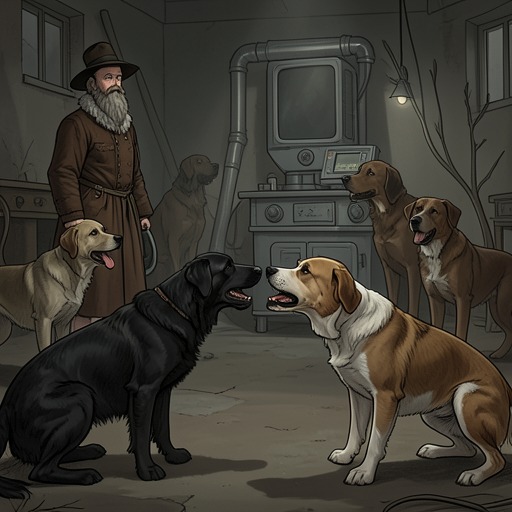
The Pugs initially hold aloof while the Pekes and Pollicles confront one another. After those opposing groups step out with their pipers playing, the Pugs and Poms no longer stay apart. Some join from a balcony and others from a roof, entering the encounter without being described as taking either side. Their contribution is vocal: barking joins the noise of the confrontation, growing into a chorus loud enough to carry all over the Park. The elevated positions from which they join make their participation a conspicuous part of the scene, even though the poem does not assign them a distinct fighting action.
Dispersal and Narrative Role
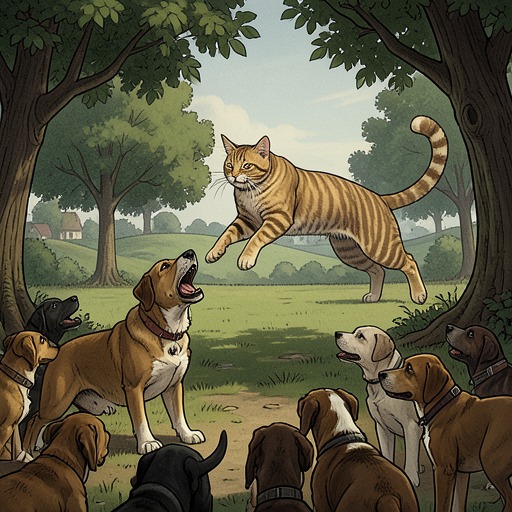
The Pugs’ brief entrance into the fray ends when the Great Rumpuscat looks at the sky and makes a great leap. The Pekes and Pollicles take warning, and every last one of the assembled combatants scatters like sheep; the Pugs’ participation thus concludes in the same rout as the main opposing groups. The Police Dog returns to his beat afterward, leaving the Pugs’ involvement as a short-lived interruption of their usual distance from fighting. Their movement from aloofness to noisy participation, and then to flight, helps make the battle an escalating but ultimately comic disturbance.