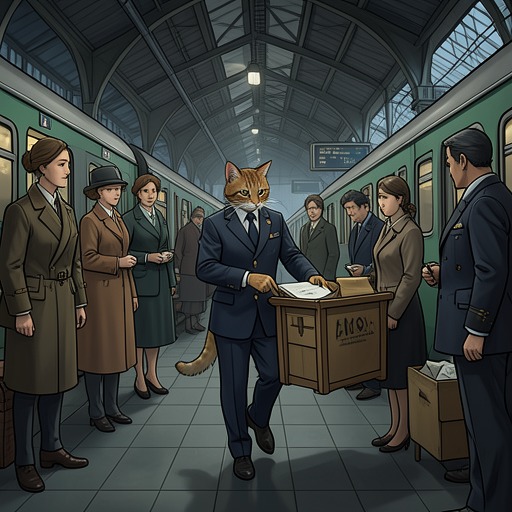
Skimbleshanks: The Railway Cat
Old Possum's Book of Practical Cats“Skimbleshanks: The Railway Cat” is a verse portrait that presents Skimbleshanks as an active presence aboard the night train. Its railway setting is established through the Night Mail’s departure and the Sleeping Car Express; the portrait’s central claim is that Skimbleshanks, rather than the passengers, takes responsibility for the train’s small but persistent threat of mice.
Title and Setting
The title identifies Skimbleshanks by his role on the railway, and the opening situates that role in the preparations for a night journey. A whisper passes down the line at 11.39 as the Night Mail is ready to depart. The train then sets off toward the northern part of the Northern Hemisphere, giving the portrait a specific timetable and a moving setting rather than an unspecified railway backdrop.
Authority on the Train
The poem says that, by and large, Skimbleshanks is in charge of the Sleeping Car Express. That authority is framed across the train’s working company: the next lines name the driver and guards, then the bagmen playing cards. The verse thus places Skimbleshanks among the people and activity of the railway while assigning him an unusually prominent role in the journey.
Night Service
Skimbleshanks’s service is presented as practical as well as authoritative. Passengers need not be bothered by mice because they can leave that problem to the Railway Cat, whom the poem identifies with the railway train itself. The reassurance makes his presence part of the comfort of sleeping aboard: during the watches of the night, he is described as fresh and bright.
The Portrait’s Emphasis
The passage builds Skimbleshanks’s identity through the contrast between a large, organized train journey and a small domestic nuisance. The Night Mail’s scheduled departure and the Sleeping Car Express’s many workers establish the railway’s scale; the promise that the Railway Cat will deal with mice makes his individual usefulness legible within it. The title and refrain-like identification of him as the Railway Cat turn that function into the defining feature of the portrait.