Three names of a cat
Old Possum's Book of Practical CatsThree names of a cat is the naming principle set out in The Naming of Cats: each cat has a familiar name, a unique and dignified name, and a final name that remains beyond human knowledge. Its decisive significance lies in the boundary it draws between names people can use and an inward identity that the cat alone knows.
A Rule of Three
The poem presents its subject as a difficult matter, not a holiday game. That opening insists that the rule is more than a playful list of possible pet names: a cat must have three different names. The sequence matters. It moves from what a family calls a cat every day, through a name particular to one individual, to a name beyond human investigation. Each stage changes who can know or use the name, so the three-part scheme also maps a gradual withdrawal from ordinary social access.
The first name belongs to the routines of family life. The poem offers familiar examples including Peter, Augustus, Alonzo, James, Victor, Jonathan, George, and Bill Bailey, then groups Plato, Admetus, Electra, and Demeter among sensible everyday names. Their variety shows that the first category is defined less by a single style than by its ordinary use: these are names a family can call a cat in daily life. This practical, shared name is necessary, but the poem makes clear that it does not exhaust the cat’s identity.
The Particular Name
The second name must be particular, peculiar, and more dignified. The poem connects this elevated naming to visible feline bearing: keeping the tail perpendicular, spreading the whiskers, and cherishing pride. The name is therefore presented not merely as a label but as part of the cat’s distinctive self-presentation. The progression from everyday familiarity to dignity gives the second category a different social weight, while still making it something that can be named and discussed.
The examples—Munkustrap, Quaxo, Coricopat, Bombalurina, and Jellylorum—make the category concrete. Their decisive qualification is exclusivity: such names never belong to more than one cat. Unlike a family’s daily name, which functions in shared use, the particular name marks an individual. The rule thus distinguishes ordinary recognition from singular recognition: a cat may be addressed in familiar terms, but it also has a name that identifies it as itself rather than as one among many.
The Name Beyond Human Knowledge
Above these two accessible names lies one more, which the poem describes as impossible for a human to guess or discover through research. Its secrecy is not presented as a puzzle that human effort might eventually solve. The boundary is explicit: the cat itself knows this name and will never confess it. Human knowledge reaches the threshold and stops; the cat’s inward possession of the name is certain even though its content remains unavailable to everyone else.
The final name is called deep, inscrutable, and singular. Those terms gather the poem’s claims into a concentrated image: the name belongs to one cat, but its meaning cannot be opened to human understanding. The rule therefore does not end with a third public label. It ends by recognizing a form of feline identity that people can affirm without possessing. The cat is not made fully knowable simply because humans can name it twice.
Meditation and Language
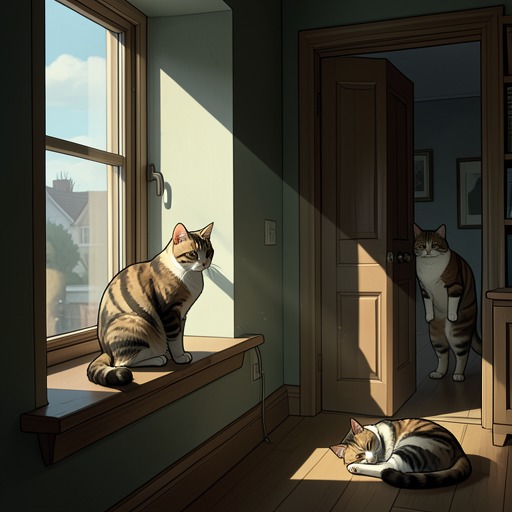
The poem links the private name to a familiar outward state: when a cat is seen in profound meditation, its mind is engaged in contemplation of its name. The repeated thought of the name slows the passage and keeps attention on the act of inward reflection rather than on any revelation of the name itself. The reader is told what the cat is contemplating, but not what the name is. That distinction preserves the rule’s central limit even at the moment when the cat’s private attention becomes visible.
The language at this point presses against the difference between what can be said and what cannot. The sequence moves through “ineffable effable,” “Effanineffable,” and the “Deep and inscrutable singular Name.” The coined-sounding middle expression gives the poem a verbal form for a name that resists ordinary explanation, while the surrounding phrases hold together opposing possibilities: the name can be approached in language, yet it remains ineffable. The poem’s final emphasis is not on decoding the name but on its singularity and its distance from human access.
Significance in the Poem
The three names distribute identity across three degrees of intimacy. A family can use the everyday name; a particular name distinguishes one cat from every other; the final name is known only to its bearer. This structure allows the poem to move from social convention toward privacy without treating the earlier names as false. Each is a different level of naming, and each has a different relation to the cat.
The result is a playful but firm limit on human authority. People may give cats names and recognize their individuality, but the poem refuses the assumption that naming grants complete understanding. Its meditating cat remains a subject with an interior life, not merely an object defined by the names humans supply. The rule’s lasting force lies in that balance: it makes feline identity describable in stages, then reserves one essential name beyond human speech.