
From Observation to Respect
Old Possum's Book of Practical CatsThis flow traces the speaker’s changing stance as detailed observation of cats culminates in advice to approach them with patience and respect.
increasing Bearing strength in each event
 decreasing
Bearing strength in each eventdecreasingWatching Behavior

Watching Behavior
Habits and Habitats
The collection describes cats at work, at play, and in distinctive environments.
Repeated observation reveals differences that a simple label would miss.
The speaker’s authority depends on attending to particular behavior.
Knowledge Built Gradually
Readers learn names, routines, and social roles over successive portraits.
Understanding grows by comparison rather than by one rule.
The closing advice rests on this accumulated attention.
A Direct Question
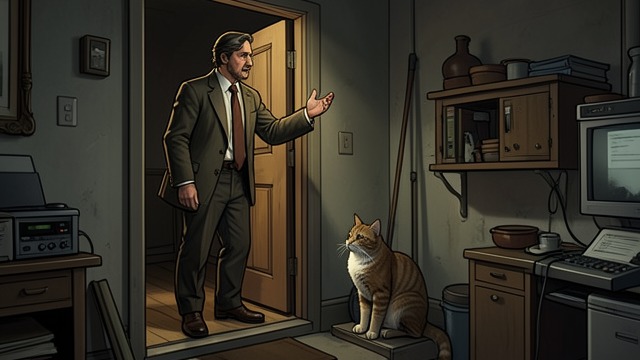
A Direct Question
Beyond Description
After describing many cats, the speaker asks how a person should address one.
The question shifts the book from observation to conduct.
Knowledge must now shape a human relationship.
A Practical Test
The right greeting depends on recognizing the cat’s nature.
The speaker rejects treating every animal as socially interchangeable.
The poem turns literary understanding into an everyday ethical choice.
Rejecting Easy Familiarity

Rejecting Easy Familiarity
A Boundary Recognized
The speaker warns that cats resent familiarity.
An affectionate impulse does not automatically justify touching or assuming intimacy.
Respect begins by acknowledging a boundary.
Active Courtesy
The speaker still advises addressing a cat rather than remaining silent.
Courtesy offers a middle path between intrusion and indifference.
A respectful approach can begin without claiming a relationship.
A Formal Greeting

A Formal Greeting
Deliberate Deference
The speaker bows, removes his hat, and addresses the animal as O CAT.
The ceremonial greeting makes respect visible through action.
Its humor does not cancel its underlying courtesy.
The Cat as Addressee
The animal is treated as a social presence worthy of direct recognition.
The speaker does not assume control over the exchange.
Address becomes an offer rather than a command.
Trust Earned Slowly

Trust Earned Slowly
Small Tokens
The speaker suggests offering food suited to the cat’s personal taste.
Such gifts may serve as tokens of esteem, not guaranteed purchases of affection.
The relationship develops through attention to preference.
Names and Recognition
In time, a trusted friend may be addressed by name.
The progression from greeting to familiarity depends on patience.
The collection ends by defining respect as earned closeness.
As the collection’s portraits accumulate
At the transition into the closing poem
When the speaker sets out the cat’s rule
At the speaker’s model greeting
In the closing lines of The Ad-dressing of Cats
