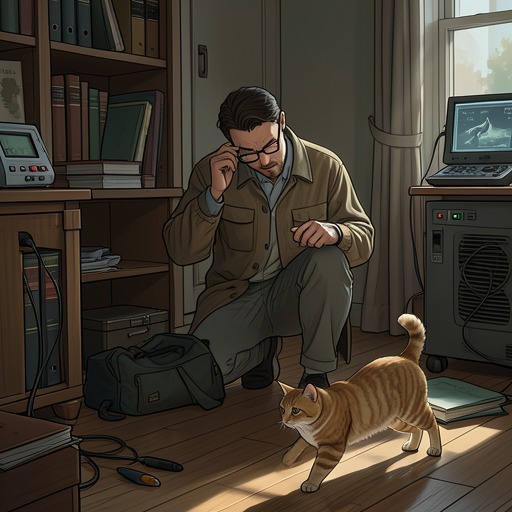
Cat-addressing etiquette
Old Possum's Book of Practical CatsCat-addressing etiquette is the poem’s practical code for approaching Cats: people should initiate conversation, but must earn familiarity through restraint, formal respect, and patience. In The Ad-dressing of Cats, this sequence turns a simple question of how to greet a Cat into a small lesson in the difference between recognizing an animal and being accepted by one.
Definition and Governing Distinction
The poem introduces its subject after recalling that readers have encountered several kinds of Cat, along with their habits and habitats. That accumulated knowledge does not, by itself, answer the more personal question of how a person should approach one. The speaker resets the discussion with a firm contrast between Cats and Dogs: the two are not to be treated as interchangeable kinds of company. The distinction is a rule of conduct, not just classification. A person who assumes that a greeting suitable for Dogs will work equally well for Cats has missed the poem’s premise that Cats require their own forms of address.
The title’s divided spelling, ad-dressing, keeps attention on the act of addressing as an art of approach. The lesson is neither to leave Cats entirely alone nor to treat them as instantly familiar companions. Instead, proper address must recognize a Cat’s independence while still making an overture. This balance gives the poem’s advice its central tension: the human speaker is expected to take the first step, yet cannot dictate what relationship that step will produce.
Initiative Without Presumption
The speaker rejects the rule that a person should wait until spoken to before speaking to a Cat. The recommendation is direct: address the Cat rather than holding back. But the permission to begin a conversation is immediately limited by a warning that Cats resent familiarity. Initiative is therefore not license to behave as though friendship already exists. The Cat may be hailed, but the greeting does not cancel the distance between stranger and trusted companion.
The contrast makes the etiquette a sequence rather than a single formula. First comes the human overture; then comes the need to show that the approach is respectful. The speaker’s tone insists on both halves. A policy of silence would fail to address a Cat at all, while overfamiliarity would disregard the Cat’s response and standing. The recommended conduct occupies the middle ground: speak, but do not mistake speaking for having earned intimacy.
Signs of Respect and the Slow Growth of Trust
The speaker illustrates the required reserve with a gesture: bowing and taking off a hat. These actions make the advice formal and visible. Respect is not left as a private attitude; it is expressed through conduct that acknowledges the Cat before any claim to friendship is made. The poem then marks a further threshold: before a Cat will condescend to treat a person as a trusted friend, some token of esteem is required. The wording keeps the Cat in control of that recognition. The person may offer respect, but the Cat’s acceptance cannot be presumed or hurried.
A later image gives respect a domestic, concrete shape. After finishing, a Cat licks its paws so as not to waste the onion sauce. The poem calls such acts evidences of respect. The detail makes the advice playful, but it also anchors the abstract rule in observable behavior: the relationship is described through what the Cat does, not through a human declaration that familiarity has been achieved. The scene does not turn etiquette into a guaranteed exchange. Rather, it presents attention to the Cat’s habits and the Cat’s own conduct as part of the terms by which regard is recognized.
Names as the Final Privilege
The progress of the etiquette culminates in naming, but only after time has passed. The speaker thinks the Cat may have been called James, then concedes that matters have not yet reached the point of names. That distinction separates knowing or guessing a label from having earned the right to use it. A name is not the opening greeting; it is the final sign that the relationship has advanced beyond formal respect and toward trust.
The closing sequence makes the order explicit: the person reaches the aim in time and finally calls the Cat by its name. The repeated emphasis on addressing returns the poem to its initial question, now answered as a process rather than a stock greeting. Begin with courtesy, avoid presumption, offer esteem, and allow familiarity to develop at the Cat’s pace. Cat-addressing etiquette thus treats a name not as a possession casually applied by a human, but as the endpoint of an approach in which the Cat’s independence remains intact.