Macavity's not there!
Old Possum's Book of Practical Cats“Macavity's not there!” is the refrain that turns Macavity’s absence into his defining signature. Repeated at the scene of a crime and expanded into an emphatic alibi, it presents evasion not as an incidental escape but as the fact by which this elusive criminal is known.
The Refrain of Absence
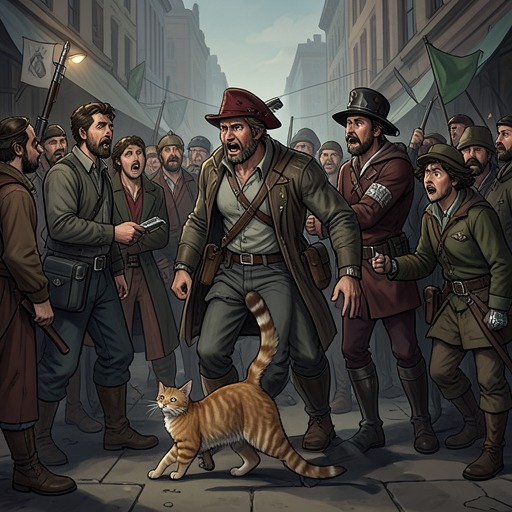
The phrase first arrives as the explanation for why the law cannot catch Macavity: when Scotland Yard and the Flying Squad reach the scene, he is gone. The refrain distills that recurring reversal into a compact declaration. The investigators may arrive at the place where the crime has become visible, but Macavity is not there to be found.
The claim returns as a direct address to the listener: even after searching the basement or looking in the air, the speaker insists that Macavity is absent. Its repetition makes the failed search feel both conclusive and inevitable. Each return confirms the same result rather than bringing the pursuers closer to him.
Alibi and Characterization
The related line, “At whatever time the deed took place—MACAVITY WASN'T THERE!”, broadens the refrain from a report about one crime scene into an all-purpose alibi. Its capitalization gives the denial the force of a public verdict, while the reference to whatever time the deed occurred makes the claim sweeping: Macavity is represented as absent whenever his crimes are committed.
That denial sits beside the description of Macavity as deceitful and suave, a cat with an alibi and others to spare. The expression therefore carries an ironic double meaning. It states that Macavity cannot be found, yet its repeated insistence makes his absence the most conspicuous thing about him. The refrain does not solve the mystery of how he escapes; it makes escape itself his recognizable mark.
A Formula in a Book of Repeated Speech
Across the book, short repeated utterances perform different work. The Jellicle Cats are summoned in the refrain introducing The Song of the Jellicles; “Presto!” marks the start of Mr. Mistoffelees’s conjuring; and the speaker’s belief that the figure before him is Old Deuteronomy leads directly into the statement that Old Deuteronomy sits in the street. These formulas invite, announce, or identify. Macavity’s refrain instead denies the pursuers the presence they seek.
The contrast also places the expression alongside the collection’s interest in what can and cannot be known about cats. The speaker says that a cat’s meditative thought is known to the cat himself but will never be confessed; later, the question of how to address a cat leads toward calling him by his name. Against that movement from mystery toward naming, Macavity’s recurring absence supplies an answer that remains deliberately incomplete: the criminal is named, but the refrain keeps him out of reach.