Pekes
Old Possum's Book of Practical CatsThe Pekes are one of the two rival groups at the center of The Awefull Battle of the Pekes and the Pollicles. The poem casts them as proud, persistent antagonists of the Pollicles, then shows how a single encounter can draw a larger group into the noise of their feud. Their collective barking and their response to the Great Rumpuscat give the episode its comic movement from a quiet street to a confrontation abruptly checked by a more frightening presence.
Identity and Feud
The poem presents the Pekes not as isolated dogs but as a group defined by its rivalry with the Pollicles. Its opening account calls the two sides proud, implacable, and passionate foes, and insists that this antagonism recurs wherever one goes. The conflict is therefore established as a habitual condition rather than a grievance whose origin is explained in this episode.
The barking gives that feud an audible, almost public presence: the repeated refrain carries across the Park. The sound is more than an individual dog’s response; it makes the conflict seem capable of spreading beyond the pair who first meet. The title also places the Pekes within a wider comic account involving the Pugs, the Poms, and the intervention of the Great Rumpuscat, though the supplied lines do not describe the Pugs’ or Poms’ actions.
The Street Encounter
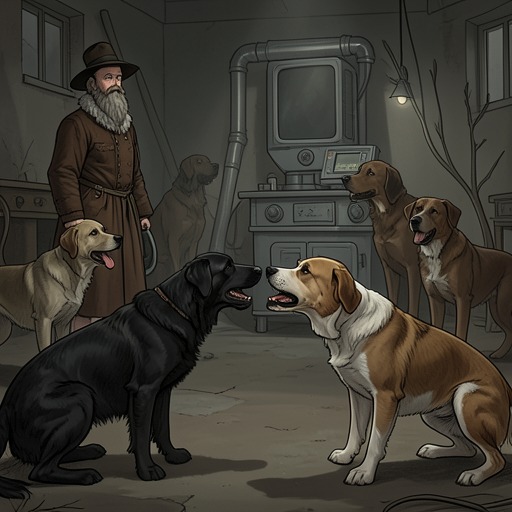
The particular incident begins after almost nothing has happened for nearly a week, a stretch the poem treats as unusually long for either side. With no one about on the street, one of the Pekes happens to meet a Pollicle. Neither dog advances nor quite retreats. Instead, they glare at one another and scrape their hind feet, holding a tense position between attack and withdrawal.
That hesitation does not settle the encounter. Barking breaks out, and the refrain makes the noise seem to travel throughout the Park. The poem turns a small, still meeting into a public disturbance without giving either dog a decisive first blow: the standoff itself, and the sound that follows it, are enough to bring the feud into view.
The Pekes Gather
The poem describes the Peke as not British and applies the period’s racialized phrase “Heathen Chinese” to it. This is the narrator’s characterization, not an explanation of the group’s conduct or a motive for the conflict. The lines use the label to mark the Peke as culturally foreign before shifting attention from the individual encounter to the group response.
When the uproar is heard, Pekes come to the window and the door. Their numbers are given with comic uncertainty: surely a dozen, more likely a score. That widening assembly makes the consequences of the barking concrete. What began between two dogs now has a crowd of potential participants, although the account does not say that every dog joins the fight.
The Great Rumpuscat’s Intervention
The growing confrontation is checked when the Pekes and Pollicles look through the bars of the area and see the Great Rumpuscat. The poem emphasizes the glare of his eyes and his yawning; those details make his appearance frightening enough that both rival groups quickly take warning. He then looks up at the sky and gives a great leap. The passage presents this intervention as a sudden interruption of the dogs’ quarrel, not as a victory for either side.
The Pekes’ part in the episode is thus collective but bounded: they are introduced as one of two enduring foes, join the disturbance through the response of their assembled group, and share the alarm that ends the immediate confrontation. The gap between the noisy standoff and the warning provoked by the Great Rumpuscat supplies the scene’s central reversal.