Barnet
Oliver TwistBarnet is the small town on the outskirts of London where Oliver Twist, exhausted and destitute after a week-long walk from his birthplace, first encounters the Artful Dodger, an event that draws him into Fagin's criminal underworld and sets the course of his London adventures.
Arrival and Encounter with the Artful Dodger
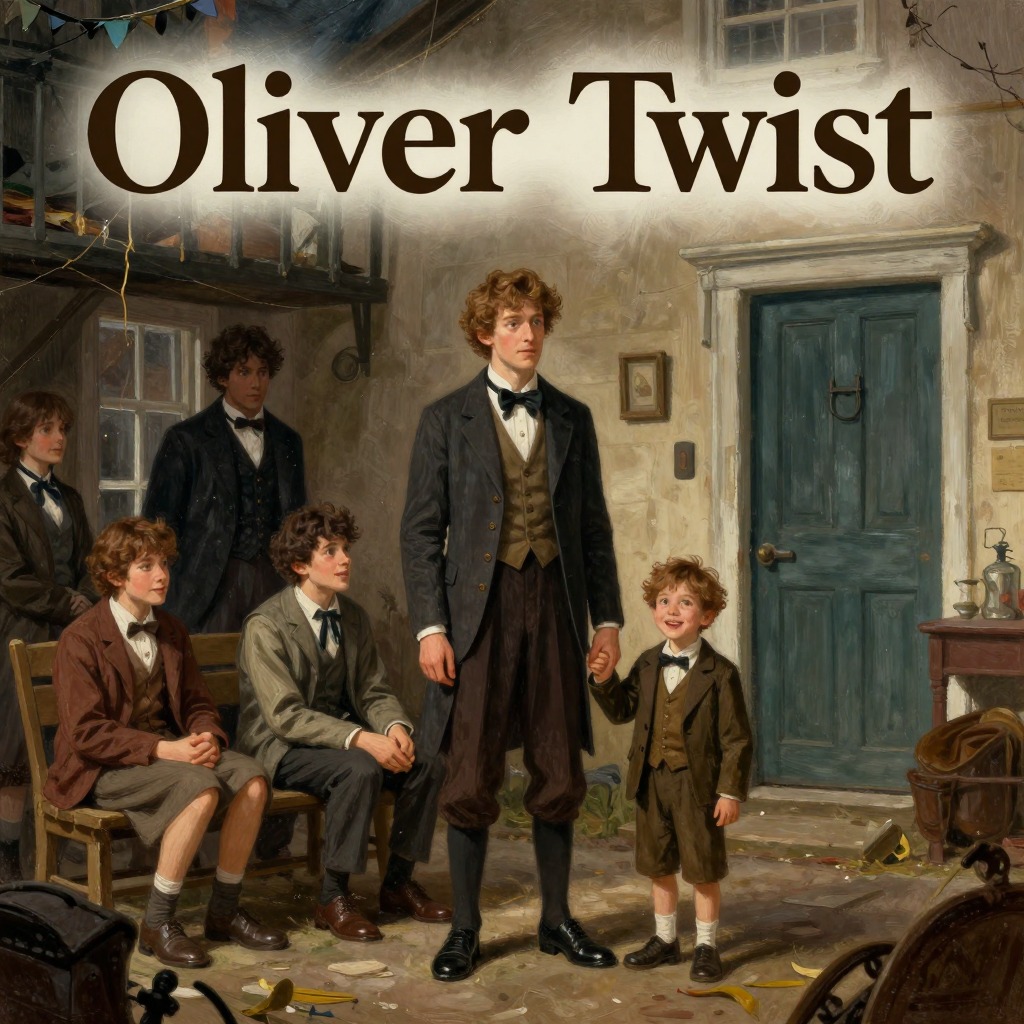
Early on the seventh morning after he had left his native place, Oliver limped slowly into the little town of Barnet. The window-shutters were closed; the street was empty; not a soul had awakened to the business of the day. The sun was rising in all its splendid beauty; but the light only served to show the boy his own lonesomeness and desolation, as he sat, with bleeding feet and covered with dust, upon a door-step. By degrees, the shutters were opened; the window-blinds were drawn up; and people began passing to and fro. Some few stopped to gaze at Oliver for a moment or two, or turned round to stare at him as they hurried by; but none relieved him, or troubled themselves to inquire how he came there. He had no heart to beg. And there he sat. He had been crouching on the step for some time: wondering at the great number of public-houses (every other house in Barnet was a tavern, large or small), gazing listlessly at the coaches as they passed through, and thinking how strange it seemed that they could do, with ease, in a few hours, what it had taken him a whole week of courage and determination beyond his years to accomplish: when he was roused by observing that a boy, who had passed him carelessly some minutes before, had returned, and was now surveying him most earnestly from the opposite side of the way. The boy crossed over; and walking close up to Oliver, said, "Hullo, my covey! What's the row?" This was the Artful Dodger, Jack Dawkins, who, after learning Oliver's story, took him to a nearby chandler's shop to buy food and then to a small public-house, where Oliver made a long and hearty meal. The Dodger then offered to take Oliver to London, to a "'spectable old gentleman" who would give him lodgings for nothing.
Significance as a Threshold
Barnet functions as the threshold between Oliver's rural past and his urban future. It is the place where his solitary, desperate journey from the countryside ends and his induction into the criminal life of London begins. The town's character—a place of many public-houses and transient coaches—mirrors the transitional nature of Oliver's own state: no longer the abused parish boy of his hometown, not yet the street-wise child of the metropolis. The encounter with the Dodger in Barnet is the first step in a chain of events that leads Oliver to Fagin's den, to the pickpocket incident with Mr. Brownlow, and ultimately to the revelation of his true identity. The town is also mentioned in the advertisement Mr. Brownlow places after Oliver's disappearance, which offers a reward for information about the boy, and in the newspaper report of Nancy's murder that Sikes overhears, linking Barnet to the wider network of communication and pursuit that surrounds the central characters.
Connection to the Murder and Pursuit
Barnet reappears in the narrative as a point of reference in the public discourse surrounding the crimes of the novel. The advertisement for Oliver, which Mr. Bumble reads in a newspaper, is headed "FIVE GUINEAS REWARD" and describes the boy who "absconded, or was enticed, on Thursday evening last, from his home, at Pentonville." Later, when Sikes is fleeing after murdering Nancy, he overhears a guard on a mail-coach at Hatfield mention "a murder, too, down Spitalfields way," and a gentleman inside the coach confirms it, saying "a dreadful murder it was." The guard then asks, "Man or woman, pray, sir?" and the gentleman replies, "A woman." This conversation, which takes place near Barnet, demonstrates how the town is situated within the information network of the time, where news of crimes spreads via coaches and newspapers. The scaffold itself, the ultimate destination for Fagin, is described as being set up in a place where a great multitude assembled, with windows filled with people, and the crowd pushing, quarrelling, and joking, a scene that echoes the bustling, indifferent public life Oliver first observed in Barnet.