Mr. Sowerberry
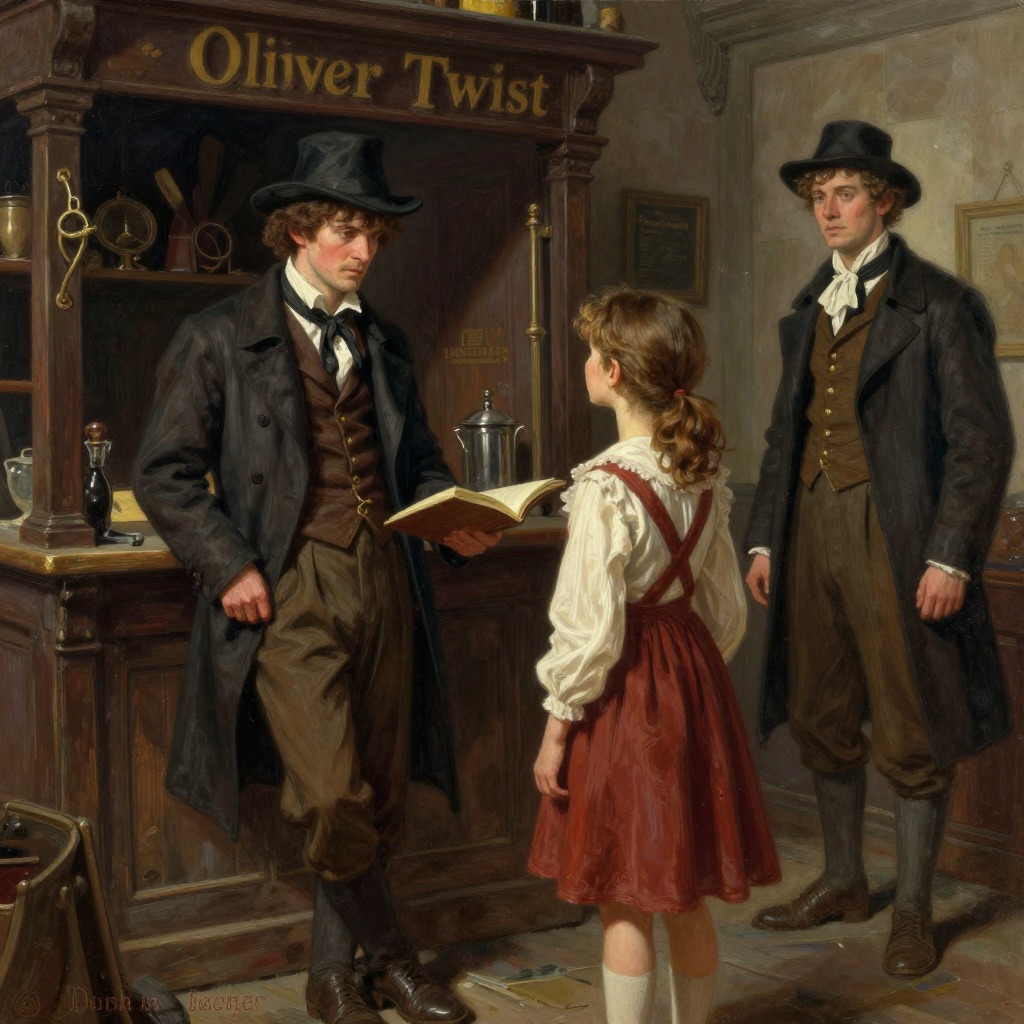
Oliver TwistMr. Sowerberry, the parochial undertaker, is a tall, gaunt, large-jointed man attired in a suit of threadbare black, with darned cotton stockings of the same colour and shoes to match. His features were not naturally intended to wear a smiling aspect, but he was in general rather given to professional jocosity. His step was elastic, and his face betokened inward pleasantry as he advanced to shake Mr. Bumble cordially by the hand. He carries an ingenious little model of a patent coffin as his snuff-box, a detail that encapsulates the grim humor of his trade.
Business and the Parish System
Mr. Sowerberry's prosperity is directly tied to the workhouse's new system of feeding, which starves paupers and thus produces more corpses. He remarks to Mr. Bumble that "since the new system of feeding has come in, the coffins are something narrower and more shallow than they used to be," and he laments that "all the stout people go off the quickest"—those who have paid rates for years are the first to sink when they enter the house. He calculates that "three or four inches over one's calculation makes a great hole in one's profits." When Mr. Bumble offers Oliver as a parish apprentice, Sowerberry quickly agrees, noting that he pays a good deal toward the poor's rates and has "a right to get as much out of 'em as I can." The board arranges for Oliver to go to him "upon liking," meaning that if the master finds he can get enough work out of the boy without putting too much food into him, he shall have him for a term of years.
Marriage and Domestic Life
Mr. Sowerberry is thoroughly dominated by his wife, a short, thin, squeezed-up woman with a vixenish countenance. When he wishes to propose that Oliver be trained as a mute for children's funerals, he must first endure a matrimonial scene in which Mrs. Sowerberry accuses him of keeping secrets, reduces him to begging for permission to speak, and then demands to know why such an obvious suggestion had not occurred to him before. He rightly construes this as acquiescence. His wife is his "decided enemy" because she resents his disposition to befriend Oliver, and she treats the boy harshly, pushing him downstairs to a damp, dark kitchen and ordering him to eat the cold bits put by for the dog.
Oliver's Apprenticeship and the Funeral Trade
Oliver is formally apprenticed to Sowerberry after a month's trial, during a sickly season when coffins are "looking up." Sowerberry's speculation in using Oliver as a mute exceeds his most sanguine hopes; the oldest inhabitants recollect no period at which measles had been so fatal to infant existence, and many are the mournful processions which little Oliver heads, in a hat-band reaching down to his knees, to the admiration of all the mothers in the town. Sowerberry takes Oliver on adult expeditions so that he may acquire the equanimity and nerve essential to a finished undertaker. He shows Oliver the reality of parish burial when they attend the funeral of a woman starved to death: the husband raves that she was starved, the old mother chuckles hideously, and the clergyman compresses the burial service into four minutes while ragged boys play hide-and-seek among the tombstones. When Oliver says he does not like it much, Sowerberry replies, "Ah, you'll get used to it in time, Oliver. Nothing when you are used to it, my boy."
Conflict and Oliver's Flight
When Oliver fights Noah Claypole after Noah insults his dead mother, Mrs. Sowerberry and Charlotte drag Oliver to the cellar. Upon Sowerberry's return, Oliver's offense is explained with exaggerations, and he unlocks the cellar door and drags his rebellious apprentice out by the collar. Oliver scowls boldly on Noah, and when Mrs. Sowerberry says his mother deserved what Noah said, Oliver cries "It's a lie!" Mrs. Sowerberry bursts into a flood of tears, leaving Sowerberry no alternative but to give Oliver a drubbing. Oliver is shut up in the back kitchen, and that night, after the household has taunted him, he runs away. Sowerberry later advertises a five-guinea reward for Oliver's return, but the boy is never recovered by him.
Later Appearance and Fate
Years later, when Oliver returns to his native town in a carriage with Mr. Brownlow and the Maylies, he sees Sowerberry's shop "just as it used to be, only smaller and less imposing in appearance than he remembered it." The undertaker's establishment remains a fixed landmark of Oliver's childhood, a place where he first encountered death as a business and learned the callousness that poverty breeds. Sowerberry himself fades from the narrative, his function as a minor agent of the parish system complete.