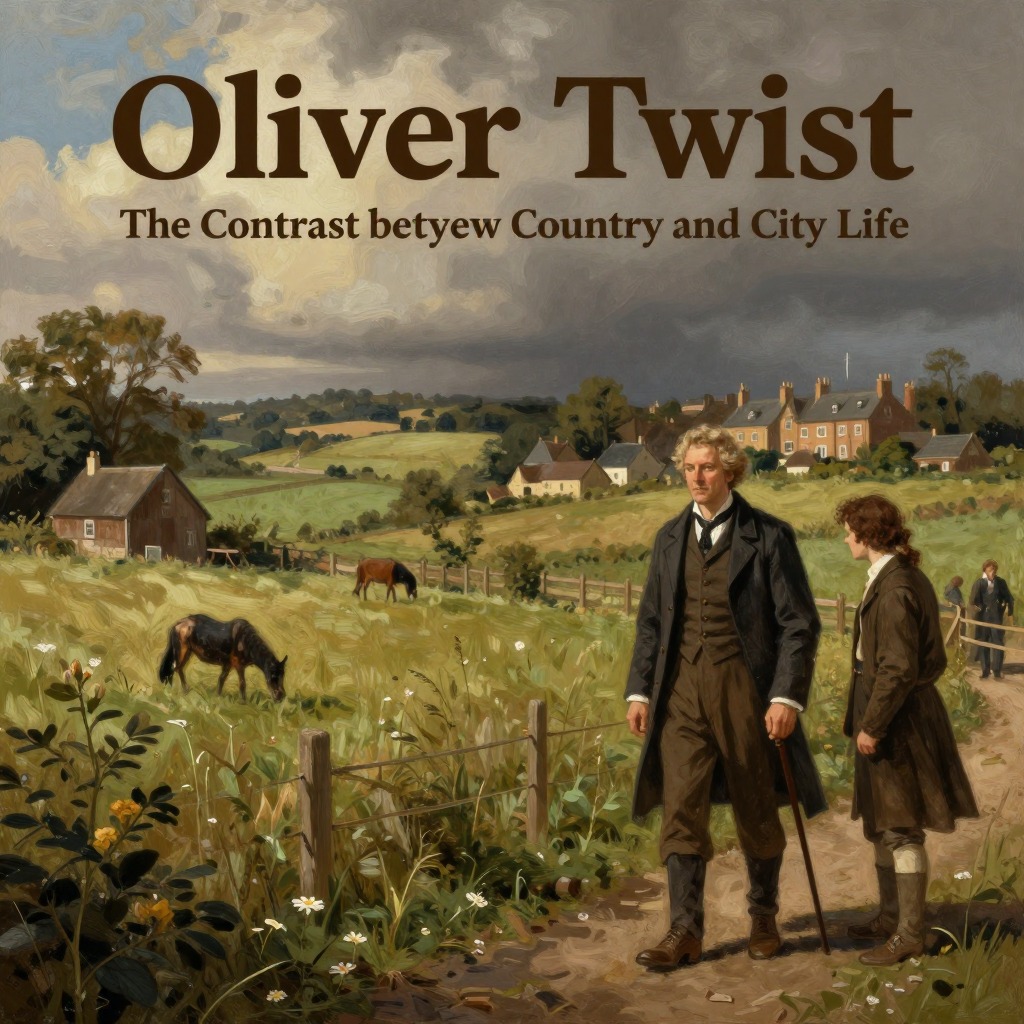
The cottage
Oliver TwistThe cottage is the rural home of Mrs. Maylie and Rose Maylie, where Oliver Twist is taken to recover after being shot during the burglary at Chertsey. It becomes the setting for Oliver's first experience of sustained peace, kindness, and domestic happiness, and the site of Rose's life-threatening fever, Harry Maylie's return, and the final confrontation with Fagin and Monks. The cottage functions as the novel's primary symbol of the safe, loving home that the orphan has never known, and its violation by the reappearance of the criminals marks the last intrusion of the criminal world into Oliver's new life.
Location and Setting
The cottage is situated in a remote inland village, some distance from Chertsey, where Mrs. Maylie and Rose retire after the attempted burglary. It is described as a lovely spot: the rose and honeysuckle cling to the cottage walls, the ivy creeps round the trunks of the trees, and the garden-flowers perfume the air with delicious odours. Hard by is a little churchyard, not crowded with tall unsightly gravestones, but full of humble mounds covered with fresh turf and moss, beneath which the old people of the village lie at rest. The cottage has a lattice-window on the ground-floor at the back, around which clusters of jessamine and honeysuckle creep over the casement, filling the place with their perfume. This window looks into a garden, whence a wicket-gate opens into a small paddock; beyond lies fine meadow-land and wood. There is no other dwelling near in that direction, and the prospect it commands is very extensive. The cottage thus stands in deliberate contrast to every previous dwelling Oliver has known: the workhouse, the undertaker's shop, and Fagin's filthy den.
Oliver's Recovery and Happy Life
Oliver, whose days had been spent among squalid crowds and in the midst of noise and brawling, seems to enter on a new existence at the cottage. The quiet place, the pure air, and all the pleasures and beauties of spring restore him in a few days. Every morning he goes to a white-headed old gentleman who lives near the little church, who teaches him to read better and to write, and who speaks so kindly that Oliver can never try enough to please him. Then he walks with Mrs. Maylie and Rose, and hears them talk of books, or sits near them in some shady place and listens while the young lady reads. He has his own lesson for the next day to prepare, and at this he works hard in a little room which looks into the garden, till evening comes slowly on, when the ladies walk out again, and he with them. When it becomes quite dark and they return home, Rose sits down to the piano and plays some pleasant air, or sings in a low and gentle voice some old song which it pleases her aunt to hear. No candles are lighted at such times; Oliver sits by one of the windows, listening to the sweet music in a perfect rapture. In the morning, Oliver is a-foot by six o'clock, roaming the fields and plundering the hedges for nosegays of wild flowers, with which he returns laden home. There is fresh groundsel for Rose's birds, which Oliver decorates the cages with in the most approved taste. There is rare cricket-playing sometimes on the green, and always something to do in the garden or about the plants. So three months glide away—three months which, in Oliver's life, are true felicity.
Rose's Illness and Harry Maylie's Arrival
The cottage's peace is shattered when Rose falls into the first stage of a high and dangerous fever. Mrs. Maylie sends Oliver to the market-town to dispatch a letter to Mr. Losberne, and it is on this errand that Oliver accidentally stumbles against Monks at the inn door. The cottage becomes a place of anxious waiting: people speak in whispers, anxious faces appear at the gate from time to time, women and children go away in tears. Oliver paces softly up and down the garden, raising his eyes every instant to the sick chamber, and shuddering to see the darkened window looking as if death lay stretched inside. Late that night, Mr. Losberne arrives and pronounces that there is very little hope. The crisis passes, and Rose recovers, but the cottage is then the scene of Harry Maylie's arrival and his urgent conversation with his mother about his love for Rose. The young gentleman, who bears so strong a likeness to the old lady that Oliver would have had no great difficulty in imagining their relationship, walks slowly from the chaise, and the meeting between mother and son does not take place without great emotion on both sides.
The Reappearance of Fagin and Monks
The cottage's security is violated when Oliver, sitting at his books in the little back room one evening, falls asleep and dreams. He awakens to find Fagin and Monks peering in at the window—so close that he could have almost touched them before he started back. The two men are gone in an instant, but Oliver's cries bring Harry Maylie, Mr. Giles, and Mr. Losberne in pursuit. The search proves fruitless: there are no traces of recent footsteps, and the men have vanished as if into thin air. This event confirms that the criminal world has not finished with Oliver, and it precipitates the final chain of revelations. The cottage thus serves as the last boundary between Oliver's new life and the old one, a boundary that is crossed but not broken.
Thematic Significance
The cottage represents the domestic ideal that the novel holds out as the reward for virtue and the antidote to the urban squalor of Fagin's den and the workhouse. It is a place of reading, music, gardening, and religious observance—the very activities that the Poor Law system and the criminal underworld deny to the poor. Oliver's happiness there is described in terms that echo the language of heaven: "it seemed like Heaven itself." Yet the cottage is not a fortress; it is vulnerable to intrusion, and its peace is interrupted by Rose's illness and the reappearance of the villains. The novel suggests that true happiness must be won through struggle and that even the most idyllic home cannot be sealed off from the world's evils. In the end, the cottage is superseded by the parsonage-house where Harry Maylie and Rose settle, and where Mr. Brownlow, Oliver, and Mrs. Bedwin take up residence within a mile, forming a little society whose condition approaches as nearly to one of perfect happiness as can ever be known in this changing world.