The kinchin lay
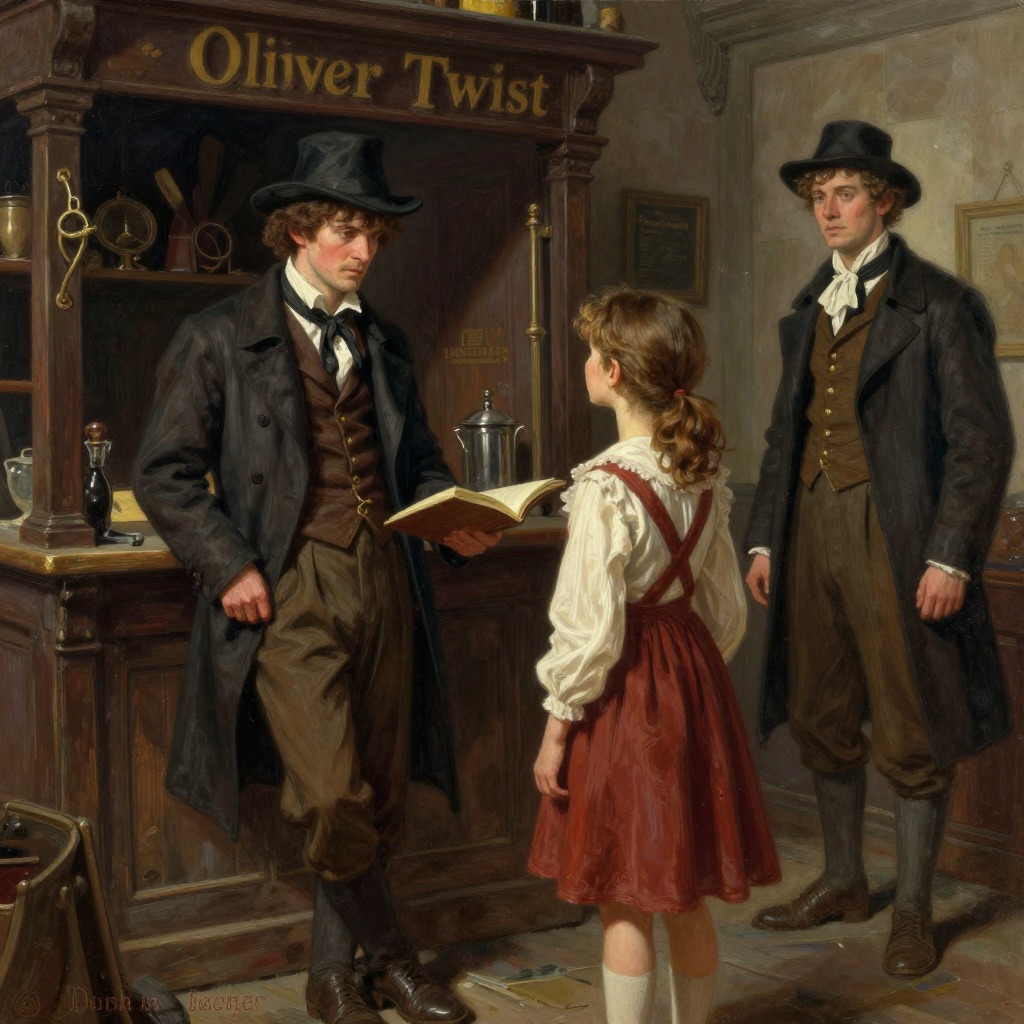
Oliver TwistThe kinchin lay is a specialized form of street robbery that appears in Charles Dickens's Oliver Twist as one of the many criminal trades plied by Fagin's gang. The term itself is a piece of thieves' cant: "kinchin" is slang for a young child, and "lay" denotes a particular line of criminal work. Fagin introduces the practice to Noah Claypole (who has adopted the alias Morris Bolter) as a low-risk, high-return specialty suited to a beginner. The method is brutally simple: the thief targets children who have been sent on errands by their mothers and who are carrying small coins—sixpences and shillings—openly in their hands. The operative technique is to snatch the money, knock the child into the kennel (the open gutter that ran along London streets), and then walk away slowly, as if nothing out of the ordinary had occurred. Fagin presents the kinchin lay as a particularly attractive option because it requires minimal strength, carries little danger of serious resistance, and can be practiced in neighborhoods such as Camden Town and Battle Bridge, where children are constantly running errands. The very casualness of the description—the way Fagin laughs while explaining how to upset "as many kinchins as you want, any hour in the day"—underscores the systematic predation that defines the gang's worldview. Children are not merely victims but raw material, their vulnerability and poverty making them the easiest possible prey. The kinchin lay thus functions as a concentrated emblem of the novel's broader critique: a society that starves and abandons its poor produces predators who prey on the even more helpless, and the line between institutional neglect and active criminal exploitation is terrifyingly thin. Noah, whose own history as a charity-boy who bullied Oliver Twist has prepared him perfectly for this work, embraces the scheme with enthusiasm, and his rapid success—six shillings and ninepence halfpenny on his first day, plus three pint-pots and a milk-can taken as opportunistic extras—confirms Fagin's cynical assessment of human nature. The kinchin lay is never shown in operation; it exists entirely within the dialogue between Fagin and Noah, which makes it all the more chilling. It is a crime that requires no elaborate planning, no specialized tools, and no accomplices beyond the willingness to treat a child's fall into the gutter as a routine business transaction. In this, it mirrors the logic of the workhouse system itself, where the board's regulations produce slow starvation and the beadle's authority is maintained through casual violence. The kinchin lay is the underworld's equivalent of the Poor Law: a system designed to extract the maximum value from the most vulnerable with the minimum of fuss.