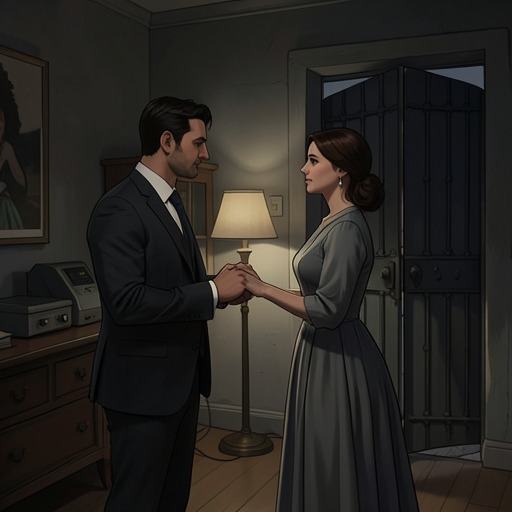
Edward and Florence’s wedding
On Chesil BeachEdward and Florence’s wedding joins a public celebration to a private crisis: the ceremony at St Mary’s Church, Oxford, goes smoothly, but the couple arrive at their wedding night without the experience or vocabulary to negotiate what marriage is expected to entail. Their story makes the wedding more than a formal beginning. It is the point at which inherited conventions, mutual reserve, and unspoken assumptions become consequential for the life they are about to share.
Background and Expectations
Both are young, educated, and virgins, and they marry in a social climate in which conversation about sexual difficulties is regarded as impossible. Their courtship has followed protocols that neither needed to state aloud. Edward has treated Florence’s reserve as a conventional sign of modesty and, in part, as evidence of a deeper sensual nature; he has not recognised how much her reticence also suits his own inexperience and lack of confidence. The wedding therefore brings two people together without giving them a common, candid account of intimacy.
Their expectations have also been shaped by a broader rule of premarital chastity. During his university years, Edward understood that the women he encountered were expected to preserve themselves for a future husband: sex implied marriage, and marriage brought duties that the couple had not learned to discuss. The Pill remained, in his view of that period, a distant newspaper rumour, while male conversation often substituted jokes, boasting, and drinking for reliable sexual knowledge. The wedding takes place within those constraints, not outside them.
Ceremony and Departure
The service at St Mary’s Church, Oxford, is decorous, and the reception is cheerful. Edward and Florence’s friends from school and college give them a loud, uplifting send-off. The anticipated tension between their families does not define the day: Geoffrey Ponting and Violet Ponting do not condescend to Edward’s family, and Marjorie Mayhew does not significantly disrupt the occasion or lose sight of its purpose.
The newlyweds leave in a small car belonging to Violet Ponting and reach a hotel on the Dorset coast in the early evening. The weather is mild enough for their plans but, according to Florence, not warm enough to eat outside; Edward thinks it is, yet does not contradict her. They settle in a small first-floor sitting room in the hotel’s honeymoon suite. Through partly open French windows they can see a balcony, the English Channel, and Chesil Beach. They intend to walk on the shingle between the sea and The Fleet after supper, but first remain for the formal meal prepared for them.
The Wedding Night
The setting is both ceremonial and awkwardly ordinary. Two young waiters bring the meal from a trolley in the corridor, moving carefully through the suite; their nervous manner mirrors the couple’s heightened awareness of being observed. The menu includes melon with a glazed cherry, roast beef, vegetables and potatoes, followed by sherry trifle, cheddar cheese, and mint chocolates. Edward watches the waiters closely, protective of the occasion and alert to any possible mockery, while both newlyweds wait for the staff to leave so that they can be alone.
Once the door closes, the beach offers an imagined alternative to the rules of the room. They are adults, on holiday, and technically free to abandon dinner and go outside; yet Edward and Florence remain governed by the expectation that they should behave properly and respect the meal prepared for them. The contrast captures the limits of their new freedom: marriage has made them adults, but it has not made them comfortable acting beyond convention.
As the evening turns toward private intimacy, Florence understands marriage as an agreement to accept sexual duties, an understanding she connects to the act of signing the register after the ceremony. She experiences that implication as a responsibility created by her own choices, rather than as something the couple have discussed together. Edward, meanwhile, has spent more than a week abstaining in preparation for the wedding, hoping to be at his best for his bride; he has nevertheless relied on assumptions about her reserve instead of asking what she wants or fears. Their contrasting interpretations turn silence into a practical barrier, and the marriage remains unconsummated.
Consequences and Retrospective Meaning
The wedding’s failure is not contained within the hotel room. The families quietly set a divorce in motion on grounds of non-consummation, and the wedding presents are returned. Edward sends Geoffrey Ponting a formal letter regretting a change of heart and offering an apology, resignation, and farewell, without mentioning Florence. The legal and familial response converts the couple’s private difficulty into an ending before either has found a way to speak openly about it.
Edward later looks back on Florence’s proposal during the wedding-night crisis differently than he did at the time. In the late 1960s, amid new freedoms and his own increasing sexual experience, he no longer regards it as ridiculous or insulting; he sees it as generous and self-sacrificing, an offer whose meaning he had failed to understand. He never tells anyone about that night. The wedding thus stands at the start of a marriage that does not become a shared life, and its lasting force lies in the distance between what the couple believed marriage required and what they were able to communicate to one another.