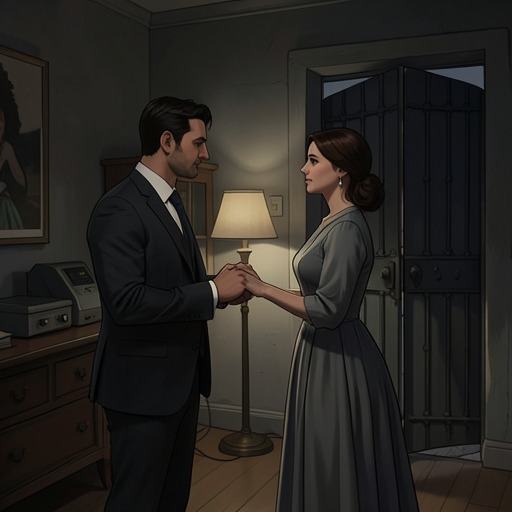
Florence Ponting
On Chesil BeachFlorence Ponting is a gifted violinist and decisive musical leader whose private terror of sexual intimacy remains difficult for her to name, even to herself. Her marriage to Edward Mayhew founders not for lack of love but because she cannot explain what she fears, and he cannot understand the unconventional solution she offers. The contrast between her authority in music and her uncertainty in intimate life shapes both the wedding-night rupture and the long, unshared aftermath.
Identity and Inner Conflict
Florence loves Edward Mayhew deeply and wants a life with him, but her feelings do not include the sexual desire she assumes a wife is expected to have. As the wedding approaches, thoughts of intimate contact provoke a strong physical aversion and dread. A supposedly helpful handbook for brides makes matters worse: its clinical descriptions and language of entry and penetration seem alien and threatening to her. She wonders whether something is profoundly wrong with her, while recognizing that her resistance is more than ordinary squeamishness.
Her fear does not extend to children in the same way. She likes babies, has enjoyed looking after her cousin’s young sons, and imagines that she would love being pregnant by Edward; childbirth, in the abstract, does not frighten her. This distinction sharpens the nature of her conflict: she can imagine family life and a future with him, but cannot reconcile that hope with the bodily intimacy she believes marriage requires.
Florence has no confidante to whom she can readily explain the problem. Her younger sister, Ruth Ponting, seems too young; her mother, Violet Ponting, tends to approach personal difficulties intellectually, through learned language and references. Florence’s school and music-college friends are comfortable with intimate talk, but their close-knit circle and readiness to share one another’s troubles make her reluctant to entrust them with a secret. Her inability to find a listener compounds her inability to find words.
Musical Authority and Private Uncertainty
In music, Florence is confident, precise, and accustomed to making decisions. She plays the violin with a rich tone and is the undisputed leader of the Ennismore Quartet, whose name comes from the address of the women’s hostel where its members lived. When the group disagrees about adding a viola player for a Mozart quintet, Florence insists that they try the piece. Her judgment prevails over the other three, and the music wins them over. The episode shows her capacity to hold to her own artistic conviction even when she faces collective opposition.
That assuredness contrasts with her everyday physical awkwardness and self-consciousness. She may stumble or knock things over, and she finds it difficult to walk towards someone in the street when she knows she is being watched. When anxious, she repeatedly lifts a hand to brush away an imaginary strand of hair. The gesture recurs during the crisis on the beach, making visible the strain behind her otherwise clear, carefully organized speech.
The music she champions also becomes a private means of understanding herself. The quintet’s opening, with its repeated questioning phrase and uncertain answers, recalls her decision to speak rather than submit to what she sees as a conventional marital expectation. For a moment she draws on the same resolve she uses in rehearsal: she means to tell Edward what she wants and seek a compromise that does not make one person’s happiness depend on the other’s unhappiness. His approach interrupts that intention, and the thought briefly disappears.
The Wedding-Night Proposal
Florence’s silence begins well before the wedding. She knows she should have spoken after Edward proposed, before the visit to the vicar, the family dinners, invitations, gift list, marquee, and photographer made the plans feel irreversible. Yet she cannot name the matter clearly, and she fears that speaking might cost her the relationship. She loves Edward’s kindness, intelligence, conversational unpredictability, and gentle attention. Her affection is warm and profound, though not the kind of passion she has read about; she wants to spend her life with him and loves the closeness they already share.
On the beach, she finally tries to explain that she loves him and wants their life together, while also believing that her aversion to sex is unlikely to change soon. She does not present this as a lack of love. Instead, she proposes that they live together and make their own rules: Edward could seek sexual relationships elsewhere if he wished, while she remained his loving partner, played music, and hoped one day to perform beautifully for him at Wigmore Hall. Her proposal is an attempt to preserve their shared life without pretending that she can meet his expectations in the way he anticipates.
Edward hears the offer as an insult and a suggestion that he go with other women. Their different interpretations turn a difficult but potentially negotiable disclosure into a rupture. Florence’s speech is increasingly rapid as she tries to carry him past what she expects will be objections; her nervousness makes her sound brisk even as she approaches despair. The exchange exposes the cost of their earlier silence: she has reached for candour only when both are distressed, and neither can make the other understand what is being offered or refused.
Separation and Musical Career
By the time Edward returns to the hotel, Florence has packed her overnight case and left. The hotel staff tell him she was called home because of a family illness and that the assistant manager drove her to Dorchester, where she hoped to catch a train towards Oxford. She leaves no note in the room. The next morning Edward drives Violet Ponting’s car to the Pontings’ house, then returns to his own family without seeing Florence. The two families quietly arrange for the wedding presents to be returned, and Lionel Mayhew and Violet Ponting set a divorce in motion on the grounds of non-consummation. Edward later writes to Geoffrey Ponting to apologize, resign from the job offered through the Ponting family, and say farewell, without mentioning Florence.
Florence’s musical life continues beyond the failed marriage. In July 1968, the Ennismore Quartet makes a triumphant debut at Wigmore Hall. A Times critic praises the players’ intensity and maturity, singles out their performance of Mozart’s D Major Quintet, and commends Florence’s expressive playing in the Adagio. The public account celebrates the first violinist’s artistry, but it cannot reveal the private meaning attached to that evening: when the applause ends and the players acknowledge it, Florence’s gaze travels to seat 9C in the third row. The detail links her professional achievement to a feeling the audience cannot see.
Retrospective Significance
Edward does not hear of the quartet’s success. Years later, he looks back on Florence’s proposal and understands it differently: what he once treated as humiliating or absurd appears to him as generous and ahead of its time. He also recognizes that she needed reassurance that he loved her and that there was no need to hurry when they had a lifetime together. This understanding comes too late to alter the separation, and the narrative does not establish what became of Florence beyond her continued musical prominence and that searching glance towards seat 9C.
In old age, Edward still imagines Florence on the paths near his home, remembers her as the young violinist he knew, and admits that he never loved anyone as much or found anyone who matched her seriousness. He wonders whether staying with her might have made him more ambitious, while imagining the children they might have had. His reflections cannot stand in for Florence’s later account of her life: the distance between them has left much of it unknown to him. The decisive loss is not simply that their marriage ends, but that Edward fails to call after her when she leaves the beach. Florence, distressed and certain she is losing him, would have turned back at the sound of his voice. He remains silent, and she recedes from sight. The novel’s final emphasis on a life changed by doing nothing makes that silence the hinge between their brief shared future and the separate lives that follow.