Premarital sexual chastity
On Chesil BeachPremarital sexual chastity is a social code in On Chesil Beach that links sex before marriage with an obligation to marry. It shapes how Edward Mayhew and Florence Ponting approach courtship and their wedding night, but the novel presents the code not as a simple personal virtue: it also narrows what the couple can discuss, imagine, and choose. Their difficulty arises within a culture of restraint, where sexual knowledge is limited and the expected transition from chastity to marital intimacy is rarely spoken about plainly.
The social code
As a university student in London, Edward Mayhew understands that the young women around him are keeping themselves for future husbands. In his experience, sex with one of them would mean marriage. The expectation appears socially consequential rather than merely private: two of his friends marry while still students, and one is remembered as having been compelled to marry after a pregnancy. The episode serves as a cautionary example in Edward’s circle, where marriage can seem the unavoidable result of crossing the boundary.
The surrounding sexual culture is contradictory. The Pill is little more than a rumour in the newspapers, while men’s talk of sex consists largely of dirty jokes, boastful stories, and drinking-fuelled camaraderie. Edward imagines that young people elsewhere may be enjoying unconstrained sex, partly under the influence of the blues he hears, but his excursions through university corridors reveal no clear evidence of the permissive world he hopes to find. The code is therefore sustained not only by expectation but by uncertainty: rumour offers glimpses of other possibilities, while everyday life gives him little reliable knowledge of them.
Courtship under restraint
The norm informs Edward Mayhew and Florence Ponting’s gradual courtship. Their advances proceed through permissions that are mostly tacit, and neither treats intimate conversation as something necessary to the relationship. A sudden move by Edward can set back their progress; when he oversteps during a cinema outing, Florence becomes more distant without openly withdrawing her love. Their pattern makes restraint appear to be a shared understanding, although the same silence conceals different feelings and assumptions.
When Florence briefly touches Edward during an afternoon at his parents’ home, he asks her to marry him. He reads the moment as a decisive advance in their physical relationship, but he does not understand the effort it has cost her or the distaste she is trying to overcome. His own abstinence for more than a week before the wedding reflects his anticipation of marital intimacy. Yet his restraint has not prepared him to understand Florence’s response; he has partly mistaken her reticence for conventional shyness and assumes that marriage will resolve the uncertainty between them.
The wedding-night expectation
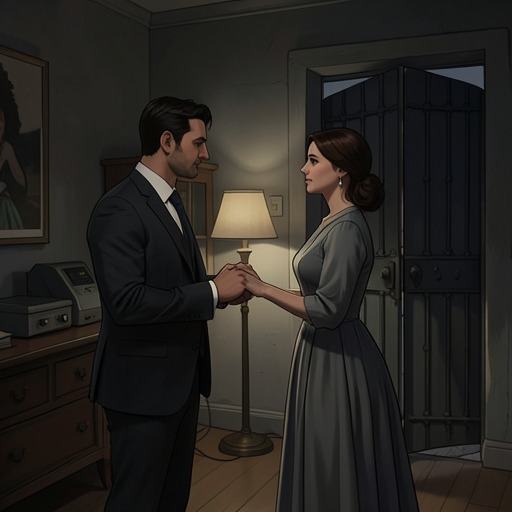
The couple arrive at their hotel on the Dorset coast as newlyweds expected to move from premarital restraint into marital intimacy. Their wedding has gone well, but they have no shared language for discussing what is about to happen. Edward’s anxieties concern his own performance and possible failure; Florence’s fear is more profound, and she cannot easily name it even to herself. The cultural script gives them a clear expectation of what marriage should bring, but no comparably clear means of negotiating whether or how they can meet it.
Florence’s sense of duty makes the expectation especially difficult to resist. Though she wants to get away from the room, she worries about disappointing Edward and believes that others would consider his desires reasonable and her refusal a sign that something is wrong with her. The code thus operates as an inward pressure as well as a public convention: even in private, the newlyweds feel bound by rules they have never openly discussed. Their eventual confrontation exposes the gap between the expected progression from chastity to marital sex and their actual, incompatible experiences.
An alternative and a changing era
At the beach, Florence tries to propose a different arrangement. She affirms her love for Edward and imagines that they might live together without following everyone else’s rules; she would accept him having other relationships, while she devoted herself to him and to music. Her proposal challenges the assumption that love, marriage, sexual exclusivity, and sexual desire must take a single conventional form. Edward instead hears it as an offer to send him to other women, and the conversation does not establish a life together on her terms.
A year or so later, Edward still avoids contacting Florence. By the late 1960s, however, new freedoms and changing sexual attitudes lead him to reconsider what she had offered. What had seemed insulting or absurd now appears to him generous and ahead of its time. This later reassessment places the couple’s wedding-night crisis within a period of social change: the chastity code that had made their expectations feel fixed was already giving way to alternatives, though that transformation comes too late to repair their relationship.