Wigmore Hall
On Chesil BeachWigmore Hall is the London concert venue at the center of Florence Ponting’s musical life: a place where she listened, worked backstage, formed a quartet, and imagined a future onstage. Its significance reaches beyond her career. During a visit with Edward Mayhew, the Hall became the setting for promises about a performance they might share; when the Ennismore Quartet eventually made its celebrated debut there, Edward was absent, and Florence’s gaze sought the seat he had once claimed for himself.
A musical home
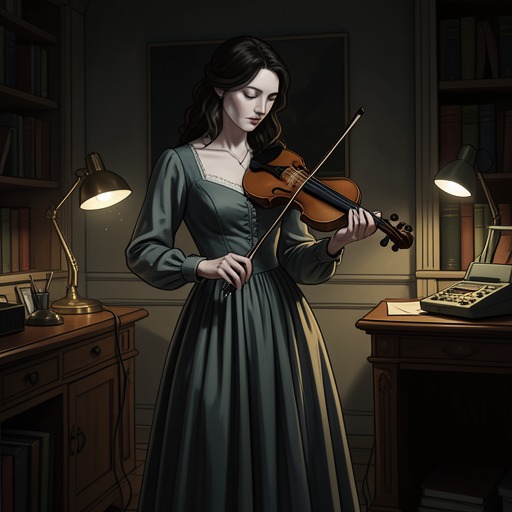
Near the Albert Hall, Wigmore Hall offered Florence an intense alternative to the restrictions of her student hostel, where lights-out came at eleven and male visitors were forbidden. She practised for five hours a day and attended concerts with her girlfriends, sometimes going to as many as five chamber recitals at the Hall in a single week, at lunchtime as well as in the evening. String quartets especially absorbed her. Her tastes were not unusual, but her attention to the music and to the place was unusually concentrated.
The building’s character was part of its hold. Florence valued the dark seriousness of the Hall, the faded and peeling walls backstage, the gleaming woodwork and deep red carpet of the entrance, and the auditorium, which seemed to her like a gilded tunnel. Above the stage, a cupola depicted, as she understood it, humanity’s hunger for musical grandeur; its Genius of Harmony appeared as a ball of eternal fire. The venue’s past seemed present in its audience, too. Florence watched elderly concertgoers emerge slowly from taxis and make their way to their seats, sometimes with tartan rugs over their knees. She associated their attentive silence with accumulated experience and judgement, or with musical knowledge that age had made difficult to express through playing.
The Hall also carried the authority of its history. Famous musicians had performed there, and important careers had begun on its stage. Florence remembered hearing the sixteen-year-old Jacqueline du Pre give her debut performance. Across three years, she followed the repertoire from Beethoven’s Opus 18 and late quartets to Schumann and Brahms, and, in her final year, to quartets by Frank Bridge, Bartok, and Britten. The venue offered her not a single formative concert but a sustained education in chamber music.
Work behind the stage
In her second year, Florence acquired a part-time job at the Hall. She made tea for performers in the spacious green room and crouched by a peephole so that she could open the door as artists left the stage. She also turned pages for pianists performing chamber music. One evening, this work put her beside Benjamin Britten during a programme of songs by Haydn, Frank Bridge, and Britten. A boy treble sang, and Peter Pears gave Florence a ten-shilling note as he and Britten were leaving.
The job extended her access beyond the concert itself. Florence found the practice rooms beneath the piano showroom next door, where pianists including John Ogdon and Cherkassky worked through scales and arpeggios. She also came to know the Hall through its less celebrated spaces, from the green room and backstage corners to the cold concrete steps leading to the washrooms. She felt possessive of these dim, ordinary parts of the building as well as its stage and auditorium; the Hall had become a kind of second home.
That sense of belonging fed directly into her musical ambitions. While tidying the green room, Florence found discarded, pencilled notes by the Amadeus Quartet in a waste-paper basket. They concerned the opening movement of Schubert’s Quartet No. 15. After struggling to decipher the faint handwriting, she made out a brief instruction about an attack. She began to treat the recovered cue as a possible message or prompt. Two weeks later, near the start of her final year, she invited three of the strongest students at college to join her quartet. The Hall was thus not only where Florence absorbed an established tradition but also where an incidental piece of musicians’ working paper helped prompt her own initiative.
The quartet and the promise of a stage
The group Florence formed was named the Ennismore Quartet after the address of the girls’ hostel. Its members included the cellist Charles Rodway, who held no romantic interest for her. An early test of Florence’s authority came over a Mozart quintet. The piece required an additional viola player, a complication the others preferred to avoid, but Florence insisted on including it and invited Sonia, a viola player from her corridor, to rehearse. The music’s opening phrase—four rising notes in which the cello seems to pose a question and the other instruments offer an uncertain reply—also became a remembered pattern of inquiry for Florence. In performance, however, the ensemble came under the phrase’s spell. Her decision had turned disagreement into a shared musical commitment.
The quartet’s prospects became more concrete after the group played Beethoven’s Razumovsky for its former tutor. He told them they had a future, urged them to stay together, and recommended that they focus first on Haydn, Mozart, Beethoven, and Schubert, leaving later composers for another time. Florence told Edward that she wanted no other life. The quartet’s work demanded intense concentration from players who each had to act like a soloist, and repeated performances revealed new features of the music to them. She could not imagine replacing that work with a job at the rear of an orchestra.
Edward’s visit to Wigmore Hall brought their different responses to music into the same space. Florence showed him the green room, changing room, auditorium, cupola, and stage. He did not share her reverence for the venue, but he loved the seriousness with which she imagined performing there. Onstage, Florence asked him to picture the thrill and terror of playing before a discerning audience and declared her determination that the Ennismore Quartet would one day succeed at the Hall. Edward jumped down into the auditorium, chose seat 9C in the middle of the third row, and promised to lead the applause and bravos from that place.
He later sat in on a rehearsal of Mozart’s quintet. At first the ensemble’s volume, muscular sound, and interweaving instruments held his attention; then he lost the thread and became bored. As the players stopped, received Florence’s notes, discussed the work, and began again, repetition made the music more legible to him. He started to notice a melody and the exchanges between the parts. On the train home he told Florence honestly that the music had moved him and hummed fragments. She promised that the quartet would play the quintet especially for him at its Wigmore Hall debut.
Debut and absence
The promise came to pass in July 1968, when the Ennismore Quartet made its debut at Wigmore Hall. The Times praised the young players’ passion, intensity, and command of Mozart’s musical writing, and singled out Florence, the first violinist, for the expressive tenderness of her performance. The debut fulfilled the ambition she had described to Edward and the artistic future her tutor had urged the quartet to pursue.
Edward did not hear about the performance. His interest in classical music had faded as his life turned toward rock and roll, and he was unlikely to read the concert reviews. Even if he had encountered the account, he would not have known that Florence looked toward seat 9C as the lights came up and the players acknowledged the applause. The place he had chosen as a pledge of future attendance had become, in his absence, a private measure of the promise they once shared. Wigmore Hall therefore holds two histories at once: Florence’s public achievement as a musician and the intimate, unfulfilled connection between that achievement and Edward.