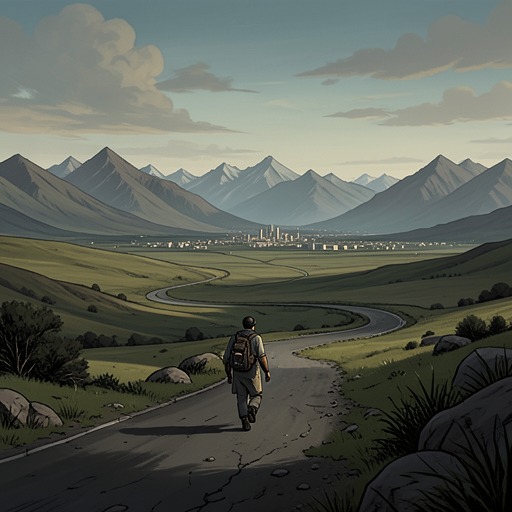
American Western Mythology
On the RoadThe myth of the West is the imaginative force that draws Sal Paradise from the stasis of New York toward the Pacific, but it is never simply confirmed by the landscapes he crosses. It takes shape in a beloved friend’s restless energy, a map’s red road, a farmer’s laughter, the speed and peril of cars, and the distance between western promise and eastern memory. As the journey moves from Nebraska to California and eventually back across the continent, the West becomes at once a lived place and a story travelers tell themselves about freedom, belonging, and escape.
The West as a Call to the Road
Sal’s attraction to Dean Moriarty is bound up with his sense that the East has become exhausted. Dean seems to reconnect him with an unbookish, physical world of boyhood companions, riversides, mills, and guitars. Set against the intellectual or disaffected postures of his New York circle, Dean’s energy appears affirmative: he moves through society in pursuit of food, love, and experience. Sal reads that motion as distinctly western, as though Dean carried the open air of the Plains within him. His aunt warns that Dean may bring trouble, but the warning does not outweigh the new horizon Dean represents.
The journey begins as an imagined line before it becomes a lived route. In July 1947, with about fifty dollars saved from veteran benefits, Sal leaves his unfinished manuscript and comfortable home to travel west. He has been studying maps and pioneer histories, savoring names such as Platte and Cimarron. Route 6, a long red line running from Cape Cod toward Ely and then down to Los Angeles, supplies the first practical shape for his dream. Yet its opening miles lead north to Bear Mountain, not west. Rain, isolation, and the wilderness leave him stranded under the eaves of an abandoned filling station, crying and cursing his decision. The road’s promise therefore begins not in effortless freedom but in disorientation and exposure.
Encounters on the Plains
The Plains become more than scenery when Sal recognizes their inhabitants as embodiments of a living West. Near Omaha, the landscape of the Platte Valley briefly seems to justify a rancher’s grand comparison of it to the Nile. More decisively, a Nebraska farmer’s enormous laugh transforms an ordinary diner into a revelation. The farmer calls for food and cherry pie, jokes with the people around him, and seems to possess an ease and generosity that Sal takes as the spirit of the West. The vision is personal and selective: Sal does not learn the farmer’s whole history, but hears in his laughter a counter-image to the tiredness and abstraction he has left behind.
Other travelers make the region less like a settled ideal than a passage shared by people with uncertain destinations. On a truck moving across the plains, Mississippi Gene quietly attends to a young fugitive’s moods and fears. Sal gives cigarettes to the pair, who accept them gratefully, while harvest workers consider moving north to follow seasonal labor toward Canada. The road gathers these lives without resolving them into one story of progress. Its open space offers movement, but the people moving through it may be fugitives, laborers, or men simply unsure where they will go next.
The landscape also carries the marks of recent hardship and contested belonging. A cowboy recalls riding freight trains during the Depression, when unemployed men traveled in great numbers, and remembers Nebraska in the mid-1930s as a blackened dust cloud that made breathing difficult. The recollection unsettles any picture of the Plains as untouched abundance: the open country is also a place of economic displacement and environmental devastation. At Shelton, Sal sees Native people standing without an apparent destination beside the railroad and water tank. The travelers’ movement through the West is not the only presence in the landscape, even when the road narrative gives most attention to those passing through.
Frontier Spectacle and American Memory
Cheyenne makes the difference between western life and the performance of western legend visible. When Sal and Montana Slim arrive, Wild West Week has filled the old town with businessmen in boots and ten-gallon hats, their wives dressed as cowgirls, crowded saloons, wooden sidewalks, and blank guns. Sal is amazed, but also finds the scene ridiculous: the city is staging its proud tradition as a public celebration. The episode puts the myth on display as something people actively reproduce, and its theatricality complicates the idea that the West’s past survives unchanged in the present.
The road’s geography is likewise layered with histories that exceed the travelers’ immediate itinerary. Sal’s map gives him a route to follow, but his imagination overlays it with pioneer journeys, wagon trails, and older movements across the continent. Later, the memory of the eastern wilderness complicates the assumption that wildness belongs only to the West. In Pennsylvania, Maryland, and Virginia, backroads curve among rivers associated in Sal’s mind with earlier American history. His account places the eastern woods alongside Arizona’s vast spaces: wilderness is not a western possession but a recurring way of seeing the country through its roads, rivers, and remembered past.
The story also exposes how the language of open space can turn inhabited land into an apparent invitation to discovery. At Council Bluffs, Sal recalls the wagon parties that gathered before setting out on western trails, then sees suburban cottages in their place. The gap between pioneer legend and contemporary settlement is striking, while his passing view of Native people at Shelton makes the human cost of a supposedly empty frontier harder to ignore. The West is made available to the traveler through roads and stories, but the landscape cannot be reduced to the travelers’ sense of possibility.
Cars, Speed, and the Cost of Freedom
Automobiles make the myth tangible by turning distance into something that can be rapidly crossed, but the book repeatedly associates that freedom with dependence and danger. Early in the journey, Sal and his companions rely on strangers for rides; later, cars and trucks carry them through changing landscapes at speeds that make forward motion feel exhilarating. The vehicles do not free the travelers from material limits: they need fuel, food, repairs, and willing drivers, and journeys are shaped by who owns a car, who can drive, and where the road allows them to stop.
A later trip with Dean in a recently purchased Hudson concentrates this contradiction in a single drive. The car is new, but already broken: its heater does not work, ice and fog gather on the windshield, and the radio is dead. Dean wipes a small opening in the glass while driving at seventy miles an hour, and talks with such intensity that he sometimes gestures without his hands on the wheel. The road’s white line appears to guide the car straight ahead, yet that apparent control is precarious. In Illinois, Dean’s attempt to pass traffic at a narrow bridge nearly produces a multi-vehicle crash. The car gives the travelers extraordinary reach, but speed repeatedly narrows the margin between escape and catastrophe.
The journey from Denver to Chicago turns that risk into a boastful record. In a Cadillac limousine, with one driver, the party covers 1,180 miles in seventeen hours of driving time, excluding delays in a ditch, at a ranch, and at a police station. The feat compresses the continent into an almost impossible stretch of motion, but its interruptions remain part of the measure. The men are stopped, watched, and delayed; the Cadillac requires fuel, and the driver’s exhaustion raises the danger. The American road myth promises mastery of distance, while the actual trip reveals how much that mastery depends on a vulnerable body and a machine that can fail.
The Pacific, Return, and the Limits of the Myth
California gives Sal’s western longing its most expansive image. After climbing a mountain near Mill City, he looks toward the Pacific beyond the foothills and imagines San Francisco through fog, white streets, Coit Tower, the Embarcadero, Market Street, and its crowded hills. From that height, the continent opens behind him toward New York. The East appears brown and sacred in his thought, California white and emptyheaded. That contrast is not a final judgment about either region so much as a record of Sal’s changing imagination: each place becomes a color and mood through which he tries to understand where he belongs.
The myth’s promise of arrival remains inseparable from departure. Sal leaves Mill City quietly with his canvas bag, and he and Remi Boncoeur lose one another. Later, his return east unfolds through a landscape that refuses to remain a simple opposite to the West. He travels home by bus through Arizona, New Mexico, Texas, Oklahoma, and Kansas, reads the scenery instead of the book he has stolen, and watches the Mississippi at St. Louis. In the Alleghenies, a strange encounter leads him to recognize an eastern wilderness of its own. The return does not cancel the West; it reveals that the country’s wildness and its imaginative hold are distributed across more than one region.
At the Mexican border, the road opens into another version of the promise. Sal, Dean, and Stan cross from Laredo and enter a dark desert where, at dawn, yucca and organ-pipe cactus emerge around them. Dean speaks of leaving everything behind and entering an unknown phase; the road ahead seems to extend the travelers’ freedom beyond the familiar United States. Yet even this apparent new beginning is understood through stories of earlier American outlaws and war. The road does not deliver the travelers outside history. Across the novel’s changing routes, the West remains powerful precisely because it is both physical country and imaginative projection: a summons to move, an encounter with other lives, and a promise that can never quite be settled by reaching a destination.