Bear Mountain
On the RoadBear Mountain is where Sal Paradise’s planned 1947 westward journey first breaks down: after months of imagining a direct crossing along Route 6, he reaches a rain-soaked, nearly empty mountain road and must accept that the map’s red line cannot carry him west by itself. The brief ordeal turns a departure meant to launch a continental adventure into an early lesson in improvisation, dependence on other travelers, and the gap between a mapped route and the lived road.
Setting and intended route
Before leaving Paterson, Sal had spent months poring over maps of the United States and reading about the pioneers. A long red line on his road map, Route 6, seemed to offer a simple itinerary from Cape Cod to Ely, Nevada, where it dipped south toward Los Angeles. He set out intending to follow it all the way to Ely, imagining the cities he would reach along the way, including Chicago and Denver, and the eventual prospect of San Francisco.
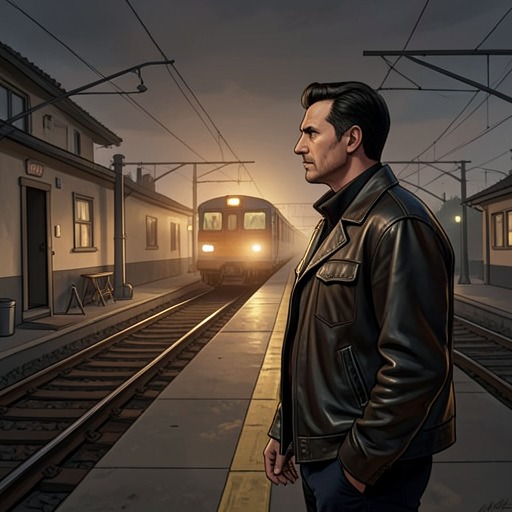
Getting to Route 6 meant traveling north first. Sal took the Seventh Avenue subway to its terminus at 242nd Street, continued by trolley to Yonkers, then transferred to another trolley and reached the city limits on the east bank of the Hudson River. From there he hitchhiked toward Bear Mountain. The approach already unsettled the itinerary: on what Sal regarded as the opening day of a westward trip, he was moving north, away from his desired direction.
The roadside breakdown
Five separate rides carried Sal to the Bear Mountain bridge, where Route 6 arched in from New England. He was let out as the rain began falling heavily. The road crossed the river, curved around a traffic circle, and disappeared into mountainous wilderness; there was no traffic and no shelter. Sal ran beneath some pines, but could not get out of the rain. Frustrated with his own decision, he cried, swore, and struck himself on the head.
He was about forty miles north of New York and felt trapped at the northernmost point of a journey he had meant to take west. He ran a quarter-mile to an abandoned English-style filling station and stood under its dripping eaves. Above him, thunder from Bear Mountain intensified his fear, while the trees and wilderness seemed to close off the road. The scene makes the landscape an immediate practical obstacle rather than an open corridor: the chosen route has brought him to a place where neither shelter nor onward traffic is available.
Abandoning the map’s promise
A car eventually stopped at the empty station. Its driver and two women were consulting a map, and Sal gestured to them in the rain. His wet hair and soaked shoes made him look, by his own account, like a maniac; his Mexican huaraches, described as plantlike sieves, were particularly unsuited to the rainy American night. The occupants nevertheless took him north to Newburgh, a better alternative than remaining in the wilderness overnight.
The driver explained that traffic did not use Route 6 there and advised Sal to return through New York and head toward Pittsburgh if he wanted to reach Chicago. Sal recognized the advice as sound. In retrospect, he identifies his mistake as a “stupid hearthside idea”: the belief that crossing America would be best accomplished by following one great red line rather than choosing among roads and routes. Bear Mountain thus marks the first decisive revision of his travel plan. The map remains useful, but its apparent simplicity gives way to the necessity of responding to local conditions and other people’s knowledge.
Reversal toward Chicago
The ride to Newburgh took Sal farther north rather than west. Once the rain stopped, he walked down to the river, then caught a bus back to New York with a group of schoolteachers returning from a mountain weekend. He resented the time and money lost and saw the day’s movement as a futile oscillation—north and south, without making progress toward the West.
Rather than continue to improvise along the Route 6 plan, Sal spent most of his remaining money on a bus ticket to Chicago, determined to arrive the next day. The journey across Ohio, Indiana, and into Illinois was an ordinary bus ride, but it achieved what the attempted route had not: westward movement. He reached Chicago early in the morning, rented a room at the YMCA, and went to bed with very little money left. After sleeping, he found that he liked the city. The episode’s consequence is therefore concrete and structural: Bear Mountain does not end the journey, but it ends the notion that its opening route can be followed as planned.
A recurring geography of the road
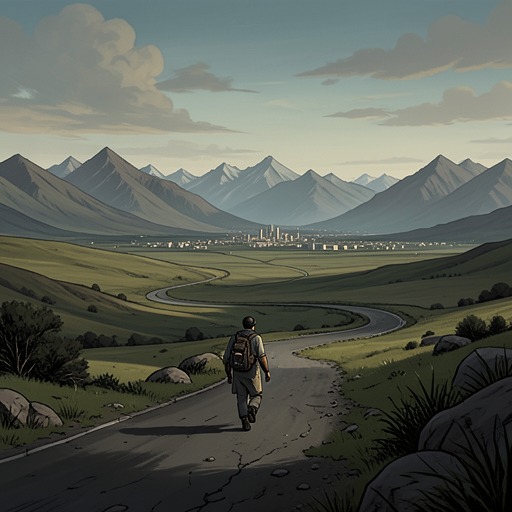
Bear Mountain’s role reaches beyond this first failed start because Sal’s travels repeatedly return to landscapes that unsettle the distinction between direction, distance, and progress. On a later journey, after he has slept in a bus station and left a Wild West festival behind, he sees the snowy tops of the Rocky Mountains and immediately wants to get to Denver. The contrast with his first encounter is sharp: in the East, the mountain road has trapped him in rain and confusion; farther west, distant mountains become a visible destination that draws him onward.
His later travels also revise his early assumption that wilderness belongs only to the West. In eastern Pennsylvania, Maryland, and Virginia, he recognizes another wilderness in the back roads winding among rivers such as the Susquehanna, Monongahela, Potomac, and Monocacy. The recognition makes Bear Mountain part of a broader pattern: American space is not divided neatly between settled East and open West, and the road’s meaning changes with the route, the traveler’s circumstances, and what the landscape reveals.
The book’s later journeys further expose the gap between the road’s promise of freedom and its material demands. A long automobile trip depends on the car’s condition, its driver, the weather, fuel, and the willingness of passengers to share the journey. On a furniture run, a new Hudson’s heater and radio fail, and Dean Moriarty reaches through fog and ice to clear a small opening in the windshield while driving. Elsewhere, a fast crossing from Denver to Chicago is measured in miles, hours, delays, and risk; the automobile’s speed creates both a record of movement and the possibility of a crash. Against those later episodes, Bear Mountain appears in miniature: an itinerary cannot overcome bad weather, unsuitable equipment, or an empty road.
Narrative significance
The Bear Mountain episode gives the book’s first westward departure an ironic shape. Sal leaves home with a map, a destination, and confidence in a single continuous route; within a day, rain and the absence of traffic have forced him to turn back. The failure is not a rejection of travel but an initiation into its actual terms. Movement depends on rides, advice, bus schedules, money, and the willingness to revise an attractive plan.
That pattern recurs as the journey expands across the country. Sal and his companions move by hitchhiking, buses, borrowed or hired cars, and opportunistic detours; routes become stories as well as lines on maps, and remembered places acquire meanings that a map cannot supply. Bear Mountain is therefore a small but decisive threshold: it exposes the instability beneath the road’s promise of direct passage and establishes improvisation—not mastery of a fixed route—as the condition of going west.