Bebop
On the RoadBebop is both a specific, evolving jazz practice and a central expressive model in the novel: its solos, rhythms, and listening crowds make improvisation audible as a struggle to discover and sustain a moment of shared intensity. Sal encounters it in cities and on the road; Dean treats it as evidence that a performer can give form to what a whole room feels but cannot say.
A Sound in Motion
In 1947, Sal finds bebop moving through America at speed. In Chicago, the Loop musicians play with an air of fatigue, as the music seems poised between the Charlie Parker period and a new phase associated with Miles Davis. For Sal, the sound gathers his distant friends into a single, restless “vast backyard”: music becomes a common ground for people scattered across the country, even as the road carries him onward.
The sound is not confined to concert halls. During the difficult weeks Sal and Terry spend in Los Angeles, bebop floats from beer parlors along South Main Street, mingling with cowboy music, boogie-woogie, and the noise of the streets. On Central Avenue, the jukeboxes play blues, bop, and jump amid crowded tenements and late-night sociability. These scenes place the music inside everyday life, among workers, travelers, families, and people living at the city’s margins.
The Solo, the Crowd, and “IT”
At Birdland, Dean links the boxer Roll Greb with the pianist George Shearing, whose performance gives his comparison a musical shape. Shearing begins with rippling phrases and gradually rocks harder at the keyboard, sweating as his chords pour out in mounting waves. Dean follows every change with his own cries and exertion. After Shearing leaves, Dean points to the vacant piano seat and calls it “God's empty chair”: the performance has ended, but its intensity remains present as an absence.
Dean later explains “IT” through the work of a soloist. The musician begins with a chorus, develops ideas, and, at some decisive point, finds a way to carry the room’s feeling forward. The tune matters less than that achievement: the player fills an empty space with something drawn from experience and bodily feeling, and the listeners recognize the moment together. Dean becomes so absorbed in explaining the idea that he sweats; his description itself takes on the pressure and momentum of the music it describes.
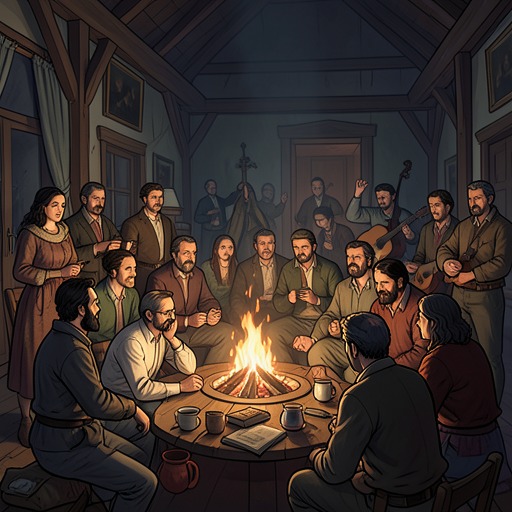
A late-night scene in a rough San Francisco saloon makes that collective recognition visible. A tenorman’s rising riff gathers force over battered drums while the crowd urges him on. Dean races toward the music, clutches his head, and sweats; Galatea and Marie stand on their chairs, jumping with beer in hand. The solo does not belong to the performer alone: the cries, movement, and attention of the crowd become part of the event, while the horn keeps pushing toward a sound that might slip away if it is not sustained.
Repetition, Change, and the Road
In Chicago, a young group of musicians carries the tradition into another night. A cool, slender tenor leader prompts the others with a quiet “Blow,” while a sharply dressed young saxophonist worries over mistakes and a teenage alto player answers with thoughtful, birdlike phrases. Dean reads the difference between them as a difference in purpose: one musician is anxious about professional success, while the leader is absorbed in the sound itself. The scene also places the young players in a history of jazz innovation, following the music’s movement from early New Orleans musicians through swing and Charlie Parker to a new generation.
Shearing’s astonishing set does not close that history. After the musicians say there is nothing left to play, the leader insists on continuing. They search for phrases, find and lose them, and wrestle toward new possibilities until morning. In this account, bebop is not a finished style or a final answer; it is a practice of return, variation, and renewed effort. The novel’s road journeys echo that structure: movement carries the characters into another place, another crowd, another attempt to find what is still just beyond reach.
Narrative Significance
Bebop gives the novel a form for representing intensity without reducing it to a fixed destination. A solo unfolds in time, depends on risks and responses, and can be recognized by listeners without being entirely explained. Dean’s account of “IT” makes this musical process a theory of communication, but the scenes also preserve the distance between performance and interpretation: the musicians play, the crowd answers, and Dean tries to name what the moment exceeds.
The music’s social life matters as much as its virtuosity. It travels from clubs to beer parlors and jukeboxes, joins strangers in a shared present, and stands against the isolation of the road without making that isolation disappear. By placing bebop inside the novel’s recurring departures and arrivals, the narrative makes improvisation a companion to travel: both press forward through uncertainty, and neither guarantees that the next phrase—or the next place—will resolve the search.