Carlo Marx
On the RoadCarlo Marx is a poet, observer, and jazz musician whose relationship with Dean Moriarty gives the novel one of its defining pairings: two restless minds drawn together by talk, invention, and a shared appetite for experience. He is not simply Dean’s audience. He keeps a record of Dean’s daily life, presses him to account for himself, and eventually confronts the traveling group with the question its motion cannot answer. His later appearance on alto saxophone turns their intellectual affinity into a public musical performance.
Identity and Introduction
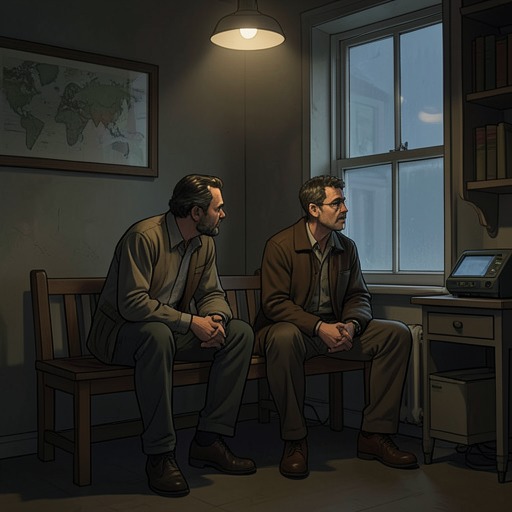
Carlo first meets Dean in New York after Dean and Sal Paradise have gone to a parking lot, where Dean changes clothes and tidies himself before they leave. The meeting is immediate and consequential. Sal sees two keen minds recognize one another: Dean, a shining, quick-witted con man, and Carlo, a sorrowful poet with a darker cast. Their energies meet so directly that Sal feels unable to keep pace and, for a time, sees little of Dean.
The friendship begins in an exchange of histories. Carlo tells Dean about Old Bull Lee, Elmer Hassel, and Jane Lee, while Dean supplies a sprawling account of Western companions, boyhood friends, lovers, and adventures. Their talk becomes an all-day, all-night undertaking. Sal watches them dance down the streets and describes his attraction to people who are intensely alive, perpetually talking and wanting. The pair’s early exuberance carries a later shadow: the same talk that initially seems inexhaustible will become more sorrowful, perceptive, and blank.
The Poet and the Chronicler
Carlo’s literary ambitions and attention to experience are visible in his Denver basement apartment, a cellar-like room in a red-brick rooming house near a church. Its single bed, candle, damp stone walls, and makeshift icon give it the quality of a private devotional cell. There he reads Sal a poem called “Denver Doldrums,” in which morning pigeons become vulgar voices, nightingales recall his mother, a gray shroud falls over the city, and the Rocky Mountains appear like papier-mâché. The landscape is not presented as reassuring scenery: in Carlo’s poem, the whole universe feels strange and askew.
Dean occupies a central place in Carlo’s writing and observation. Carlo gives him extravagant poetic names, including “child of the rainbow” and “Oedipus Eddie,” and keeps a huge journal tracking what Dean does and says each day. The journal makes Carlo more than a participant in Dean’s stories. He is also their close reader and recorder, turning the flux of Dean’s behavior into material that can be examined, remembered, and argued over.
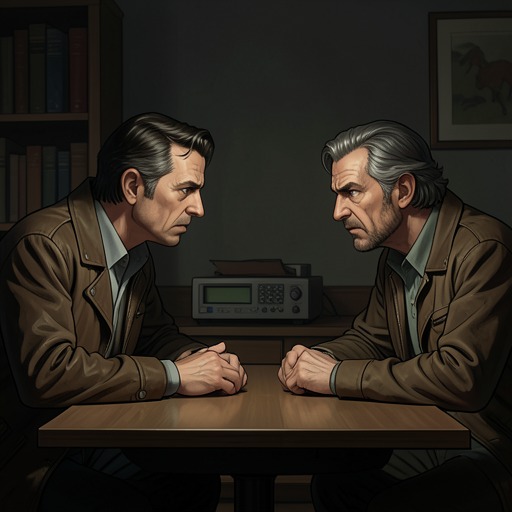
That scrutiny becomes an explicit practice when Sal finds the two men sitting cross-legged on the bed, facing each other. They move from one abstract idea to another, return to points lost in their rapid conversation, and revive forgotten thoughts through examples. Carlo asks whether Dean is honest with him, specifically at the deepest level of his soul. Their friendship therefore joins imaginative collaboration to an effort at emotional and intellectual accountability: Carlo wants not only to hear Dean’s stories, but to know what truth stands behind them.
Friendship, Counsel, and Friction
The intimacy between Carlo and Dean is shaped by talk that aspires to completeness. Carlo tells Sal that he and Dean are trying to communicate everything on their minds with absolute honesty. They take benzedrine, sit facing one another on a bed, and pursue that ambition through long conversations. Carlo has tried to persuade Dean that he could become almost anything—even mayor of Denver, a millionaire’s husband, or a great poet—yet Dean repeatedly breaks away to watch midget auto races. Carlo’s account registers both his expansive faith in Dean’s possibilities and his frustration at Dean’s distractions.
The difference between them becomes especially clear in their modes of attention. Carlo tries to hold an idea still long enough to examine it, returning to the thread when the rush of conversation pulls it aside. Dean generates new associations and moves toward the next excitement. Carlo’s questions about honesty and purpose press against Dean’s momentum without stopping it. Their friendship is intense, but the evidence does not resolve that tension into a final judgment: Carlo remains fascinated by Dean while repeatedly asking what his choices mean.
The Voice of Rock and the Question of Direction
When Carlo rejoins Sal and Dean during their New York preparations, he has returned from Dakar with poetry under his arm and a quieter manner. He initially watches without committing himself. Dean and Sal listen to a music box playing “A Fine Romance”; Ed Dunkel adds a barely audible rhythm with drumsticks, and the group gathers around the small tune as if listening for its secret. Carlo then breaks the spell with an announcement that demands an accounting of the journey: he asks what the voyage to New York means and where America is going in its shining car at night. Dean echoes the question, but no answer comes. The group concludes that there is nothing more to discuss and sets off again.
Before the departure, Carlo spends long days with the group in his apartment, wearing a bathrobe and challenging each of them to explain their conduct. He questions Dean about leaving Camille and taking up with Marylou, Marylou about her travels and intentions, Ed Dunkel about leaving his wife in Tucson, and Sal about his own disordered life and Lucille. His questions turn a gathering into a temporary reckoning. He predicts that their balloon of talk and travel will not sustain them indefinitely and that they will return west in search of their “stone.” The prediction gives Carlo a countervoice to the group’s habitual forward rush: movement is not the same as arrival.
Carlo calls his manner of speaking the Voice of Rock, hoping to shock people into recognizing what he calls the rock. His warnings mingle stark questions with visionary imagery. He tells the others they are pinning dragons to their hats and ending up in the attic with the bats. He also describes the Holy, or Harlem, Doldrums: a period in Harlem when he woke at night believing the great machine was descending from the sky and walked along 125th Street as though underwater among fish. These episodes show the imaginative intensity behind his pronouncements, while his questioning of the travelers keeps their practical choices in view.
Musician and Recurring Witness
Carlo’s creative life is not confined to poetry and the journal. At Jamson’s Nook in San Francisco, a small, low-ceilinged jazz room, Dean recognizes the frenzied alto player who bursts into the session as Carlo. He is physically slight, with taped-up alto, crooked feet, and glittering eyes; he hops and flops as he plays, fixed on the audience and absorbed in the possibilities of a simple variation. The prose follows the changing phrases rather than treating the performance as a static portrait: Carlo repeats a chorus, alters it, and draws laughter and recognition from the listeners.
He sustains the performance across two hundred blues choruses, each more frantic than the last, without showing a willingness to stop. His playing is an instance of the intensity the novel elsewhere associates with jazz: repetition becomes a means of change, and a simple phrase can open into another possibility. Dean watches in bodily sympathy, jumping on his heels and sweating as Carlo plays. The scene gives their bond a form beyond conversation: Dean responds to Carlo’s music as he once responded to his ideas, attending as though the performance were a discovery unfolding in real time.
Carlo also appears among young musicians in a Chicago club, where he is remembered as an alto player associated with the same nocturnal, grandmother-centered image used for other young players. There, Dean and Sal pursue the musicians from bar to bar through the night, while the group continues playing into the morning. Carlo’s placement in these musical circles links the poet who records Dean to the improviser who makes new phrases in public. Both roles depend on listening closely to what is already there and finding a way to carry it further.
Narrative Role and Significance
Carlo’s part in the novel rests on a productive contrast. He is drawn into Dean’s speed and excess, yet he also keeps journals, composes poems, asks pointed questions, and searches for a durable meaning beneath the stream of events. His first meeting with Dean begins the social swirl that entangles the narrator’s friends and remaining family; his later question about the voyage exposes how little the group’s movement has settled. He cannot end their journey or supply a final destination, but he makes the absence of one audible.
As poet, chronicler, skeptic, and musician, Carlo offers several ways of responding to experience: transform it into verse, record it, interrogate it, or improvise from it. The novel places these practices alongside Dean’s restless appetite rather than treating them as solutions to it. Carlo’s friendship with Dean is therefore both intimate and observant. He joins the adventure, helps give it language, and remains one of the figures most capable of asking what all that motion is for.