Chicago
On the RoadChicago is both a mapped promise and a lived test of the road’s velocity: Sal Paradise first imagines it as a milestone on his journey west, then reaches it with Dean Moriarty after an 1,180-mile drive from Denver, where the city’s crowded streets and sleepless jazz clubs turn arrival into another beginning rather than a pause. Its scenes bring together automobile risk, transient companionship, and music as an ideal of movement that seems always to lead farther on.
A City on the Map and the Road
In July 1947, Sal sets out from Paterson with about fifty dollars, intending to travel west to meet Remi Boncoeur in San Francisco. Months of studying United States maps have made the route itself part of the anticipation: Route 6, the long red line running from Cape Cod toward Ely, Nevada, and then down to Los Angeles, promises a passage through places that already carry imaginative weight. Chicago is among the cities in which Sal dreams of what he might do before reaching Denver and San Francisco. It is not yet an experience but a point in a projected continental journey, a name that helps give the westward trip shape.
That first journey teaches Sal that the map’s straight promise is lived through delays, weather, and improvised rides. On the way west, he travels across the plains in a truck whose road has a raised, uneven center and soft shoulders; when the truck finally crosses into Colorado, he sees Denver in the distance and cries out with joy. Years later, Chicago will be approached at a very different speed, but the same contrast remains: a destination appears on the map, while the road imposes its own unstable measure of distance and arrival.
Chicago also belongs to Sal’s return journeys. In October, heading home by bus from California, he watches the Mississippi at St. Louis and then travels through Indiana cornfields and on toward Pittsburgh, still hundreds of miles from New York. Later, with Dean and Marylou, he drives through the night from New Orleans toward Texas, crossing the Mississippi near Port Allen and pushing west with barely enough money for food, fuel, and cigarettes. The city is therefore not an isolated destination in the novel’s geography. It sits within a network of departures and returns, where the same roads and rivers acquire new meanings as the travelers’ circumstances change.
The High-Speed Arrival
The most concentrated Chicago episode begins after Dean drives from Denver through a sequence of delays and hazards. The party has been on the road for seventeen hours, not counting two hours in a ditch, three at Ed Wall’s ranch, and two spent with police in Newton, Iowa. Even with those interruptions excluded, the journey averages seventy miles per hour. Dean has driven alone, and his urgency has already produced a near-disaster on an Illinois bridge, where he threads the car between slow traffic and an approaching truck with almost no room to spare.
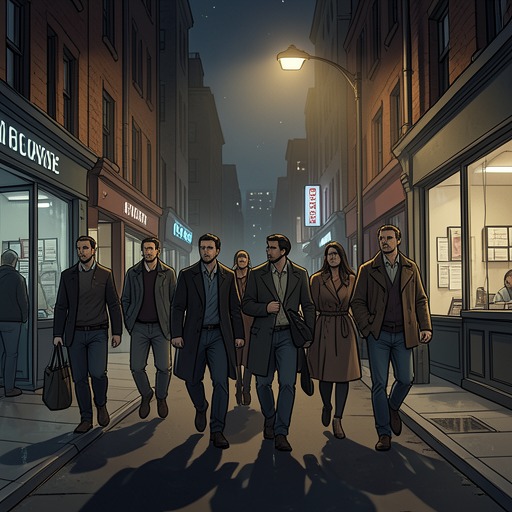
The arrival does not reduce the trip’s velocity. Chicago appears red before them, and suddenly they are on Madison Street among hundreds of hobos sprawled on the pavement or gathered in saloon doorways and alleys. Trolleys screech, newsboys call, neon signs wink, and the smell of fried food and beer fills the air. Dean greets the city as a big town, but the first practical task is to conceal and prepare the borrowed Cadillac. They park it in a redbrick alley, its front pointed toward the street for a quick departure, then use a YMCA room obtained by college boys to shave and shower. The arrival is less a settled entry than a brief preparation for the next nocturnal excursion.
The car remains an emblem of both mobility and exposure. It belongs to a wealthy Chicago owner, but Dean and Sal are only its temporary users, traveling with a mixed group that includes two college boys and, later, two hobos who contribute fifty cents toward gas. At a small-town station, people come out to study the party without speaking. In Chicago, the Cadillac is hidden in an alley rather than presented as secure property. Its borrowed status makes the travelers’ freedom conditional: they can move rapidly because they have access to a powerful car, but the car, its fuel, and the obligation to return it are always waiting beneath the apparent exhilaration.
Streets, Clubs, and the Night’s Music
After a spin through the Loop, Dean and Sal head for North Clark Street to see the hootchy-kootchy clubs and hear bebop. Dean reads the street as a succession of human signs: people passing, a woman looking down from a window, the city’s unfamiliar mixture of lives. His response is not to choose a destination within Chicago but to insist on continuation. When Sal asks where they are going, Dean says he does not know; they simply have to go. That answer makes the city a threshold in the journey, not its conclusion.
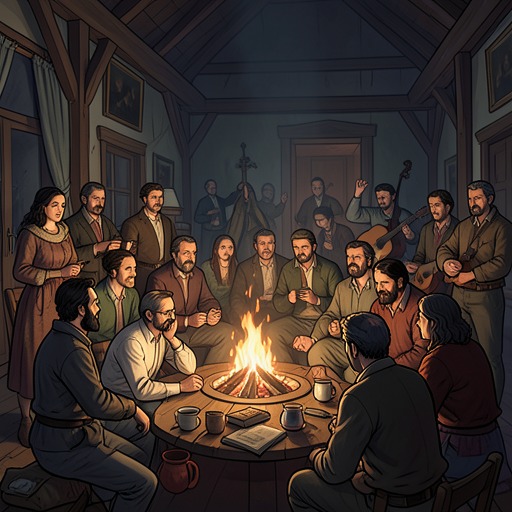
A group of young bop musicians carrying their instruments draws the two men into a saloon. The band’s leader plays in a cool, restrained manner, while another saxophonist—Prez—works with the visible anxiety of a musician conscious of mistakes and money-making. Dean interprets the contrast as a difference between technical worry and artistic freedom: the leader tells Prez to keep playing, valuing the sound and its exuberance over anxious concern for a wrong note. A young alto player contributes quiet, thoughtful phrases. The musicians continue for an hour amid the distractions of a crowded bar, where the people present do not all listen attentively and other nightlife competes with the performance.
The scene also makes exclusion visible. A sixteen-year-old, thin and goateed, arrives carrying a trombone case and tries to join the group. The musicians do not make room for him. After they finish and leave, he raises his instrument alone in the bar, gives a single sound, and hurries after them. Dean compares his rejection to being refused a place on a sandlot football team. The aspiring player’s brief appearance complicates the night’s celebration of improvisation: the music may suggest openness and discovery, but access to the band is not freely granted to everyone who wants to play.
Dean and Sal follow the musicians to Anita O’Day’s club, where the group plays until nine in the morning. During the breaks they drive around trying to pick up women, but their scarred Cadillac frightens them away. Dean’s backing into hydrants and laughing maniacally turns the car’s movement into damage as well as freedom. By morning its brakes no longer work, its fenders are dented, and its rods rattle. The night’s mobility has consumed the vehicle that made it possible.
Return, Damage, and Continuing Motion
Once the music ends, Dean and Sal return the Cadillac to its owner’s apartment on Lake Shore Drive. The mechanic does not recognize the car, now a muddy, battered wreck, but the travelers hand over the papers and leave quickly. They never hear from the owner, despite his having their addresses. The return closes the practical arrangement without erasing its cost: the borrowed car has carried them through the city at speed and has paid for the night in broken parts.
Chicago’s position in the novel is defined by this pattern of arrival and immediate departure. The city gathers together the road’s promises—distance crossed, strangers encountered, music discovered—and its limits: precarious access to cars, dangerous driving, exclusion from artistic company, and the exhaustion that follows an all-night spree. After returning the Cadillac, Dean and Sal take a bus to Detroit with money running low and their baggage in hand. Chicago is not a homecoming or a final destination; it is a brief, intense passage in which the travelers stop long enough to encounter the city’s street life and jazz, then move on, carrying the night’s damage with them.