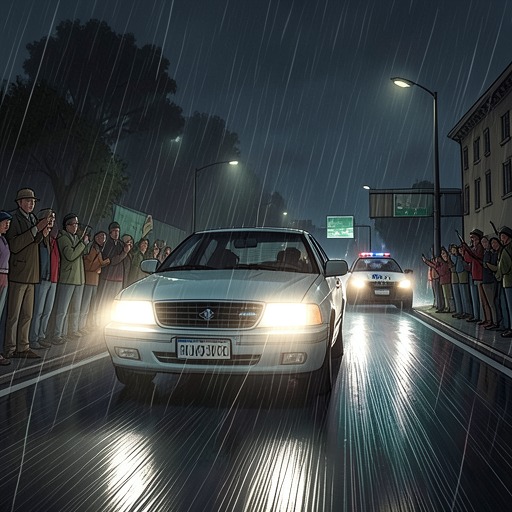
Dean’s Denver car-theft spree
On the RoadDean Moriarty’s Denver car-theft spree is a volatile night in which borrowed company, drunken confusion, and stolen cars converge into a flight from arrest. Dean’s repeated thefts turn the automobile from an instrument of freedom into a conspicuous liability: by morning, he fears that the police know his fingerprints, and he and Sal Paradise must leave before the wrecked coupe is found. The episode’s sudden change from reckless motion to urgent escape sets the terms for their next eastward journey.
The Night’s Escalation
The episode begins at a roadhouse near the hills, where Dean and his companions stumble in and order beer amid a sense that everything is collapsing. An ecstatic, distressed man throws his arms around Dean and moans in his face; Dean, already driven into another spell of frantic behavior, rushes outside and steals a car from the driveway. He drives to downtown Denver and returns in a newer vehicle while police and bystanders gather around the first theft. Standing behind a cop who is discussing the stolen car, Dean listens and answers with casual assent, then slips back into the bar.
Inside, Dean rocks back and forth with the distressed man, who had married that day and is drinking heavily while his bride waits elsewhere. Dean praises him and proposes that he, Sal, Frankie, and the man go for a drive in the mountains. When Dean goes back out to get what he calls a better car, a cop enters to report that a car stolen downtown has been left in the driveway. Dean takes a nearby car and roars away unnoticed; minutes later he returns in a brand-new convertible, explaining that the previous car coughed too much and that he had left it at a crossroads. The rapid substitutions make the spree less a planned escape than a succession of impulsive attempts to keep moving.
Refusal and the Wrecked Coupe
Sal refuses to take part in driving stolen cars. Dean urges him to come anyway and appeals to the distressed man, but the man recoils in sudden fear and throws up his hands. Dean bows his head, sweats, and runs out alone. His invitation has briefly gathered the bar’s disparate figures around the promise of a mountain drive; the refusal and retreat instead leave Sal and Frankie to go home by cab.
Dean catches up with the cab in the stolen convertible, honking, crowding it, and shouting until the driver turns pale. Sal reassures the driver that Dean is a friend. Dean then speeds ahead at ninety miles an hour, turns in at Frankie’s road, makes a U-turn, and heads back toward town. A short while later he returns in yet another vehicle, a battered coupe, stops in a cloud of dust, and collapses drunk on the bed. The stolen car is now on the doorstep, turning the house into an extension of the danger he has brought back with him.
The Cornfield and the Flight
Sal wakes Dean because he cannot start the coupe to dispose of it. Dean comes out in his underwear and joins Sal in the car. They bounce across the hard alfalfa rows until the vehicle gives out beneath an old cottonwood near the mill. Dean simply says it cannot go farther, gets out, and walks back across the cornfield in the moonlight. The stranded coupe, left wrecked in the field, makes the night’s reckless accumulation of cars a practical threat rather than a passing spectacle.
The following morning, Dean crosses the field to see whether the car can take them east. He returns pale and says that it is a detective’s car, that every precinct in Denver knows his fingerprints from the year he stole five hundred cars, and that they will end up in jail unless they leave immediately. Sal agrees, and they pack in haste. They say quick goodbyes to Frankie and the children; Sal kisses Frankie and apologizes, while little Janet cries as they go. Dean also fears discovery by a woman with a shotgun, and the wreck in the cornfield could soon be found by a farmer. Their departure is thus driven not by a new destination alone but by the need to get beyond the consequences of the abandoned coupe.
From Stolen Cars to the Eastbound Cadillac
The pair first try to arrange a cab. A farm dog drives them away from one house, and after an old woman lets them use her telephone, the cab they call fails to arrive. As morning traffic begins, each approaching car seems to Sal like a police cruiser. When a cruiser finally appears, he thinks their flight has ended; it proves to be their taxi, and they set off east.
At a travel bureau, they find an offer to drive a 1947 Cadillac limousine to Chicago. Its owner, who had driven north from Mexico with his family before sending them on by train, wants identification and delivery of the car. The arrangement replaces the stolen vehicles with a legitimate assignment, though Dean’s impulse to turn the Cadillac into another occasion for pleasure remains: while Sal sleeps from exhaustion, Dean makes a date with a waitress to take her driving. The spree therefore does not end with a conversion to caution; it gives way to a precarious, authorized ride in which speed and improvisation continue under different terms.
The drive culminates in a remarkable measure of distance and pace. From Denver to Chicago by way of Ed Wall’s ranch, the journey covers 1,180 miles in seventeen hours of driving, excluding two hours in a ditch, three at the ranch, and two with police in Newton, Iowa. The contrast between the deserted coupe in the field and the Cadillac’s eastward passage makes the episode’s consequence plain: Dean and Sal escape the immediate Denver danger, but only by moving at the edge of further trouble. The car-theft spree is a concentrated version of the road’s double promise—mobility as release, and mobility as a fresh source of risk.