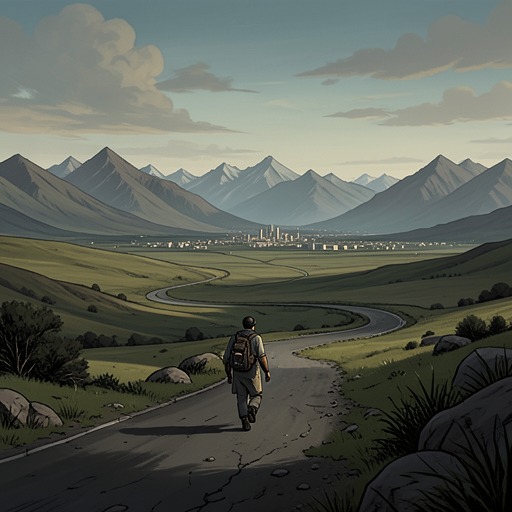
High Plains
On the RoadThe High Plains are both a physical stretch of elevated, open country and a charged space in the novel’s road narrative. Under a widening sky, the travelers experience the West as distance, exposure, and forward momentum; yet the region’s apparent emptiness is repeatedly complicated by human presence and by the histories the narrator brings to the land.
Terrain and Route
The High Plains enter the journey as a change in both elevation and road conditions. Riding in a truck whose road is humped in the middle, soft at the shoulders, and bordered by deep ditches, the narrator feels it bounce and teeter across the Nebraska panhandle. The truck’s drivers manage the perilous surface with confidence, carrying the passengers toward Colorado while the landscape opens toward Denver, still hundreds of miles away.
As the party climbs the western plateau, the account makes altitude perceptible through the thinning air and the absence of trees to obstruct the low stars. At night, the road seems as steady and straight as a railway line. The country is not just scenery beside the vehicle: its exposed terrain and great distances shape the travelers’ experience of speed, risk, and isolation.
Night Travel and Companionship
The High Plains’ darkness gathers the passengers into a makeshift community. A blond fugitive travels beside Mississippi Gene, who attends to the younger man’s moods and fears; the narrator shares his cigarettes with them, while Montana Slim keeps his own pack to himself. In the truck’s passing light, lanky men in jeans appear clustered at crossroads like moths, then vanish as the vehicle returns to the open dark.
At Ogallala, the Dakota boys leave to seek harvest work, and Gene and the blond boy continue with the others. As the temperature drops, Gene recommends bundling beneath the truck’s tarpaulin. The narrator lies on his back under it, watching the stars brighten as the truck climbs higher. Gene’s quiet song about a lost young sweetheart gives the vastness a human counterpoint: the road carries not only exhilaration but also separation and longing.
Westward Promise and Its Complications
The High Plains fulfill part of the narrator’s long-imagined westward route. Before leaving Paterson, he had studied maps and chosen Route 6, imagining the cities and western destinations ahead. His first day began in rain and disorientation near Bear Mountain; by the time the truck crosses the Nebraska panhandle and enters Wyoming, he can measure how far he has come from that stalled beginning. The open country turns progress itself into a source of exhilaration, while Denver remains an uncertain destination rather than a settled promise.
Yet the West is not simply untouched space waiting to be crossed. The route passes workers and travelers seeking seasonal employment, and the narrator’s later reflections on the American wilderness extend beyond the celebrated West to the backroads of Pennsylvania, Maryland, and Virginia. In the novel, the High Plains belong to a national geography made of lived-in places, labor, memory, and movement—not merely an empty backdrop for escape.
Landscape, History, and the Road Myth
The novel’s expansive account of the High Plains participates in a familiar western vision of open country and limitless travel. Its stars, sparse vegetation, and long horizon make the journey feel momentarily unbounded; the truck becomes a vehicle for imagining that the narrator can keep moving toward whatever lies ahead. The landscape thus gives physical form to the road’s promise without guaranteeing that the promise can be fulfilled.
That myth is also unsettled by the book’s wider geography. On a later journey, the narrator looks toward Indigenous people in Mexico and interprets them through a sweeping account of ancient human history. His vision challenges the notion that the continent is simply empty or newly discovered, even as its own language turns living people into symbols of a universal past. Read alongside that passage, the High Plains’ open horizon carries an unresolved tension: the traveler’s sense of freedom depends on seeing land as available for passage, while the narrative intermittently registers human presence and histories that such a view can obscure.