IT
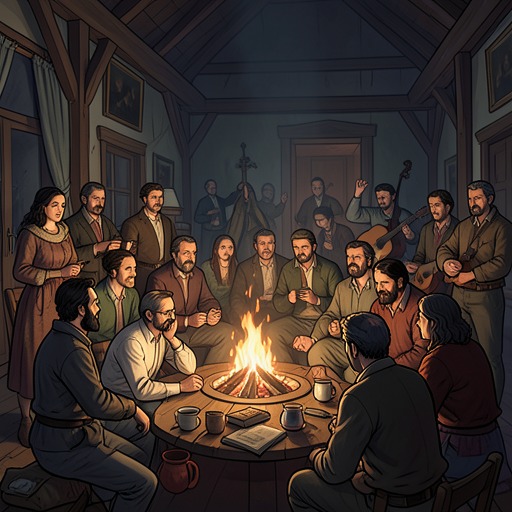
On the RoadIT is Dean Moriarty’s name for a presence that jazz musicians sometimes discover in performance and that he believes can transform the experience of time, attention, and shared life. It is never reduced to a technical formula: Dean recognizes it in a player’s ability to find and sustain a musical idea, but also in the unguarded intensity of a person who lets life move through him. The word consequently joins musical improvisation to a larger, urgent hope—that people might inhabit the present together instead of submitting to false worries about what comes next.
The word and its first model
Dean first explains IT through his encounter with Roll Greb, a scholar whose exuberance seems to overflow every ordinary restraint. Greb lives in a house crowded with books, performs Verdi operas in his pajamas, and moves through the world in states of visible excitement and despair. Watching him, Dean recognizes a model of total release: Greb is never hung up, goes in every direction, and has nothing to do but rock back and forth. Dean calls him the end, and says that going like him might finally lead to getting IT. Asked what IT is, Dean can only repeat the word and postpone an explanation; the experience, as he presents it, exceeds the capacity of an immediate definition.
That first account makes IT at once an ideal and an unresolved promise. Dean does not describe a skill that can simply be learned or a result that can be secured on demand. He sees it in a person’s openness and in a way of moving through time, yet insists that its arrival cannot be hurried into words. His excited repetition—IT, IT—registers the gap between recognizing the experience and explaining it.
Jazz performance as discovery
At Birdland, Dean and Sal Paradise watch George Shearing play. Blind and led to the keyboard, Shearing begins with a delicate number, then rocks faster as the beat rises. His body joins the performance: his foot jumps with the beat, his neck rocks, his hair comes loose, and sweat gathers as the chords pour out in increasingly rich runs. The audience urges him onward. Dean, sweating too, hails the pianist as a god; after Shearing leaves the stage, Dean points to the empty piano seat and calls it “God’s empty chair.” The music has made the absent performer’s place feel charged with what has just passed through it. Dean’s awe is both worshipful and unsettled: the scene suggests transcendence, but the silence after the playing also marks the departure of something that cannot be held.
Dean identifies the same quality in Slim Gaillard, whose performance moves between playful speech, long silences, sparse piano notes, and bursts of rhythm. Slim can let a sound diminish until traffic from the open door becomes audible, then begin “C-Jam Blues” with a few notes before the band’s beat gathers force. Dean stands sweating with his hands clasped as if in prayer, insisting that Slim knows time. In his dream, Slim also appears as a figure to whom Dean turns in despair, and Dean approaches him in person with a reverence that makes the musician seem like a god. The episode shows how IT can be carried not only by a climactic solo but by a performer’s handling of duration, restraint, rhythm, and attention.
Other jazz encounters extend the pattern without making every performance identical. In a crowded San Francisco club, a tenorman’s rising and falling riff catches the room; the listeners urge him to hold it, and his horn’s cry gathers the crowd into a single response. In Chicago, a young band continues searching for phrases after Shearing has played. The musicians find and lose possibilities, wrestle with them, and try again, while Dean urges them on. For him, musical discovery does not end when one player has succeeded: the attempt can be renewed, and the next phrase remains possible.
Dean’s explanation: time, feeling, and the group
Dean gives his fullest account while traveling with Sal in the back of a car headed east. Speaking of an alto player he heard the previous night, he describes the passage from a first chorus, when a musician begins to arrange ideas, to the moment when the player seems to find and carry them. The listeners recognize the change together. In Dean’s account, time stops; the musician fills empty space with the substance of people’s lives—with bodily strain, remembered ideas, and musical history remade for the tune of that moment. It is not the tune alone that matters, but what the player makes happen through it. Dean struggles to finish the explanation, sweating as he speaks, as if the act of describing IT reproduces some of its intensity.
This account makes IT relational rather than merely private. The soloist supplies the occasion, but the audience hears and confirms the arrival together. A player must answer the attention of the room and continue at the level the moment demands; the listeners, in turn, become part of the event through their recognition and response. Dean’s repeated cries of assent—“Yes!”—and his calls for musicians to go on are not detached judgments. They place him inside the shared scene of listening, where feeling is registered in bodies as well as in sound.
From musical time to the road
The car journey gives Dean and Sal’s understanding of IT a conversational form. Sal recalls imagining, as a child riding in cars, that he cut down the trees and posts beside the road with an enormous scythe. Dean answers with his own version, extending the imagined blade over distant mountains and across the landscape. Their exchange opens into memories of childhood visions and movement, and the two men sway so vigorously while talking that the driver complains they are rocking the car. The moment turns private recollection into a kind of duet: each story prompts another, and their shared rhythm matters as much as the individual memories.
Dean sets that intense present against the passengers in front, whom he imagines counting miles, calculating fuel and lodging, and worrying about weather. He calls these preoccupations false urgencies: the travelers will arrive whether or not they submit to every anxious calculation, but anxiety can occupy their attention and make them unhappy. This is Dean’s interpretation, not a neutral rule of travel. For him, knowing IT means recognizing that time is already passing and that life is not made more secure by rehearsing every possible worry. In the back seat, he and Sal briefly experience their excitement as an alternative kind of attention—one that accepts the journey as it unfolds.
The idea also becomes a promise attached to destinations. As the two men prepare to leave Denver for Mexico in a damaged 1937 Ford sedan, Dean says the southbound journey will finally take them to IT. The trip is imagined as more than an ordinary east–west crossing: it points toward new regions and a transformed world. Yet the earlier scenes have already shown that IT is not a place or a lasting possession. It appears in performances, conversations, and moments of collective recognition, then gives way to silence or renewed searching. That tension is central to the expression: Dean’s faith gives motion a purpose, while the music keeps the desired arrival open, repeatable, and never fully secured.