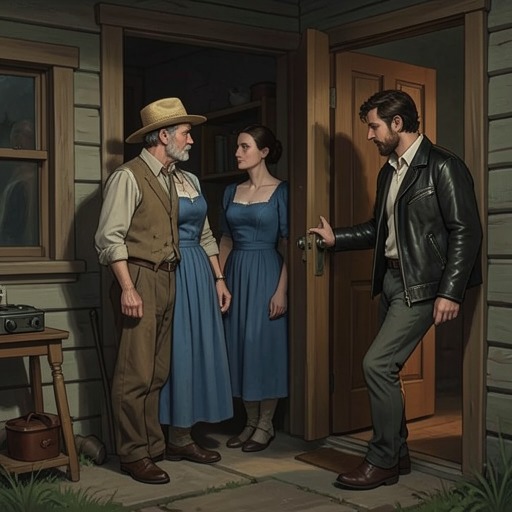
Laura
On the RoadLaura enters Sal Paradise’s life after his return from Mexico City and becomes his partner in a future imagined as domestic, shared, and mobile. Her relationship with Sal offers a brief counterpoint to his restless road life, but Dean Moriarty’s unexpected arrival interrupts their plans, and Laura is present at the final scene in which Sal and Dean part without resolving what either man’s journey means.
Identity and Introduction
Sal first finds Laura in New York after returning from Mexico City. He has just heard a white-haired stranger on the road say, “Go moan for man,” and has hurried on to the city; there, calling up to a loft where he thinks his friends are gathered, he hears Laura answer from the window. She invites him upstairs and is making hot chocolate. The contrast is immediate: after the dark road and its cryptic encounter, Sal finds a welcoming domestic scene and a woman whose eyes he describes as pure and innocent.
The narrative identifies Laura primarily through Sal’s attachment to her rather than through a detailed account of her background. He says that she is the girl he had searched for, and the two agree to love each other intensely. His language makes her arrival feel like a discovery, but the account gives their bond its substance through what they decide and attempt together, rather than through an independent history for Laura.
A Shared Future with Sal
In winter, Laura and Sal plan to move to San Francisco together. They expect to bring their furniture and belongings in a jalopy panel truck, an improvised household packed into an equally improvised vehicle. The plan belongs to both of them: it joins a shared home to movement westward, allowing Sal to imagine commitment without giving up the road entirely. They have six weeks to save for the truck and begin working, counting every cent toward the journey.
Sal tells Dean about the plan in a letter. Dean replies with an enormous account of his younger years in Denver and says that he will come to choose the truck himself and drive Laura and Sal home. But he arrives five and a half weeks early, when they have not saved enough money to proceed. His arrival therefore changes the practical course of the couple’s plans before the move can happen. The hoped-for departure is left unfunded, and Laura’s prospective life with Sal is suddenly entangled with Dean’s claim on Sal’s attention.
Dean’s Arrival and Laura’s Response
When Dean appears, the room’s details signal his presence before the visit is fully explained: Sal notices a battered copy of Proust on the radio and sees Dean tiptoe in from the dark hall in his stocking feet. Dean is agitated and struggles to speak, insisting that the others must listen before losing his thought. Laura is there with Sal as Dean tries to communicate through broken phrases, laughter, gestures, and pauses. Rather than treating her as an observer outside the encounter, the scene places her inside the intimate triangle formed by the two old friends and Sal’s new partner.
Dean says that he does not know why he came, then explains that he wanted to see Laura and Sal and was glad of them. He also raises the possibility of Laura returning to San Francisco with him to live on the other side of town. His proposal complicates the couple’s own plan to move west together: Laura is addressed as someone whose future Dean imagines involving, even as he cannot clearly account for his visit. The text does not report Laura accepting his suggestion. Her presence instead makes visible how Dean’s sudden reappearance presses into a relationship and a future Sal has only just begun to establish.
The Final Parting
Laura accompanies Sal to a Duke Ellington concert at the Metropolitan Opera, a night arranged by Remi Boncoeur, who has secured tickets and organized the drive. Dean stands outside the Cadillac with his bag, ready to go to Pennsylvania Station and continue across the country. He asks whether he can ride with Sal to Fortieth Street, saying that he wants to be with him as much as possible and that the night is bitterly cold. Remi refuses. Sal does not overturn Remi’s decision, and the car departs with Laura inside while Dean remains outside.
From the back seat, Sal can only wave. Dean walks away alone in a ragged, moth-eaten overcoat, and Laura begins almost to cry. She asks why they should let him go like that and what they can do. Sal answers that Dean will be all right, though he remains preoccupied with the man who has crossed thousands of miles and still does not know why he came, except to see Sal. Laura’s response registers the human cost of the scene: she recognizes Dean’s loneliness even as the concert and her own relationship with Sal continue without him.
Narrative Role
Laura’s role is concentrated in a late sequence that turns a tentative romance into a test of competing attachments. The move to San Francisco gives Sal and Laura a concrete shared objective; Dean’s early arrival disrupts its timing, and his final request to ride with Sal forces a choice in public, with Remi’s refusal setting the boundary. Laura does not control the decision, but her distress prevents the departure from reading as a simple escape from Dean’s demands. The separation remains painful and unresolved.
The novel’s closing movement returns Sal’s thoughts to Dean, his absent father, and the immense road stretching between the East and West. Laura is part of the immediate scene from which Sal looks back toward that larger expanse: she has offered the possibility of shared life, yet the final image leaves Sal thinking of Dean as he walks alone. Their proposed move remains a plan rather than an accomplished journey, and Laura’s place in Sal’s life is defined by that open ending as much as by their declaration of love.