Mexico
On the RoadMexico is at once a country on the travelers’ map and the imagined far side of the road: a place where Dean Moriarty, Sal Paradise, and Stan Shephard expect to leave the known world behind. Their southward passage makes Mexico the culmination of their drive, but the novel complicates that promise. The country is encountered through real roads, towns, and people, while the travelers’ language repeatedly turns it into a dream of elsewhere; the journey reaches Mexico City, but it does not deliver a permanent escape from their old troubles.
Route and Threshold
Mexico enters the journey as a direction beyond the familiar east–west road. Looking over a map in Denver, Sal measures more than a thousand miles to the border at Laredo and another 767 miles through Mexico to Mexico City. Dean imagines the trip as a plunge down the curve of the hemisphere toward other tropics and worlds. The battered 1937 Ford sedan makes the ambition materially precarious: its right-side door is unhinged and tied to the frame, and its front passenger seat is broken. The route is not a smooth passage into fantasy but a long, rough drive in a damaged car.
The border crossing at Nuevo Laredo gives the imagined threshold a concrete form. In Laredo, the three travelers arrive exhausted in oppressive heat, among suspicious-looking drivers, border figures, and the smell of the nearby river. They can scarcely swallow their food. Across the bridge, however, they see straw-hatted men in white trousers lounging beside battered storefronts, and the scene seems to confirm their anticipation of a different world. The Mexican officials inspect their baggage, warn them not to drink tap water, and welcome them across; the practical details of entry remain beside the travelers’ sense that they are stepping into a fabled elsewhere.
They leave the car parked and walk together into the Spanish street, entering a smoky lunchroom where Mexican cabdrivers and other customers eat tortillas, beans, and tacos to the sound of guitars on an American jukebox. The travelers buy beer and cigarettes with Mexican money, marveling at how little it costs. Behind them, they feel, lie America and the life they knew on the road. After a last look back across the Rio Grande bridge, they return to the Ford and drive onward. The border therefore marks both an actual change of country and a symbolic break that the travelers eagerly declare, though their vehicle, their habits, and their American perspective cross with them.
The Road Through Mexico
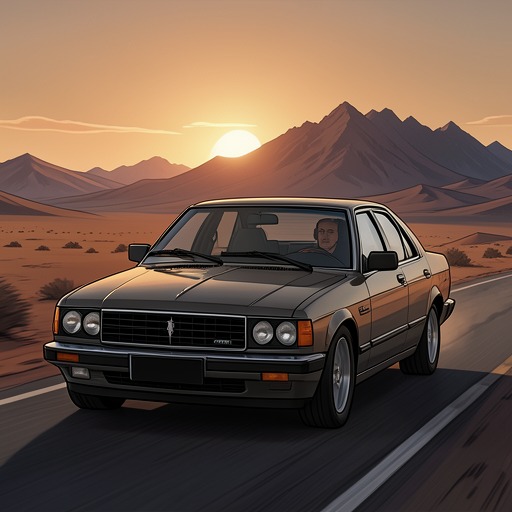
The first stretch beyond the border intensifies the sense of open space. Before dawn the car is out on dark desert flats, with no lights or other cars for fifty miles. Yucca and organ-pipe cactus emerge as the day comes up. Stan sleeps in the back while Dean and Sal, newly alert after their exhaustion in Laredo, look ahead at the country before them. Dean describes the crossing as leaving everything behind and entering an unknown phase, but Sal also recalls the older American outlaws who once crossed the border toward Monterrey. The road carries several histories at once: a new personal adventure, a route into unfamiliar territory, and a path already shaped by earlier American movement across the border.
As the travelers approach Monterrey, the landscape shifts from mesquite desert to mountain pass and high plateau. They climb through cooler air beside precipices and stone walls marked with the names of Mexican presidents. Monterrey appears as a manufacturing city, its factory walls recalling Detroit, but the city also has burros grazing nearby, adobe neighborhoods, crowded sidewalks, and shops whose wares the travelers cannot identify. The contrast resists any simple division between a modern United States and a timeless Mexico. Yet Dean wants to press on rather than stop in the city: the road ahead has priority, and the promise of reaching Mexico City outweighs the chance to remain and look around.
The drive becomes slower and more attentive in the high country. Near the Moctezuma River, Dean brings the car down to five miles an hour to take in steep agricultural slopes, immense ravines, and people carrying heavy loads along the mountainsides. He gets out beside a small thatched hut perched over a precipice, where a young girl watches the visitors. The travelers’ view is intensely visual and imaginative: the landscape appears at once difficult to reach and complete in itself, while the girl’s life becomes, in their speculation, a world bounded by the ledge. That encounter makes the journey more than a fast drive through scenery, but it also reveals how quickly the visitors turn what they see into a story about the lives of people they do not know.
The Travelers’ Mexico
Dean’s response to Mexico is shaped by the contrast he draws with the suspicion and strain of the road he has known. He describes the people he meets as calm and kind, and rejects the crude stories Americans tell about Mexicans. His enthusiasm has a genuine moment of recognition: it is the first time he has encountered a society that unsettles his assumptions about what life on the road can show him. At the same time, Mexico remains in his speech a vision of difference, a place he wants to experience as an answer to the limits of ordinary American life.
The country’s landscapes enlarge that vision. At the mountain hut, Dean is moved by the child’s isolation as he imagines the steep slopes, the work of her family, and the limits of what she might see beyond her home. Further on, the road climbs into the Sierra Madre Oriental, with bananas high on the slopes, fog beyond the stone walls, and the Moctezuma far below as a thin thread in the green. In the travelers’ account, the mountains are both geographically specific and nearly sacred in scale. The road supplies the vantage point, but it cannot make the people beside it fully knowable: the visitors see, wonder, and move on.
That tension sharpens when people hold out their hands along the route. Sal imagines them hoping for what civilization can offer, unaware of the danger he believes may someday reduce the travelers’ own world to ruin. The image briefly reverses the assumed direction of progress: the Americans, who have arrived in a car and appeared to carry modernity, may also become poor and dependent. Yet the scene is still filtered through the travelers’ projection of a future catastrophe, rather than through the people’s own speech or understanding. Mexico is not merely scenery in this passage; it unsettles the travelers’ confidence in their place in the world, while the narrative also exposes how their grand interpretations can speak over the people they encounter.
Arrival and Departure
After nearly 1,900 miles from Denver, the travelers approach Mexico City through broad fields, immense groves of trees, and old missions turning salmon-pink in the late light. Arrival promises an endpoint to the road, but the journey has taught them to imagine each destination as another beginning. Their drive has carried them from a damaged Ford and a Texas border crossing through desert, city, plateau, and high mountain country; reaching Mexico City completes the route without resolving the desire that propelled them forward.
The difference between Dean’s continuing appetite for motion and Sal’s physical limits becomes decisive. In Mexico City, Sal develops dysentery, becomes delirious, and lies ill while Dean prepares to leave. Dean tells him he has obtained a divorce from Camille and intends to drive back toward Inez in New York; Stan will stay and take care of Sal. Thus the country that had seemed to promise escape becomes the setting for another separation and another turn in Dean’s unsettled marital life. Mexico is not the end of the story or a cure for its recurring restlessness. It is the farthest south the travelers have reached, a vivid encounter with places beyond their usual routes, and the point at which their shared expedition breaks apart.