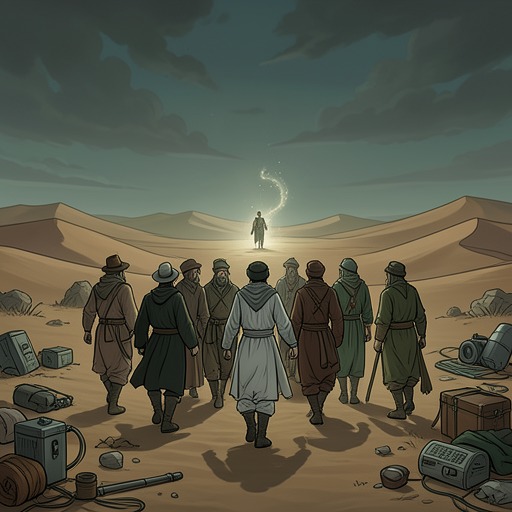
Mexico: The road’s end as an enchanted land
On the RoadMexico is the imagined land at the end of the road in the novel: the destination that transforms a familiar American journey into a passage toward another world. For Dean Moriarty, Sal Paradise, and Stan Shephard, the border promises not simply a change of country but a way to leave their old lives behind. The enchantment gathers force from the route’s real distances, vehicles, landscapes, and encounters, even as the travelers’ sweeping expectations reveal how much of this new world they have yet to understand.
From the Road to a Southern Destination
The journey begins with a practical plan and an unreliable car. Dean Moriarty prepares a battered 1937 Ford sedan, its right-hand door unhinged and tied to the frame, its front passenger seat broken so that its occupant must lean back toward the torn roof. Looking at a map, Sal Paradise measures more than a thousand miles to the border at Laredo and another 767 miles to Mexico City. The road south is therefore not an abstract escape: it is a long drive in a damaged car, through Texas and into a country whose distances the travelers can only begin to imagine.
Yet the direction itself changes the meaning of travel. Their earlier roads have run east and west across the United States; now, Dean sees the route as a descent along the curve of the hemisphere toward the tropics and, in his imagination, as far as Tierra del Fuego. He believes that the trip will finally take them to IT, the elusive intensity and completeness he associates with life on the road. Mexico acquires its promise before the travelers arrive: it is the next place on the map, but also a possible threshold into a different order of experience.
The novel repeatedly makes such distances tangible through movement. Earlier, Sal had studied Route 6 on a road map and set out toward Ely and Los Angeles; later journeys brought him back through St. Louis and the Mississippi Valley, and through Illinois toward Chicago. Those returns make the southbound trip feel like a departure from territory already traversed, not another leg in an undifferentiated adventure. The same roads can carry fatigue, danger, or the desire to get home; the Mexican route is charged instead with the hope of beginning anew.
Crossing the Border
Laredo is the last American town before the crossing, and the travelers reach it exhausted, in oppressive heat, after Sal has slept through the final 150 miles. The Rio Grande lies close by, but the boundary is at first only the promise of an elsewhere beyond the river. They have little idea what Mexico will actually be like. The change begins when they cross the bridge and roll onto Mexican soil for inspection. Across the street, Nuevo Laredo appears to confirm the vision: men in straw hats and white trousers lounge outside battered storefronts, while music and all-night restaurants suggest a street life unlike the world they have just left.
The border officials alter the travelers’ expectations as much as the scenery does. They ask to see the baggage, warn them against drinking tap water, and exchange their American money for pesos—eight pesos to roughly one American dollar. Dean is struck by the officials’ manner and says he cannot believe it, as if the ease and warmth he perceives were evidence that he is dreaming. The new currency, gathered into thick rolls in their pockets, gives the crossing an immediate, material consequence: the same small sum now feels abundant. Their anticipation is not only a fantasy of distant landscapes; it is also the excitement of entering daily transactions under unfamiliar conditions.
After the inspection, the three leave the parked car and walk into the town. In a smoky lunchroom, they buy cold beer for about thirty Mexican cents for three bottles and cigarettes for six cents a pack, listening to campo guitar music on an American jukebox. Dean and Sal look around and smile at the people there. For a moment, Mexico seems to offer a simple reversal: behind them lies everything they previously knew, while ahead lies a place where their money goes further and the night continues. They return to the car and set off, taking one last look at America across the Rio Grande bridge.
A Landscape Made into Possibility
The first miles beyond Nuevo Laredo intensify the sense of release. For fifty miles, the travelers see no lights or cars across the flats. Dawn comes over the Gulf of Mexico as yucca and organ-pipe cactus emerge on either side of the road. Sal and Dean, nearly spent in Laredo, wake fully to the landscape; Stan, who has been abroad before, sleeps in the back seat. That contrast makes the newcomers’ astonishment visible without making it universal: the country is new to Sal and Dean, not necessarily a revelation to everyone in the car.
As the light strengthens, Dean describes the crossing as leaving everything behind and entering an unknown phase. Sal connects the landscape to the history of American outlaws who used to cross the border toward Monterrey, giving the road a second, remembered geography. Dean answers that the world itself lies open and imagines they could continue to South America if the road allows. The conversation turns the highway into both physical infrastructure and a story about movement: a drivable route with mileposts and towns, and a line of escape that seems to point beyond the known map.
The actual road also resists the travelers’ purely symbolic vision. Dean notices that it resembles an American road, except that its mileposts mark distances in kilometers and count down toward Mexico City. He points out that everything in the country seems to point to that one city, still 767 miles away. The apparently simple difference in measurement makes the new territory legible while keeping it unfamiliar. They can follow the road and read its signs, but the landscape and the destination have not yet become theirs.
The route soon leaves the desert behind for the mountains near Monterrey. A pass climbs through cool air beside a stone wall at the edge of a precipice; the names of presidents are painted in large white letters on the cliffs. Beyond it, the plateau opens toward a manufacturing city sending smoke into the sky. Monterrey surprises the travelers with its factories, adobe neighborhoods, burros in the grass, crowded sidewalks, shops, and people gathered in doorways. Dean wants to press on rather than stop, insisting on making time for Mexico City and believing that the road ahead will be more interesting. The country thus arrives as a series of particular places, while the travelers’ attention keeps tugging toward the next one.
Enchantment and Its Limits
The travelers’ language makes Mexico seem almost sacred before they have traveled far into it. Before the crossing, Dean and Sal imagine the country through films and stories of the Sierra Madre, jungles, and a vast plateau stretching toward Guatemala. Nuevo Laredo, a border town, appears to them like a remote holy city; the country beyond becomes a magic land at the end of the road. These images record the force of their expectation, not a settled knowledge of Mexico. Their excitement is genuine, but it repeatedly outruns what they have seen.
The new country does offer them experiences that unsettle their assumptions. In Sabinas Hidalgo, they move slowly down a muddy, potholed main street past broken-down adobe buildings, pack burros, barefoot women in doorways, and people beginning the day. Three bearded, bedraggled Americans in a car attract attention because they do not resemble the well-dressed tourists the onlookers might expect. At a stop beyond town, local ranchers gather around old gas pumps, while an old man walks across the fields with a burro. The journey’s wonder is grounded in such scenes of ordinary work and public life rather than in an empty wilderness waiting to be discovered.
The episode’s central tension lies between encounter and projection. Sal and Dean are exhilarated by a border that seems to put their former lives behind them, but they are also visitors reading unfamiliar people and places through their own expectations. Their sense that Mexico is wholly new cannot erase the older histories they evoke, including American wars and the outlaws who crossed the border before them. Nor does the road deliver a final revelation at the frontier: the first crossing leads to further towns, mountains, and hundreds of miles still to go.
Mexico’s significance, then, is less a claim that the travelers have reached a definitive end than a transformation of what the road can mean. In the United States, movement has often brought the group back toward familiar regions or toward home; here, the border makes forward motion feel like a break with everything known. Yet the same sequence that gives Mexico its dreamlike power also shows how that power is made: by mileage and roads, money and meals, heat and exhaustion, roadside encounters, and the travelers’ insistent desire to keep going. The enchanted land is both a real country encountered one place at a time and an open promise that the journey might continue beyond its current horizon.