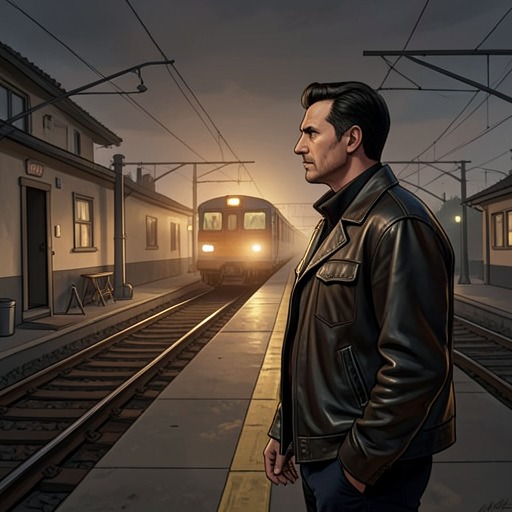
Sal Paradise
On the RoadSal Paradise is the novel’s first-person narrator, a would-be writer whose journey west becomes a succession of returns, missed encounters, and renewed departures. He begins on the road after a serious illness and the end of his marriage, drawn toward Dean Moriarty’s restless energy; over years of travel, Sal remains both participant and observer, trying to turn movement into a life and the people he follows into a story.
Identity and the Call of the Road
Before meeting Dean, Sal had dreamed vaguely of going west but had not acted on the idea. He was recovering from illness and a marital separation, and felt that everything had gone dead. Dean’s arrival marks the beginning of what Sal calls his life on the road: the longing to leave acquires a companion, a route, and urgency. Sal is also working on a novel. His writing is not separate from his travels: before his first western trip he leaves a half-finished manuscript on his desk, and the experience of the road repeatedly becomes material for his observing, remembering voice.
Sal first hears about Dean through Chad King, who shows him letters Dean wrote from a New Mexico reform school. The letters ask Chad to teach him about Nietzsche and other intellectual subjects. Sal and Carlo Marx wonder whether they will ever meet their mysterious young correspondent; when Dean arrives in New York with Marylou, Sal’s curiosity becomes personal. Yet the decisive meeting for Dean is with Carlo. Their rapid intellectual and emotional alliance leaves Sal feeling unable to keep up, establishing a recurring position: he is close to the people whose energies fascinate him, but often follows rather than directs them.
Sal’s declaration of allegiance is to people who are intensely alive, talkative, and hungry for experience. He describes them as “the only people for me,” and imagines their vitality as Roman candles bursting across the night. The image explains both his attraction to Dean and the imbalance in their friendship: Sal admires the force that carries Dean forward, even as he registers the sadness and exhaustion that accumulate behind it.
First Westward Journey and Return Home
In July 1947, Sal sets out with about fifty dollars saved from veteran benefits. His friend Remi Boncoeur has invited him to San Francisco, promising a possible shipboard job and a place to write in Mill City while they arrange passage. Sal’s aunt supports the trip, asking only that he return in one piece. He leaves with a canvas bag and his unfinished manuscript still on the desk.
The journey begins not west but north. Sal has studied maps in Paterson and fixes on Route 6, which runs from Cape Cod toward Ely, Nevada, before turning south. To reach it, he rides the subway and several trolleys toward Bear Mountain, then hitchhikes through heavy rain. Stranded without shelter, he runs beneath pines and curses his decision; at an abandoned filling station, the wilderness and thunder make the vastness he had desired feel suddenly frightening. This uneasy opening establishes the road as more than uncomplicated escape: its promise is inseparable from exposure, uncertainty, and the practical problem of getting onward.
Sal’s journeys repeatedly turn back toward the East. In October, after leaving Hollywood with only a dollar and ten sandwiches for the bus, he crosses the desert and the Midwest, reading the landscape more avidly than the book he has with him. Near New York, exhausted and short of money, he walks out of Pittsburgh and reaches Harrisburg by rides in an apple truck and a trailer truck. He wants home, but the return is not a clean arrival: he has no bus fare, must panhandle a quarter, and reaches his aunt’s house worn down by travel.
At home, Sal eats everything in the icebox. His aunt sees how thin he has become; he wears two shirts and two sweaters, and his bag contains torn cotton-field trousers and the remains of his huarache shoes. The money he sent from California helps them buy the family’s first electric refrigerator, a domestic consequence of his travels that contrasts with their precarious conditions on the road. His half-finished manuscript awaits him, and he means to work again. Dean, however, has just left after waiting several nights at the house, so Sal’s return also means missing his friend by two days. Dean has gone to San Francisco, where Camille has an apartment; Sal had not thought to look her up while he was in Mill City.
The Road as Repeated Crossing
Sal’s movements are episodic, but the geography gathers meaning through repetition. Places encountered on earlier trips return as landmarks in altered circumstances. On the journey east with Dean, Sal recognizes Newton, Iowa, where he had walked at dawn in 1947, and Davenport and the Mississippi again. The West, which had once stood ahead as an imagined destination, becomes a region that can be crossed and left behind. Illinois seems to unfold in a single movement as Dean drives, until a dangerous bridge passage brings the speed of their travel into sharp focus: Dean threads the car through converging traffic, narrowly avoiding a collision with a truck and several cars.
That journey’s scale becomes explicit in the figures Sal records. They cover the 1,180 miles from Denver to Chicago in seventeen hours of driving, apart from time spent in a ditch, at a ranch, and with police in Newton. Dean handles the drive while the passengers and the car carry the consequences of his haste. At a small-town gas station, he puts his T-shirt around his neck like a scarf to speak with the attendant, then gets back into the car. The detail joins the trip’s spectacle to its improvised routine: relentless motion still depends on fuel, stops, a vehicle, and the people gathered inside it.
The passage into Mexico pushes the road’s promise of elsewhere to a new threshold. At Laredo, after the last hundred and fifty miles, Sal is so exhausted he sleeps through Dilley and Encinal and wakes when the car stops at two in the morning. He and his companions are sweating in the heat among moths beating against lights; the Rio Grande marks the edge of the country they know. Across the bridge, the Mexican street and its late-night lunchroom seem to fulfill their expectation of a different world. Sal and Dean turn back toward the car and drive into the dark, while Stan sleeps. At dawn, Sal and Dean are awake in the desert with the country ahead of them; the border crossing makes departure feel like the start of an unknown phase rather than simply another leg of a familiar route.
The Mexican landscape continues the pattern of movement outrunning the travelers’ strength. The road climbs from desert toward the mountains and the high plateau approaching Monterrey. Dean wants to make extra time for Mexico City and will not stop; Sal and Stan, exhausted, give up and sleep. The route is at once physical terrain and an expanding horizon, but the companions do not experience its demands equally. Sal’s account preserves both Dean’s drive onward and the fatigue that makes his companions unable to share it without limit.
Friendship, Conflict, and the Limits of Following
Sal’s bond with Dean combines admiration, companionship, and recurring disappointment. When the two arrive in New York after a long crossing, Sal’s aunt allows Dean to stay only a few days. The trip is over, and the men take a final walk among Long Island’s gas tanks, railroad bridges, and fog lamps. With the Atlantic leaving them no more land to cross, they clasp hands and agree to be friends forever. The scene gives their friendship an affectionate ending to one journey, but its promise sits beside the larger pattern of departure and separation.
Sal’s loyalty becomes especially visible when Camille expels Dean and the two men must decide what to do. Dean suggests walking to New York; Sal counts his money and offers eighty-three dollars and change, proposing that they go east and then continue to Italy. The imagined extension of the trip is characteristic of their shared appetite for elsewhere, but Sal is the one who makes the immediate offer and supplies the available money. His role is not only to follow Dean’s momentum; at this crisis he turns concern into a concrete plan.
That commitment is tested in Mexico City. Sal develops dysentery, becomes feverish and delirious, and lies ill while Dean prepares to leave. Dean tells him he has obtained his divorce from Camille and is driving back toward Inez in New York; he says Stan will look after Sal and that he wishes he could stay. Dean pulls the blanket over Sal’s shoulders before going. Sal does not at first understand that Dean is gone, and only twelve hours later, in his fever, realizes he has left. Once recovered, Sal calls Dean a rat, then acknowledges the complexity of Dean’s life and the pull of his wives and troubles. His response neither erases the abandonment nor reduces their friendship to it: he decides he will say nothing.
Later Life and the Last Meeting
Sal’s later passages keep the road in tension with home and the possibility of settled affection. Returning from Mexico, he encounters an old white-haired traveler on the road near Dilley, Texas, who tells him to “Go moan for man.” The phrase prompts him to wonder whether he should undertake a pilgrimage on foot, but he hurries on to New York. There, he gives his name to a woman who invites him upstairs, and the two agree to love each other. They plan to move to San Francisco in winter, taking their furniture and broken belongings in a panel truck. This projected homeward-westward move is practical and shared, unlike Sal’s earlier solitary departure with a canvas bag.
Sal writes to Dean about the plan. Dean replies with a very long letter about his youth in Denver and says he will come select the truck and drive Sal and his partner west. But Dean arrives five and a half weeks earlier than expected, when there is no money to carry out the plan. His visit does not restore the easy rhythm of their earlier traveling: he struggles to speak, says he has come to see Sal and Laura, and then leaves again across the country. Sal cannot go with him. The old bond remains, but its familiar form—setting off together—no longer reliably converts desire into action.
The last time Sal sees Dean, Remi Boncoeur has come to New York after years at sea and arranged for Sal and Laura to attend a Duke Ellington concert at the Metropolitan Opera. Dean waits outside with his bag, ready to go to Penn Station and cross the country once more. He asks to ride with them as far as Fortieth Street because he wants to be with Sal and it is bitterly cold. Remi refuses; Sal does not overturn the evening he has planned. The farewell is brief and constrained, not a new expedition. Sal’s story of Dean ends in the image of a friend outside the car, close enough to ask for company but again bound for somewhere else.
Narrative Role
Sal’s position as narrator makes the road both a sequence of practical passages and a landscape of memory. Routes, vehicles, distances, money, and fatigue keep the journeys concrete; the return to places such as Davenport and the Mississippi shows how movement revises rather than simply erases what came before. His account is shaped by looking back: the exhilarating promise of going west is set against missed meetings, strained bodies, and the repeated need to return home or make another plan.
That perspective also makes Sal’s relation to Dean a measure of change. Early on, he trails the pair of Dean and Carlo because their energy exceeds his own; later, he offers money to take Dean east, sits with him at the edge of a final departure, and accepts that affection cannot make their lives move in unison. Sal remains drawn to the road and to those who seem to burn through it, but his narrative registers what their forward motion costs—and gives the fleeting encounters a form of continuity that the travelers themselves cannot maintain.