Sal Paradise's dysentery
On the RoadSal Paradise's dysentery is the bodily crisis that leaves him feverish, delirious, and unconscious in Mexico City while Dean Moriarty departs. The illness makes Sal dependent on others at the very moment his closest companion announces another upheaval in his marriages; only after the fever lifts can Sal understand both the injury of being left behind and the complications that drove Dean away.
The Illness and Its Altered Perspective
Sal's illness arrives after an all-night excursion through a field, where a boy in a straw hat laughs, chats, and wants to play catch. The episode has the sense of an unclosed world, but the next turn is abrupt: Sal develops a fever, becomes delirious and unconscious, and is incapacitated by dysentery. He later describes looking out from the dark swirl of his mind and finding himself on a bed eight thousand feet above sea level, in Mexico City's high-altitude setting. His feverish perception expands into a vision of having lived many lives in the poor, atomistic husk of his body, with all the dreams; the account makes physical collapse inseparable from an intensified, disoriented awareness.
That altered state also fractures Sal's grasp of time. When he looks up, several nights have passed, and Dean is already preparing to leave Mexico City. Sal's first question is a moan of recognition and confusion, not a clear understanding of the interval or the decision. The gap between the departure as it happens and Sal's ability to comprehend it becomes central to the scene: illness delays emotional knowledge until Dean is gone.
Dean's Departure at the Bedside
Dean tells the sick Sal that Stan will take care of him. He explains that he has obtained a divorce from Camille in Mexico and plans to drive back to Inez in New York that night, provided the car holds out. The news sounds to Sal like a familiar cycle repeating, and he cries that it is all happening again. Dean agrees: he has to return to his life, wishes he could stay, and hopes he can come back.
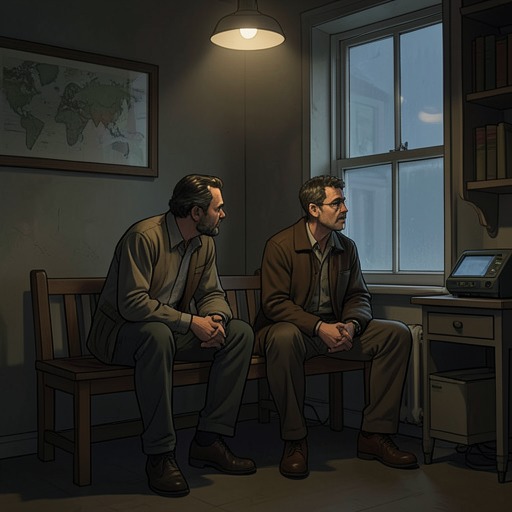
The exchange is not a clean farewell between two equally able companions. Sal is doubled over with abdominal cramps, groaning and clutching his belly, while Dean stands above the bed with his old broken trunk. Sal no longer knows who Dean is; Dean recognizes that estrangement and responds with sympathy, pulling the blanket over Sal's shoulders. His tenderness does not reverse the departure. He says goodbye to the feverish Sal and leaves, making care and abandonment coexist in the same bedside scene.
Delayed Recognition and Conflicted Judgment
Sal does not immediately understand that Dean has gone. Twelve hours pass before, still sunk in sorrowful fever, he finally comprehends the departure. By then Dean is driving alone at night through the banana mountains. The physical distance has already opened before Sal can register its emotional meaning; the fever makes the loss not only painful but belated.
When Sal recovers, his judgment first hardens: he realizes what a rat Dean was to leave him there sick. Yet that verdict does not hold by itself. Sal also tries to understand the impossible complexity of Dean's life and the pressure of getting back to his wives and woes. His illness thus frames a change in interpretation rather than a simple reconciliation: he names the harm, then makes room for the circumstances behind it, without claiming that those circumstances undo the harm. His closing decision to say nothing to the old Dean leaves the injury present but unpursued.
Narrative Significance
The episode places bodily dependence against Dean's restless mobility. Sal is confined to a bed and cannot follow or even fully recognize the person leaving; Dean, with the broken trunk beside him, is already turning toward another marriage and another drive. The contrast gives the departure its particular force: this is not an abstract breach of loyalty but a choice made while Sal is acutely ill and reliant on Stan's care.
The fever also controls when the scene can be understood. Sal's expansive, many-lived visions give way to confusion at the bedside, and understanding arrives only after Dean has crossed the mountains alone. By making recognition lag behind action, the narrative preserves two truths at once: Dean's departure wounds Sal, and Dean's life is governed by tangled attachments and obligations. Sal's recovery does not resolve their relationship; it leaves him with a more complex account of why he was left, and with the decision not to speak.