San Francisco
On the RoadSan Francisco is a destination, refuge, and recurrent point of departure in the novel. Its jazz rooms make the elusive “IT” of improvisation audible, while its streets and domestic spaces reveal the cost of Dean Moriarty’s ceaseless motion. Sal Paradise arrives eager to encounter the city, but Dean’s momentum repeatedly turns a stay into a hurried passage elsewhere.
A destination imagined from the road
In 1947, Sal sets out west with about fifty dollars saved from veteran benefits and a plan to reach San Francisco. The route begins not with a direct westward drive but with a map, a subway ride, trolleys, and a hitchhike toward Bear Mountain, where Route 6 leads him into a storm. His imagined destination is already part of a continental design: he has studied the map for months and pictures Chicago and Denver along the way before the final arrival in San Francisco. The city functions first as a promise at the far end of a mapped journey, not yet as a place he knows.
That westward ambition is bound to practical hopes. Remi Boncoeur has written from San Francisco and proposed that Sal join him on an around-the-world liner, perhaps working in its engine room. Remi also offers the prospect of time to write in a shack in Mill City while they arrange the voyage. Sal leaves his unfinished manuscript at home and travels with a canvas bag and the money in his pocket. The imagined San Francisco thus joins adventure to work, friendship, and the possibility of supporting himself while finishing his book.
The first journey makes the destination seem both vast and uncertain. A truck ride carries Sal across Nebraska toward Colorado; later, during his return east in October, a bus takes him through the Arizona desert, New Mexico, Texas, Oklahoma, and Kansas. He watches the landscape rather than reading the book he has taken from Hollywood, and the cross-country passage becomes a way of apprehending America. San Francisco is one pole in that repeated movement, but the road between destinations supplies the narrative’s experience of distance, fatigue, and anticipation.
Jazz, listening, and “IT”
The city’s musical life gives the road’s abstract promise a concentrated form. During a long, frantic weekend, Dean and Sal go to Birdland to hear George Shearing. They are the first customers when the pianist appears, blind and led to the keyboard. As the bass player establishes the beat and the drummer works with his brushes, Shearing begins to rock, then plays with gathering speed and intensity. The audience calls for him to continue; Dean sweats and exclaims over the performance. When Shearing leaves, Dean points to the empty piano seat and calls it “God’s empty chair.” The performance has ended, but the vacant seat holds the force of what the music briefly made present.
A later night in San Francisco gives that musical ideal a more crowded, street-level setting. Sal and Dean hear a tenorman across the way and rush into a sawdust saloon where musicians play on a small bandstand and listeners crowd around them. The solo rises through repeated calls and variations, while the drummer drives the beat and the crowd urges the horn player onward. Dean clutches his head and sweats in the audience; Galatea Dunkel and Marie stand on chairs, beer in hand, moving with the music. The scene makes listening collective: the performance is sustained by the player, the band, and a crowd that answers each new phrase.
The contrast between the tenorman’s command and an uncomprehending interlude sharpens the scene’s stakes. A visitor sits at the drums and brushes softly while the horn players continue their forceful blues. The big drummer waits, asks what the visitor is doing, and calls for the music to be played. The mismatch is not simply a difference in volume: the scene distinguishes a performance that joins the room’s shared intensity from one that seems detached from it. Jazz in San Francisco is presented as a social practice of attention and response, not just a succession of sounds.
The tenorman’s son then drives Dean, Sal, and the others across the city in a Cadillac, at seventy miles an hour through traffic. Dean marvels at the driver’s stillness and command, linking the way he handles the car to the musician’s ability to sustain an effortless-seeming performance. At Jamson’s Nook, a skinny preacher rushes in, calling for the musicians to play, and the group finds Carlo Marx onstage with his taped alto. Carlo hops and flops as he plays, repeating a simple musical idea and changing it into a fresh variation. Dean recognizes him and cries out his name. The reunion of friends is folded into the musical scene: Carlo’s playing is at once an individual performance and the occasion for recognition and shared delight.
On the drive away, Dean tries to explain what he means by “IT.” A player begins with an idea, develops it through the chorus, and at some point, in Dean’s account, finds the force that carries the music beyond the tune itself. The listeners recognize the change; time seems to stop as the performer fills the space with feeling. Dean cannot finish the explanation without breaking into another story, but the language of performance has given him a way to describe the intensity he seeks on the road. San Francisco’s jazz becomes a model for improvisation: an attempt to seize the moment, carry it forward, and make a temporary community around it.
A hurried home and a city left behind
The jazz nights do not give Sal the time to settle into the city. After a stay of just over sixty hours, he says goodbye, gathers his bags, and takes a route taxi along Mission Street. The city appears in a dense rush of construction, children playing, workers coming home, dust, and movement beneath a blue sky; the sea’s fog is expected to roll in at night. Sal hates leaving, but he recognizes that Dean’s frantic pace has kept him from seeing the place. By afternoon they are moving toward Sacramento and eastward again. The brief visit sets the city’s palpable life against the haste that prevents sustained contact with it.
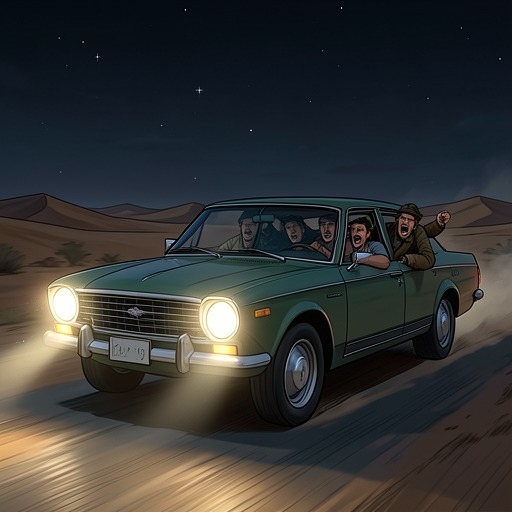
That westward return is again an improvised ride. The car belongs to a careful driver heading home to Kansas, but Dean dismisses it as an effeminate Plymouth, and its lack of power makes it an awkward vehicle for the journey. Sitting in the back, Sal and Dean talk about the previous night’s alto player and Dean’s idea of “IT.” The limited car and the long road provide the setting for Dean’s expansive theory of music: a makeshift journey becomes another occasion to turn lived experience into a language of motion and performance.
The novel’s later movements place San Francisco in a still more unsettled pattern. After leaving Sal ill in Mexico City, Dean drives north, sees Victor in Gregoria, and pushes the failing car as far as Lake Charles before its rear end gives way. He wires Inez for airplane fare, reaches New York with divorce papers, marries her, and then leaves almost immediately for San Francisco to rejoin Camille and their two daughters. The city is once more the place toward which Dean rushes after another upheaval, but the account offers no settled arrival scene: movement, rather than domestic resolution, defines his return.
Domestic plans and repeated departures
For Sal, San Francisco eventually enters a plan for a shared future. After returning to New York from Mexico City, he meets a woman whose eyes seem to embody what he has long sought, and they agree to love each other. They plan to move west in winter, taking their furniture and belongings in a panel truck. Sal writes to Dean, who replies with a huge letter about his youth in Denver and promises to come select the truck and drive them home. The proposed move imagines San Francisco as a home to be made together, furnished from the remains of their current life.
Dean arrives five and a half weeks before the planned departure, when Sal and his partner still lack the money for the truck. The visit unsettles the plan without completing it. Dean appears unable to speak fluently; he gestures, listens to the night, and says he has come and is gone. His presence turns a practical scheme for relocation into another encounter with his restless, fragmentary way of being in the world.
During Dean’s three days in New York, he says he wants Inez to come back to San Francisco and live on the other side of town, though he cannot explain why he came. His marital arrangements remain divided: Inez throws him out after their confrontation, while a letter from Camille expresses concern for him and welcomes Sal and his companion to live on the same street. San Francisco is therefore both the destination of Dean’s return to Camille and the imagined neighborhood where Sal might join them. These plans briefly align the characters around a place, but they do not erase the separations and reversals that have brought them there.
The city as refuge and threshold
Across the novel, San Francisco’s significance lies in the tension between its capacity to gather people and the roads that draw them away. The clubs make a night of music into a shared event: players improvise, listeners respond, and friends recognize one another amid the sound. The city also offers the possibility of a household, whether through Dean’s return to Camille and his daughters or Sal’s intended move with his partner. Yet the visits are brief, the vehicles unreliable, and the plans repeatedly overtaken by departures.
That tension keeps San Francisco from becoming a final destination. It is imagined from the East, reached through improvised travel, experienced intensely and briefly, and revisited as a possible home after marriages and journeys have fractured. The music offers a momentary form of belonging through attention and response; the road offers continual movement without guaranteeing arrival. In this pattern, the city stands not outside the novel’s restlessness but at its center: a place where the desire for community becomes vivid, even as the characters continue to leave.