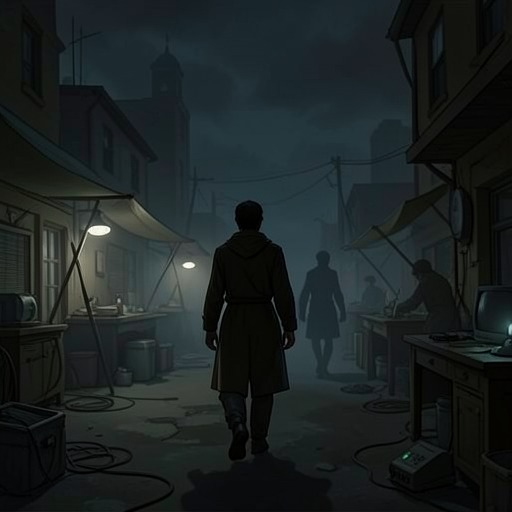
The Shrouded Traveler
On the RoadThe Shrouded Traveler is the pursuing figure in Sal Paradise’s desert dream, an image he and Carlo Marx ponder as a possible spirit following everyone through life. Sal eventually identifies the pursuer as death: an inescapable presence that catches the living before they reach heaven. The image links a forgotten decision, a lost sense of bliss, and the fear of mortality without resolving the longing that gives it force.
The Dream and Its Pursuer
Sal recalls sitting knee to knee with Carlo, facing one another as he tells him of a strange Arabian figure pursuing him across a desert. Sal tries to evade it, but it overtakes him just before he reaches the Protective City. Carlo asks who the figure is. Sal first proposes that it is himself wearing a shroud, then rejects that explanation; the dream leaves open the possibility that the pursuer is something beyond the dreamer.
The image expands from an individual nightmare into a shared human predicament. Sal suggests that some spirit pursues all of them across the desert of life and is bound to catch them before they reach heaven. The desert journey makes the dream’s central relation stark: movement toward safety continues, but the pursuer cannot be left behind.
Sal’s Interpretation of Death
Looking back, Sal concludes that the pursuer is simply death. Its force lies in the timing: death overtakes people before heaven, making the promised destination inaccessible within life. The dream does not depict a death occurring; it gives form to the certainty that life ends before its deepest hope can be secured.
Sal connects that hope to a lost bliss, perhaps experienced in the womb, which he says can only be reproduced in death. The claim makes the figure both terrifying and entangled with desire: death is the pursuer to be escaped, yet it is also associated with a primordial bliss that living people yearn for, even while resisting the admission.
The Forgotten Decision and the Figure’s Return
Around the time of the New York party, Sal is haunted by the feeling that he has forgotten a decision he was about to make before Dean Moriarty arrived. He cannot tell whether it was an actual decision or merely a thought, and his repeated attempts to recall it leave him sad and bewildered. The Shrouded Traveler returns to his mind as part of this unsettled awareness, not as a newly encountered supernatural being but as an image through which he tries to understand what has slipped from reach.
Sal tells Dean about the dream’s meaning. Dean recognizes it as a simple longing for pure death and wants nothing to do with that longing; Sal agrees with him then. This response does not erase Sal’s later interpretation or the image’s emotional pressure. Instead, the episode sets the idea of death beside the characters’ drive toward life and motion, leaving the dream’s pursuit as a countercurrent to their onward rush.
Narrative Significance
The figure’s identity moves from uncertainty to a natural, human explanation: what first appears as a mysterious spirit becomes death, the universal limit of life. That explanation settles who the pursuer represents without making the dream’s emotional meaning simple. Death remains at once the end that prevents arrival and the imagined return to a lost bliss.
The image also gives narrative shape to Sal’s uncertainty about the forgotten decision. He cannot recover its content, and the dream does not supply it; instead, the two unresolved matters gather around the same sense of something approaching and beyond his control. The Shrouded Traveler therefore functions less as a plot revelation than as a recurring interpretive image for mortality, frustrated arrival, and the pull between living forward and longing for an impossible return.