The road
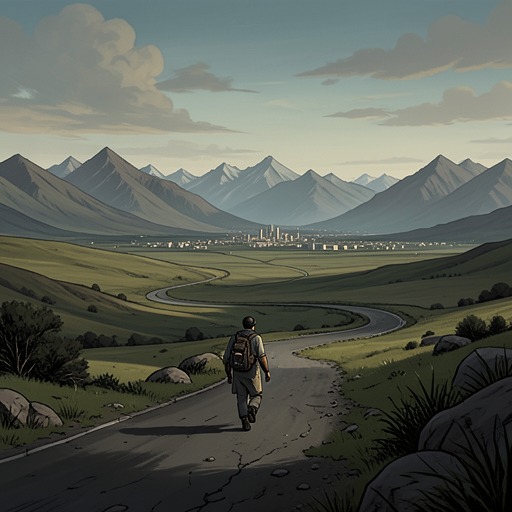
On the RoadThe road is the physical route and the imaginative principle that shape Sal Paradise’s life: it turns a desire to escape stagnation into repeated journeys across the continent, while exposing the distance between movement’s promise of freedom and its costs in fatigue, danger, dependence, and loss. Its meaning changes as Sal travels with Dean Moriarty—from a western horizon glimpsed on a map to a restless practice of setting out, and finally to a vast landscape in which departure cannot prevent loneliness or aging.
Origins and the Call West
Before Sal begins traveling, the West exists as a deferred intention. He has often dreamed of seeing the country but has planned vaguely rather than left. Dean’s arrival changes that abstraction into an invitation: Sal’s life on the road begins with their meeting, which follows Sal’s illness and the breakdown of his marriage. The road thus opens against a sense that ordinary life has gone dead, and Dean’s arrival gives movement the force of a new beginning.
Dean’s own history seems to embody mobility. He was born in 1926 in a jalopy passing through Salt Lake City, while his parents were on their way to Los Angeles. Before Sal meets him, letters from a New Mexico reform school have already made him an object of curiosity: they ask Chad King to teach him Nietzsche and other intellectual subjects. When Dean finally comes to New York with Marylou, his arrival by Greyhound makes the road a biographical fact as well as Sal’s emerging ambition. The cafeteria at Hector’s, where the couple buys cakes and cream puffs after getting off the bus, becomes a lasting New York emblem for Dean—a small fixed point created by a journey.
Sal’s decision to leave is more deliberate but no less charged with expectation. In July 1947 he has saved about fifty dollars from veteran benefits, leaves a half-finished manuscript on his desk, packs a canvas bag, and sets out for the Pacific. He has spent months studying maps and reading about pioneers; the red line of Route 6, running from Cape Cod to Ely, Nevada, and then down toward Los Angeles, gives his longing a route he can follow. To reach it he travels north through Yonkers toward Bear Mountain, even though the direction initially feels like the opposite of the West he wants. When rain leaves him stranded in the wilderness, his confidence collapses into crying, swearing, and self-reproach. The road’s first lesson is that a chosen direction does not mean control over the journey.
Rides, Routes, and Roadside Dependencies
Travel proceeds less by mastery of a vehicle than by dependence on other people and whatever transport becomes available. Sal hitchhikes, waits at crossroads and ticket offices, and accepts rides from strangers; a long-distance trip is assembled from brief, contingent passages rather than a single planned drive. The landscapes that had lived in his books arrive piecemeal: after a bus reaches Omaha, the first cowboy he sees walks beside meat warehouses, and a rancher compares the Platte Valley with the Nile. The mismatch between imagined pioneer country and ordinary towns does not erase the romance of the map, but continually tests it against what is actually there.
The road also creates temporary fellowship. In Iowa Sal stays with Eddie, pays his bus fare, and accepts him as company partly because his smile recalls an old friend. On another westbound passage, Montana Slim and Mississippi Gene travel with a blond young fugitive whom Gene has taken under his care. Gene explains that the boy got into trouble and had never been on his own; on the dark plains he leans over from his trance to speak tenderly to him. Sal shares his cigarettes with the pair, moved by their gratitude and by their exposed dependence on one another. The road’s openness is therefore not simple solitude: it repeatedly gathers strangers into short-lived obligations of shelter, money, food, and attention.
Its physical conditions can be as forceful as its social ones. Riding with high-school boys in a truck across Nebraska, Sal watches the road turn humpy in the middle, with soft shoulders and deep ditches. The truck bounces and teeters from side to side; its drivers’ skill keeps the ride from becoming a rollover. When the truck reaches the edge of Colorado, Sal’s joy at finally seeing the country he has been pursuing becomes almost bodily: he feels like an arrow able to shoot outward. Yet the trip depends on other people’s driving, on precarious roads, and on a vehicle whose safety is never guaranteed.
Sal’s return journeys make the eastern road a counterpoint to the myth of the West. In October, after leaving Hollywood, he rides a bus through Arizona, New Mexico, Texas, Oklahoma, and Kansas, reading the landscape more intently than the book he has stolen from a Hollywood stall. He has made ten sandwiches with his last dollar; later, with only a dime left and hundreds of miles still to reach New York, he walks out of Pittsburgh and takes rides east. In Harrisburg he sleeps on a station bench, is thrown out at dawn, and, starving, sucks the sugar from old cough drops. The eastern wilderness he encounters is not the immense desert he once associated with the West but a network of backroads and dark roads winding among the Susquehanna, Monongahela, Potomac, and Monocacy. The road’s hardship is not confined to the frontier: it follows him home.
Dean’s Motion and the Road’s Momentum
Dean makes movement feel less like a route to a destination than an urgent vocation. After Sal has spent Christmas quietly with relatives, the “bug” is on him again, and he leaves on another drive with Dean. The specific contrast matters: the tree, presents, and roasting turkey represent a settled domestic interval, while Dean’s return immediately converts rest into departure. The road is not merely where the friends go; it is the recurring force that interrupts a life trying to stay still.
On the drive east to collect furniture, motion is paired with mechanical risk. Dean loads the back of the Hudson and promises a thousand miles north and south in thirty hours. Its heater fails, the windshield fogs and ices, and Dean reaches out at seventy miles per hour to wipe a hole through which he can see. The new car is already broken, with only one installment paid. Later he drives with one hand—or at moments with no hands on the wheel—while talking and gesturing, keeping the car aligned with the white line beside the left front tire. The car makes speed possible, but it also makes the body’s exposure unmistakable: the passenger’s faith rests on Dean’s nerve, the road surface, and a narrow strip of visibility.
A subsequent westbound journey turns the road into a collective release from quarrels and confusion. In drizzle, Dean hunches over the wheel and accelerates; the group understands that they are leaving their disputes behind by moving. The route signs in New Jersey point south and west, and they choose south toward New Orleans before continuing west to visit Old Bull Lee. In the car, Dean urges the travelers to forgive their New York arguments and to recognize that they are not truly worried about anything. The white line unrolls beside the tire, seeming to hold the group in a shared groove. Yet the same drive contains a fracture in their hopes: Dean tells Marylou that she should live with him in San Francisco while he continues living with Camille, and Sal realizes that the earlier expectation that Marylou might pair with him is vanishing. The road can make a group feel briefly whole without resolving the unequal desires within it.
Motion is both exhilarating and dangerous in the long drive from Denver to Chicago. The party covers 1,180 miles in seventeen hours of driving time, averaging seventy miles per hour with one driver, despite time lost in a ditch and at a ranch and police station. In Illinois, Dean drives through an almost impossible encounter on a narrow bridge, narrowly missing a truck and several cars; the near-crash turns speed from a record into a threat that Sal cannot forget. When they reach Chicago, they release two hobos who have contributed money for gas, and the Cadillac carries them onward from roadside ties into the city. That shared ride shows how the road rearranges social positions for a moment: men who were sitting beside railroad tracks become passengers in a limousine hurtling toward Chicago.
The Border, the Destination, and the End of the Drive
Crossing into Mexico gives the road its most explicit promise of entering an unknown world. After the group passes through Laredo, the travelers leave the car parked and walk into a Mexican town. The cheap beer and cigarettes, the diners and the music, make the familiar American measure of money feel newly unstable. Dean imagines the Sierra Madre, jungles, and a vast plateau ahead; Sal sees the border crossing as a departure from everything they have known about life on the road. At dawn, the three travelers are out in the desert, but Dean and Sal alone are awake to the yucca and organ-pipe cactus: Stan, who has been abroad before, sleeps in the back seat. The journey’s newness is shared unevenly, even within the same car.
The route then climbs from desert toward the mountains. On the road to Monterrey, the travelers pass from mesquite country into cooler air, follow a pass along a precipice, and reach a plateau above the industrial city. Dean wants to press on rather than stop, convinced that the road will become more interesting farther ahead; he drives without resting while Sal and Stan are exhausted enough to sleep. The upward movement through sharply changing terrain sustains the sense that another revelation lies just beyond the present view. At the same time, Dean’s insistence on going on turns possibility into pressure: the destination keeps receding because motion itself has become the demand.
The party finally reaches Mexico City after a journey of 1,900 miles from the outskirts of Denver. Vast fields, immense groves of trees, old missions, and the late sunlight mark the approach, but the narrator calls the city the end of the road. Arrival is real, yet it cannot settle the longing that drove the journey. Even the travelers’ decision to wear their insect-marked T-shirts into town rather than change them carries the improvised spirit of the trip into its supposed conclusion: reaching the destination does not transform them into people who have outgrown the road.
Separation, Return, and the Road as Memory
The road’s promise of companionship is repeatedly shadowed by departures. When Sal and Dean leave the gathering around Old Bull Lee, Dean’s disagreement with Bull over money adds to the estrangement Dean has been creating with people. The figures recede across the plain until they are only specks, and the immense world seems to vault over those left behind. The travelers lean toward the next venture, but the image holds both movements at once: forward momentum and the people becoming smaller in the rearward distance.
In San Francisco, Sal offers Dean a new journey when Dean is ill, confused, and unable to decide what to do after Camille has thrown him out. Dean suggests walking to New York and taking stock of everything along the way. Sal counts his eighty-three dollars and change and proposes that they go east together, then continue to Italy. Dean’s eyes light up at the prospect. Outside Camille’s house, the friends see a Greek wedding party assembled on the sunny pavement; then they pick up their bags, take the cable car downhill, and agree to remain buddies for life. The plan is not simply a return to an old route. They promise to do what they had failed to do before, including finding Dean’s father, and agree to travel by share-the-gas cars to save money. Even this fresh departure begins with an accounting of limited resources and with an unresolved search for home.
The final image of the road is not another shared ride but Sal’s view across New Jersey after Dean has walked away. Sal is with Laura, and Dean cannot travel uptown with them in the Cadillac; the driver wants nothing to do with him. Ragged in a moth-eaten overcoat, Dean rounds a corner and walks on alone. Sal imagines him taking a train more than three thousand miles back across the country, never fully knowing why he had come except to see Sal. The movement that once joined the friends now carries Dean away from him, while Sal remains behind to think of the man and the father they never found.
From the river pier, Sal looks across the long skies and the land rolling toward the West Coast, imagining the people who dream within its immensity. The ending preserves the road as a space of possibility, but places that possibility beside aging, uncertainty, and separation: no one knows what will happen to anyone. The route cannot promise a permanent home or a lasting reunion. What endures is the act of remembering Dean and the immense geography that made their friendship possible, then made its distance visible.