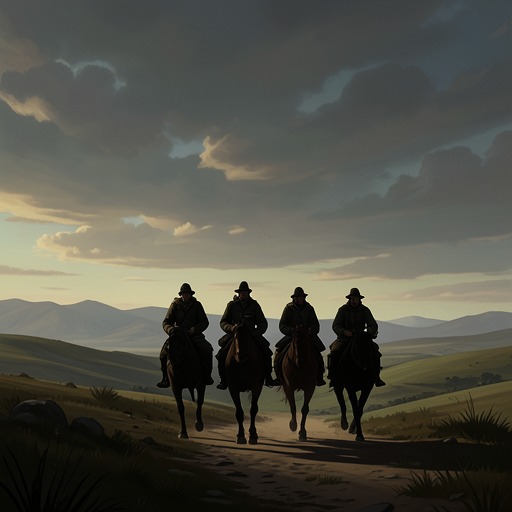
The road is life
On the Road“The road is life” names the principle that gives Sal Paradise’s journeys their force: motion is not simply a means of reaching somewhere else but the condition in which experience unfolds. The phrase gathers together the exhilaration of setting out, the improvisations that keep a trip moving, and the danger and fatigue that accompany it. Its power lies in that doubleness: the road feels like freedom, but it is also a material route shaped by weather, money, vehicles, passengers, and risk.
A Route Chosen Before It Is Traveled
In July 1947, Sal leaves with about fifty dollars saved from veteran benefits, a canvas bag, and an unfinished manuscript left on his desk. He has been studying maps in Paterson and chooses Route 6, a red line running from Cape Cod toward Ely, Nevada, before dipping down to Los Angeles. The map turns the continent into a prospect of possible movement; the lived road immediately complicates that confident design. To reach Route 6, Sal travels north toward Bear Mountain, where torrential rain, empty roads, and the wilderness leave him stranded and frustrated on the very day he hoped to begin heading west.
The distance between map and journey persists even when the trip gathers momentum. Crossing Nebraska in a bouncing truck, Sal realizes he is at last over Colorado and shouts for joy; the plains open toward Denver, and the truck’s speed makes him feel as if he could shoot forward across the land. The road’s promise is therefore experienced through particular vehicles and changing conditions, not as effortless passage. A road can be a line on a map, a rough surface under a truck, or a direction that only gradually becomes real.
Movement as a Recurrent Pattern
The journeys repeatedly turn departure into a temporary condition rather than a clean break. After spending a quiet Christmas in the country, Sal sees the tree, presents, and family gathering, but the road’s pull returns when Dean Moriarty arrives. Sal joins Dean and Marylou on a furniture run in a new Hudson, setting out at dark with a promise to return in thirty hours. The heater fails, the windshield fogs and ices over, and Dean reaches out while driving seventy miles an hour to wipe a hole through which he can see. The car’s straight course along the center line becomes an image of forward motion sustained amid discomfort and precariousness.
A later west-to-east bus journey makes the road’s return movement explicit. Leaving Hollywood with only a dollar, Sal spends his last hours making ten sandwiches behind a parking lot before setting out across the country. At dawn the bus crosses Arizona; it continues through New Mexico, Texas, Oklahoma, and Kansas, then reaches St. Louis and the Mississippi River. The trip is not a simple reversal of his earlier westward departure: the landscape, the exhausted traveler, and the dwindling food give the return its own weight. Sal’s declaration that he is going home in October places home at the far end of another long passage, not outside the road’s reach.
Speed, Risk, and the Work of Getting There
The road’s apparent openness depends on practical exchanges and dangers. On the journey from Denver to Chicago, Dean drives a battered Cadillac through Iowa and Illinois, carrying Sal and other passengers. After police in Newton check the car’s ownership and their status as hired drivers, they continue east. On a narrow bridge in Illinois, Dean threads the Cadillac between slow cars and an approaching truck, narrowly avoiding a collision. The passage’s speed and exhilaration are inseparable from the possibility of a fatal mistake.
The journey also has a measurable, almost boastful scale. From Denver to Chicago by way of Ed Wall’s ranch, the party covers 1,180 miles in seventeen hours of driving, excluding time spent in a ditch, at the ranch, and with police. That figure makes the road’s velocity concrete while exposing what a bare record leaves out: stops, setbacks, and the burden of sustaining such speed. Even the arrival in Chicago does not end the journey’s movement; the travelers stash the Cadillac in a dark alley, ready to leave again.
The Road’s Open Ending
In Denver, after a difficult drive through the mountains, Sal and Dean are let out with their battered suitcases at the corner of Ayth and Federal. They still have farther to go. Sal’s assertion that the road is life follows this unfinished arrival: the saying does not promise that travel will resolve their circumstances or deliver them to a permanent home. It makes continued passage itself the point.
The phrase reaches a different threshold on the journey into Mexico. After crossing the Rio Grande, Sal and Dean drive into desert darkness, with fifty miles of flats ahead and dawn beginning over the Gulf of Mexico. The desert’s emptiness makes the border crossing feel like entry into an unknown phase, but the road continues onward through the mountains toward Monterrey. Across these episodes, travel keeps changing its form—from hitchhiking and buses to trucks and cars—while its central tension remains: the promise of going anywhere is inseparable from the need to find a ride, endure the route, and keep moving without certainty about where movement will lead.