Virginia
On the RoadVirginia serves as both a family refuge and a launch point for renewed travel. At Christmas 1948, Sal is visiting his brother in Testament when Dean arrives from San Francisco; the reunion quickly turns into a furniture run north and back, making Virginia the place where settled domestic life gives way again to the road.
Setting and First Journey
Virginia enters Sal’s westward story as part of the imagined route rather than its destination. Studying a road map in Paterson, he plans to follow Route 6 west toward Ely and Los Angeles, with Bear Mountain and the Hudson crossing as his first obstacles. The route belongs to a larger map of anticipated cities and open country, but the narrative also establishes that leaving home means confronting weather, uncertainty, and the practical difficulty of finding a ride.
Christmas Reunion in Testament
More than a year after their previous meeting, Sal spends Christmas 1948 with his aunt at his brother’s home in Testament, Virginia. He has been writing to Dean and has told him that he will be there between Christmas and New Year’s. Dean appears at the house in a mud-spattered 1949 Hudson, having driven from San Francisco in a remarkably short time. Marylou and Ed Dunkel are asleep in the car, and the exhausted travelers need a place to wash and rest.
The arrival breaks the quiet rhythm of the family gathering. Sal sees the Christmas tree, presents, and preparations for dinner, but recognizes that Dean’s presence has restarted his appetite for travel. The house offers temporary shelter and family company; it does not keep Sal from joining the next journey.
The Furniture Run North and South
At dark, the group loads Sal’s brother’s furniture into the Hudson and sets out, promising to return within thirty hours after covering roughly a thousand miles. The car’s heater does not work, and its windshield fogs and ices over. Dean wipes a small opening in the glass while driving at speed, while the four travelers sit crowded together beneath a blanket. The radio is broken, and the nearly new car has only one installment paid, details that make the trip’s strain and precariousness tangible.
The party drives north toward Washington on Route 301, then continues to New York to see Carlo, intending to meet him again in time for New Year’s Eve. After leaving Carlo in Times Square, Sal and Dean take turns driving south and reach Virginia in ten hours. The return trip becomes an extended conversation: Dean speaks excitedly about his changing beliefs and his work as a brakeman, while the road carries the group back to the household they had briefly left.
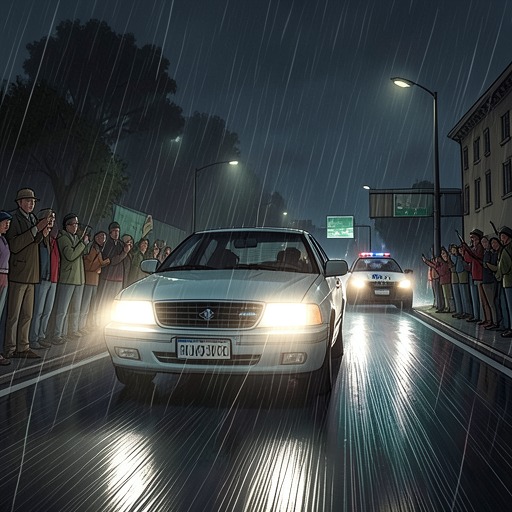
The return north with the furniture brings another interruption. Near Washington, police stop the car and threaten to jail Dean over a speeding ticket unless the group can pay. Sal’s aunt supplies the fifteen dollars required, drawing on the twenty dollars she has with her. Virginia is therefore not an insulated home base: the journeys out and back expose the travelers to mechanical trouble, dangerous driving, and encounters with law enforcement, and family resources help them continue.
Virginia in the Larger Road Narrative
The state’s importance lies in its repeated position between domestic attachment and restless movement. Sal’s brother’s house gathers relatives for Christmas, while Dean’s arrival converts that scene into a starting point for another drive. The furniture trip makes the contrast especially clear: a household’s possessions are carried through the night in a car that is itself unreliable, and the travelers measure the journey by hours and miles rather than by the ordinary pace of family life.
Virginia also sits within a national geography that the novel repeatedly turns into memory and myth. The party crosses the Mississippi and Illinois on a later return east, while Sal’s account of eastern wilderness recalls the Susquehanna, Potomac, and other rivers as part of an older landscape of back roads and settlement. In this pattern, Virginia is neither simply home nor merely a stop on a route. It is a temporary point of reunion whose shelter makes departure possible, and whose return journey never quite restores the stillness from which the travelers set out.