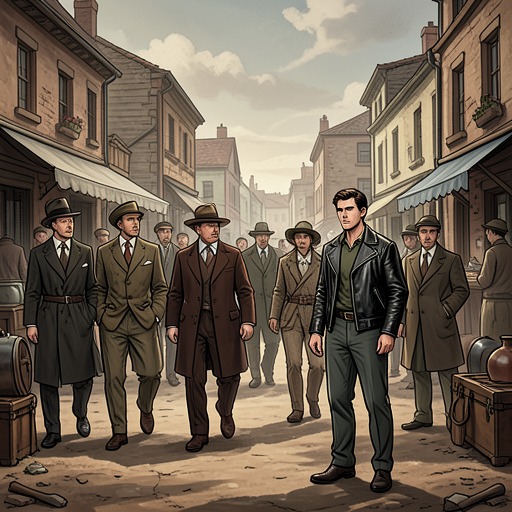
1960s countercultural Western style
Once Upon a Time in HollywoodThe 1960s countercultural Western style marks a break from the reassuring conventions of older television Westerns: its heroes may be morally uncertain, its villains sadistic, its clothes conspicuously modern, and its violence difficult to mistake for a clean theatrical gesture. In the novel, this change becomes both a history of the genre and a practical problem on the set of Lancer. Director Sam Wanamaker uses the series pilot to bring the look and attitude of newer Westerns into a Sunday-night television drama, while Rick Dalton’s transformation into Caleb DeCoteau makes that shift visible in a costume and in a changed reflection.
From television convention to a new Western
The pilot’s premise has recognizable ingredients: a ranch, estranged family members, a threatened empire, and a dangerous antagonist. Rick Dalton sees echoes of Bonanza and The High Chaparral, but considers Lancer darker, more violent, and more cynical. The difference is not that the older Western framework disappears; rather, familiar western-TV roles are made less reassuring. Murdock Lancer is not a stern but compassionate patriarch. Scott Lancer retains the likable good-guy quality associated with the genre, but his Eastern-dandy wardrobe sets him apart. Johnny Lancer, meanwhile, has the shadowy, alluring qualities usually assigned to a guest character whose past or intentions remain suspect.
That change in character function is central to the new style. A familiar television episode might introduce a young, cocky stranger at a ranch, gradually disclose his secret, and finally have the established hero redeem or kill him. Lancer instead makes Johnny Lancer, played by Jim Stacy, the lead. Rick recognizes how unusual it is for a character who looks like a dubious guest star to carry the series. The shift is more than a fresh wardrobe: it changes which kind of man can occupy the center of a Western and what uncertainty the audience must live with.
The look: history remade for the present
Wanamaker wants the costumes to escape the familiar outfits of Bonanza and The Big Valley without looking anachronistic. His challenge to costume designer Rebekkah is to find a meeting point between the story’s 1889 setting and the contemporary cultural moment of 1969. Her solution for Rick’s character is a Custer jacket with fringe down the sleeves, dyed from tan to dark brown. The proposed costume is period-based yet striking enough to look at home on the contemporary Strip or in the London Fog nightclub.
On the set, Rick’s first response to the completed look is uneasy: in the makeup-trailer mirror, surrounded by the crew, he wonders whether anyone will recognize him. Walking through the Western back lot, however, he becomes absorbed in the jacket’s movement. The fringe emphasizes his gestures, while the boots and hat help establish Caleb as a figure distinct from Rick’s established screen image. He likes the effect more as he sees it in the saloon-window reflection, and begins to understand that not looking like himself may be useful. The costume does not simply decorate a character; it lets Rick test whether a television actor formed by an older Western persona can be legible in a different one.
That recognition connects the clothes to the changing market and style of Westerns. Marvin Schwarz has described Rick as an Eisenhower actor in a Dennis Hopper Hollywood. Looking at himself without his familiar pompadour, in shaggy-haired, fringed-jacket guise, Rick sees how the old hairstyle has come to stand for his identity. The reflection suggests a contemporary actor rather than an aging cowboy from the 1950s; Rick even imagines that this version could belong in a Sam Peckinpah film. The visual change thus becomes a small, concrete encounter with a career problem: adapting to a new Hollywood may require relinquishing the look that once made him recognizable.
Antiheroes, stars, and violence
The broader Western landscape described around the pilot explains why this reinvention matters. Italian spaghetti Westerns have introduced a grittier style, while American Westerns in 1969 increasingly feature younger stars, more distinctive clothing, and antiheroes. The influence of Clint Eastwood’s sex appeal in Sergio Leone’s Westerns accompanies a loosening of the old division between familiar heroic stars and established villains. Actors such as Lee Marvin, Charles Bronson, Lee Van Cleef, and James Coburn, once associated with villainous roles, can become heroes and movie stars; older performers can also subvert the images attached to their careers. The Western’s screen identity is no longer secured by a simple opposition between respectable hero and disposable heavy.
The villains grow correspondingly more extreme. The account contrasts these new films with older screen deaths in which a character clutches his stomach, groans, and falls. In films such as Little Big Man and Soldier Blue, violence is graphic, and the films invite parallels with contemporary political conflicts, including the Vietnam War. Tell Them Willie Boy Is Here gives its fugitive Indigenous character an association with the Black Panther movement. In Sam Peckinpah’s hands, violence becomes an especially stylized spectacle, slowed to 120 frames per second and transformed into what the narration describes as visual poetry. These comparisons show the countercultural Western carrying political resonance through its subjects and methods, not just through a fashionable silhouette.
Wanamaker cannot reproduce that degree of violence in a CBS series airing at 7:30 on Sunday night. He can, however, pursue the newer Western’s atmosphere through two available choices: costume and character. Johnny Lancer supplies the second. The network rejects the idea of giving Stacy a moustache, despite the actor’s and director’s interest in making Johnny more distinctive and further from television’s familiar paired leads. Its compromise is that the moustache belongs on the heavy. Even the restriction becomes part of the negotiation: the production pushes against genre expectations, but the network’s rules determine where the visual rebellion can appear.
Lancer as a vehicle for the shift
The choice to cast Rick Dalton as Caleb makes the pilot’s genre experiment legible to an audience already familiar with Western television. Wanamaker considers another actor, Joe Don Baker, but likes the idea of using a known television cowboy as the villain opposite Jim Stacy’s hero. Johnny’s eventual victory over Caleb can then play as a reversal of screen associations: the audience sees the new lead triumph over a recognizable figure from the older television Western world. Rick’s costume supports the same strategy. The brown fringed jacket marks Caleb as part of a changed visual idiom, while the casting makes his defeat carry meaning beyond the immediate conflict.
The pilot also refuses to make Caleb an interchangeable heavy. Rick recognizes that the character has strong dialogue and a distinctive place in the story. The narrative identifies a further complication: Johnny Madrid and Caleb DeCoteau were friends. That disclosed connection unsettles the straightforward opposition suggested by their roles as hero and murderous gang leader. Within the series, countercultural style therefore extends beyond clothes or brutality; it can alter the moral and relational structure of the Western, making its central figures harder to sort into the genre’s customary boxes. The result is not a complete escape from television convention but a deliberate remaking of it, using costume, casting, character, and violence to make the old form feel newly uncertain.