Antihero
Once Upon a Time in HollywoodAntihero describes the morally ambiguous Western protagonist who unsettles the genre’s familiar division between a righteous hero and a plainly wicked opponent. In the book’s account of Lancer, the idea becomes more than a character trait: it marks a shift in television Westerns, as the shady stranger once reserved for a guest role becomes the series lead. Johnny Lancer, also known as Johnny Madrid, embodies that change, while Rick Dalton’s casting as Caleb DeCoteau turns the old television cowboy’s screen identity into part of the experiment.
From guest outlaw to series lead
Rick Dalton reads Johnny Lancer through a familiar television pattern. In series such as Bonanza, The Big Valley, and The Virginian, a young, cocky, attractive stranger would arrive at an established ranch carrying some kind of dark secret. He might be running from a person, an action, or his former self; he might have come for revenge, a robbery, or an encounter with someone from his past. The audience could recognize the danger around him before learning whether he was a bad man or a misunderstood one. That uncertainty ordinarily belonged to a guest character, whose story would reach a decision in the third act: a familiar hero such as Michael Landon, Lee Majors, or Doug McClure would either help him redeem himself or shoot him dead.
The type’s ambiguity was part of its appeal, and actors who specialized in such roles—including Charles Bronson, James Coburn, Darren McGavin, Vic Morrow, Robert Culp, Brian Keith, and David Carradine—often went on to become stars. Lancer makes a consequential change to that pattern. Johnny is written with the shadowy promise of a guest star, but he is not a visitor whose moral status will be settled before the episode ends. He is the lead of the series. Rick considers him unlike the other cowboys on the major television networks: a character usually positioned at the edge of another hero’s story now occupies its center.
Johnny Lancer and the unsettled hero
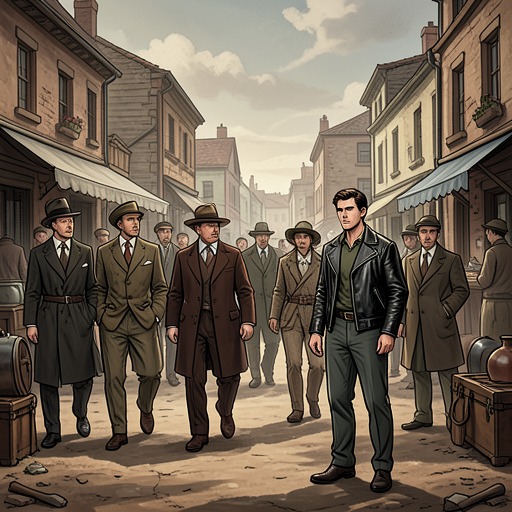
Johnny’s entrance in Royo del Oro carries the conventional signs of a suspicious stranger. He is handsome, roguish, and mysterious—the kind of young man who might ride into an established Western series with a secret and a dangerous purpose. But Lancer does not make him a temporary test of someone else’s goodness. The pilot presents him as one of the show’s central figures, allowing that uncertainty to define the series rather than merely interrupt it.
Rick compares Johnny with Jake Cahill, his own antiheroic Western character, but judges that the pilot script takes Johnny considerably further than Jake had been allowed to go. The comparison makes the change legible through Rick’s professional experience: a familiar television star recognizes that this new lead occupies territory his earlier role could approach but not fully claim. Johnny’s darkness is not simply an episode’s mystery to be cleared away. It is part of the premise of his starring role.
The pilot’s family-and-ranch conflict gives that ambiguity concrete stakes. Murdock Lancer offers to make his two sons equal partners if they help defend the ranch against Caleb DeCoteau and his men; the inheritance is conditional on surviving the fight and taking on the work of running the empire. The promise of a family therefore sits beside the risk of violence and the practical cost of the ranch. Johnny’s secret further complicates the arrangement: he and Caleb were friends. The apparent opposition between the ranch’s defenders and its enemy is thus not a simple moral division, and Johnny’s ties reach across the conflict he has been drawn into.
A changing Western and its performers
The book places Lancer’s antihero within a wider change in Western storytelling. In the 1960s, the Italian Westerns associated with Sergio Leone helped establish a grittier screen style, while the American genre increasingly featured younger stars, more distinctive clothes, and protagonists closer to the antihero than to the old, dependable champion. Older performers from the Eisenhower era also began to disrupt their established images. William Holden led murderous bank robbers in The Wild Bunch; Henry Fonda’s role in Once Upon a Time in the West began with the killing of a child. Meanwhile, performers who had often played Western villains—including Lee Marvin, Charles Bronson, Lee Van Cleef, and James Coburn—could become heroes and movie stars.
That reversal altered the villain as well. In the newer Westerns, antagonists could be sadistic and bloodthirsty, and filmmakers could encourage parallels with contemporary political conflicts. Little Big Man and Soldier Blue invoked the Vietnam War; the fugitive Indigenous character in Tell Them Willie Boy Is Here was described as a de facto Black Panther. Violence, too, was represented differently: deaths could be explosive and bloody rather than a conventional clutch, groan, and fall. Sam Wanamaker could not reproduce the full visual extremity of this cinema in a CBS series broadcast at 7:30 on Sunday evenings. He could, however, pursue its atmosphere through costumes and through Johnny, whom the book identifies as the closest television Western of the period came to an antihero.
Casting, appearance, and the network boundary
The casting of Rick Dalton as Caleb DeCoteau makes the new approach visible in the pilot’s central opposition. Wanamaker considered Joe Don Baker as another possible villain, but preferred the effect of using a well-known television cowboy as the heavy. Dalton had played a Western hero and starred in The Fourteen Fists of McCluskey; placing him opposite Jim Stacy’s Johnny made the conflict a reversal of the audience’s expectations as well as a contest within the story. If Johnny defeats Caleb, he will have beaten that week’s villain and emerged victorious over Jake Cahill, a familiar television icon represented by Dalton. The recasting of a recognizable hero as the antagonist helps announce that Lancer does not intend simply to repeat the settled patterns of Bonanza or The Big Valley.
Appearance becomes another battleground for the same idea. Stacy and Wanamaker wanted Johnny to wear a mustache, both to support the character’s shady quality and to distinguish him from his fair-haired half brother, Scott Lancer. Stacy also believed the mustache would draw attention toward him and push against the convention that paired one dark-haired lead with one light-haired lead. The network refused: if anyone in the series was to wear a mustache, it said, the mustache belonged on the heavy. On the first day of filming, Dalton appeared in a brown rawhide-fringe jacket with the very mustache the network had denied Stacy. The detail neatly exposes the production’s compromise: Lancer could place an antihero at its center, but television’s production rules still tried to confine the most conspicuous sign of outlawishness to the villain.