Bruin Cinema
Once Upon a Time in HollywoodBruin Cinema is the Westwood theater where Sharon Tate comes upon The Wrecking Crew while running errands and then, on impulse, watches her own performance. The cinema gives her two views of the same work: the polished images displayed outside and the comic scene unfolding on its screen. When the audience responds with laughter, a source of private uncertainty becomes a shared, affirming experience.
Setting and Approach
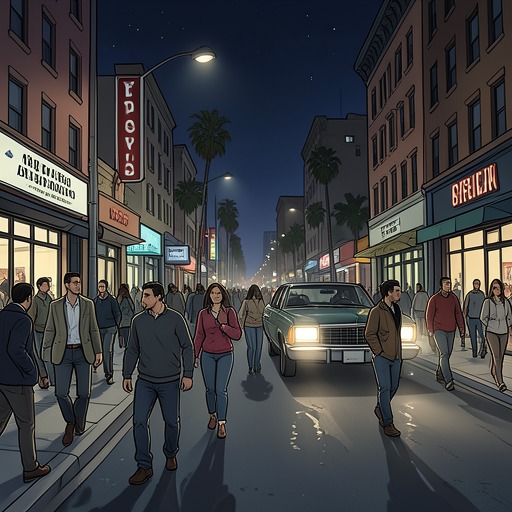
The theater stands amid the Westwood streetscape of head shops, coffeehouses, pizza parlors, and newspaper vending machines offering the Los Angeles Free Press. Sharon first notices that her new Matt Helm adventure comedy is playing there as she walks toward her destination in white patent-leather go-go boots. She takes black bug sunglasses from her purse against the California sun and sees the film advertised at the cinema. The public display makes her screen work an unexpected part of an ordinary afternoon.
After visiting a shop, Sharon walks back toward her car with a rare first edition of Tess of the d’Urbervilles. She starts to pass the cinema and cross the street, but the red traffic light makes her wait. When the signal changes, something catches her attention from behind; she turns and enters the courtyard instead of continuing across. The change of direction brings her from the errands of the street into a close encounter with the film and with her own image in it.
Lobby and Screen
In the courtyard, Sharon studies the lobby-card display. One card shows Dean Martin with Elke Sommer; others show him with Sharon in her baby-blue outfit and cap, or depict her first entrance, lying in a hotel lobby after a pratfall while Dean’s character bends to help her. These still images make the performance legible in fragments before she sees it move: a costume, a fall, and her comic partnership with the star. They also recall the work behind the scene. Sharon had been nervous about playing a klutzy character and about doing slapstick in front of Dean Martin, whose screen career had included years of comedy with Jerry Lewis. She had heard that the director thought her entrance gave the film its real beginning, but now she could only wait to see how the moment landed with an audience.
Sharon asks to enter, and a man gestures toward the open door. She passes through the lobby and into the darkened auditorium, listening to the rotation of the projector and the ticking of the 35mm print moving through its gate. The sound carries personal meaning: her memories of going to movies in Texas had been of entertainment, not of cinema as art. Her life with Roman Polanski has changed that understanding. She now regards film as capable of artistic force, though not every film reaches the level she associates with her husband’s work. That distinction sharpens the contrast she feels in the auditorium: The Wrecking Crew is, to her, a movie rather than a work of comparable artistry, even if audiences enjoy Dean Martin as Matt Helm.
The Matinee and Its Response
When Sharon enters, the film is already showing Matt Helm’s arrival in Denmark. She finds a seat among roughly thirty-five to forty people scattered through the large auditorium and realizes that the hotel scene containing her entrance is next. The delay between entering the room and seeing herself on screen turns the theater into a place of anticipation: she knows the pratfall is coming, but cannot know how it will register beyond the production’s praise.
On screen, Sharon appears as Freya Carlson, runs in carrying champagne, calls for Mr. Helm, and falls backward over his camera case, landing flat on her backside. The matinee audience laughs heartily. Sharon turns to look at the spectators’ smiling faces, delighted by the response; she would have thanked them individually if she could. The laughter answers the question the lobby cards could not: the gag works in the room, with people watching together. She turns back to the screen grinning, unzips her white go-go boots, slips out of them, rests her legs over the chair in front, and settles in to watch the rest of the film.
Narrative Significance
Bruin Cinema makes the boundary between performer and spectator briefly porous. Sharon is not merely the star represented on the marquee and lobby cards; she is also a viewer seated among strangers, waiting to discover whether her comic timing will succeed. The theater’s successive spaces—the street-facing display, courtyard, lobby, and auditorium—draw her from recognition of her image toward direct evidence of the audience’s response.
That response matters because her uncertainty is specific: she wonders whether she is genuinely funny or whether her established image as a bombshell is simply being asked to perform comedy. The laughter does not settle every doubt about the film or her craft, but it gives her an immediate, concrete pleasure that professional reassurance alone could not provide. Bruin Cinema is thus both the venue for a public screening and the setting for Sharon’s private shift from apprehension to enjoyment.