CBS's restriction on facial hair for Lancer's lead
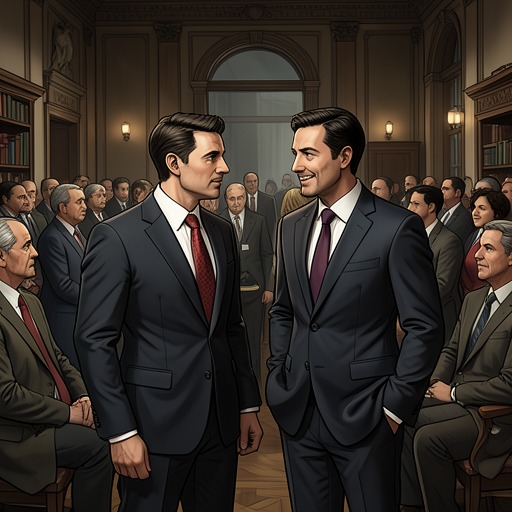
Once Upon a Time in HollywoodColumbia Broadcasting Company's restriction on facial hair for Lancer's lead kept Jim Stacy's Johnny Lancer clean-shaven even though Stacy and director Sam Wanamaker regarded a mustache as central to the character's modern, unsettled identity. The rule did more than dictate grooming: it redirected the show's desired look onto Rick Dalton's villain, making Caleb DeCoteau wear the very feature denied to the hero and sharpening the rivalry between the two roles.
The Network's Rule
Wanamaker explains the restriction while discussing how to shape Caleb for the pilot. He and Stacy had wanted Johnny to have a mustache, partly because facial hair could make the Western feel current, in a way they associated with the Italian Westerns then influencing the genre. Columbia Broadcasting Company rejected that proposal. As Wanamaker recalls the decision, “Nice try. But no fucking way. You want to put a mustache on somebody, you put it on the heavy.” The network did not prohibit facial hair across the production; it assigned it to the villain rather than the lead.
That distinction matters because Johnny was not conceived as a conventional, plainly upright Western hero. The series presented him as Johnny Lancer, also known as Johnny Madrid: a roguish, ambiguous figure whose shadowed past and edge made him unusual among television Western leads. Stacy wanted the mustache not simply as decoration but as a way of making Johnny visually and dramatically distinct. He was already the brunette opposite the light-haired Scott Lancer, a familiar pairing in television Westerns; a mustache, Stacy believed, would draw still more attention to him and push the character further from the genre's established mold.
A Modern Western Look, Reassigned
Wanamaker's interest in the mustache belonged to a broader effort to keep Lancer from looking like a repetition of older television Westerns. He wanted contemporary flair without making the period costumes anachronistic, and he saw the Italian Westerns as evidence that the genre could acquire a rougher, more modern appearance. The show's Sunday-night television setting constrained how far it could follow the violence and visual intensity of newer Western films, so costume and characterization became important means of suggesting that shift.
Johnny's character offered one route. Wanamaker and Stacy were drawn to his dubious, potentially dangerous quality, which the novel presents as a departure from the usual television protagonist. The mustache was another route: a visible marker that could help establish a different kind of cowboy. The network's refusal therefore blocked a specific design choice while leaving intact the larger ambition to make the series feel unlike its predecessors. In the production's workaround, Caleb received the facial hair and Johnny remained without it.
Rick Dalton as the Beneficiary
Wanamaker turned the restriction into a character choice for Rick Dalton, who played Caleb DeCoteau. He planned a large, drooping, Zapata-like mustache for the heavy and told Rick that Stacy would be furious when he saw it. Rick disliked fake beards and mustaches, especially the sensation of spirit gum on his face. Yet the reversal appealed to him: if the lead could not wear the feature he wanted, Rick could wear it as the antagonist. He asked whether Stacy had wanted Johnny to have a mustache and whether the decision would upset him. Wanamaker confirmed both the desire and the likely reaction, noting that it would add another layer to the antagonism between the actors' characters.
The finished image made that reversal visible. On the first day of the set, Rick appeared in Caleb's brown rawhide jacket with fringe and the prominent mustache Stacy had been denied. For Stacy, watching Rick wear it made the network's decision feel pointed: the heavy had the look meant for the hero. The costume thus carried a conflict beyond the fictional opposition between Johnny and Caleb. It embodied a production compromise that gave Rick a conspicuous part of the show's modern style while withholding it from the actor who had pressed for it.
Friction Between the Actors and Roles
The mustache also acquired force because Rick was not merely an anonymous villain. Wanamaker had chosen a recognizable television actor for Caleb, rather than the alternative, Joe Don Baker, in part because casting Rick as the heavy could subvert his established image. The pilot would set Johnny's victory over Caleb against Rick's familiar Western persona, making the defeat of the villain a way to launch the new lead. In that arrangement, the mustache helped distinguish Caleb while also making him an unusually prominent counterweight to Johnny.
Stacy understood the casting and costume choices as signs of where the director's excitement lay. He saw Rick receive the best lines and the forbidden mustache, and suspected that Wanamaker was as interested in overturning Rick's image as in introducing Johnny. That perception intensified the real professional friction already carried by the parts. The facial-hair rule did not create the rivalry by itself, but it gave it a tangible prop: every time Rick appeared as Caleb, the denied feature was on the other actor's face.
Consequence and Significance
Wanamaker later recalled having fought repeatedly over the mustache, while Stacy continued to regard it as integral to Johnny Madrid. Rick, who initially disliked wearing the fake hair, gradually warmed to the idea precisely because Stacy wanted it so badly. The same object therefore meant different things to the three men: for Stacy, a way to express Johnny's edge and individuality; for Wanamaker, a modernizing device and a means of heightening antagonism; for Rick, an uncomfortable costume that became appealing as an advantage over his co-star.
The restriction's dramatic effect came from this reversal rather than from a total ban. By reserving facial hair for the heavy, Columbia Broadcasting Company tried to preserve a distinction between lead and villain; the choice instead helped make the villain's look memorable and exposed how network standards could shape characterization, performance, and on-set relations at once. Johnny's clean-shaven appearance and Caleb's mustache became a small but visible negotiation between television convention and a production seeking a different kind of Western.