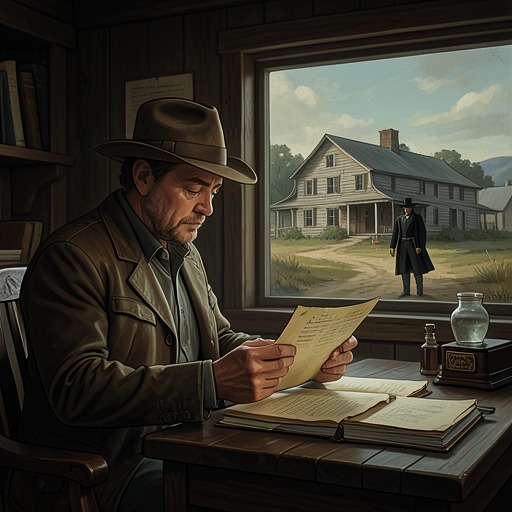
Caleb’s kidnapping of Mirabella
Once Upon a Time in HollywoodCaleb DeCoteau’s kidnapping of Mirabella Lancer is the decisive crisis in the Lancer pilot’s story-within-the-story: he takes the eight-year-old and holds her for a $10,000 ransom, turning a ranch conflict into a test of family allegiance and identity. The abduction forces Johnny Lancer, who has been drawn into the struggle against Caleb, to choose between a man he knows and likes and the father and family he has reason to hate.
Background and Stakes
Mirabella is Murdock Lancer’s eight-year-old daughter. Her place in the family carries a history of loss: her mother died after being thrown from a strawberry roan horse, and Murdock shot the horse after returning from the funeral. The kidnapping therefore threatens not an abstract hostage but a child whose family already bears the consequences of an earlier death.
The pilot initially sets up a familiar Western conflict: Murdock brings his estranged son Johnny to town to defend the ranch against Caleb and his men. The abduction makes that conflict personal and sharply raises its stakes. Caleb holds Mirabella for $10,000, while her brother Scott Lancer becomes the person with whom Rick Dalton’s character negotiates the ransom.
The Abduction as a Turning Point
Caleb’s seizure of Mirabella is identified as the story’s emotional turning point. Before it, the conflict can be understood as a defense of the ranch against an outside threat; with the child held for ransom, the danger presses directly on the Lancer family and demands a choice from Johnny.
The kidnapping changes the direction of the pilot rather than merely adding another threat. It supplies the catalyst that ultimately pushes Johnny toward the Lancers’ side, making the rescue crisis the hinge between his old loyalties and his possible place in a newly found family.
Johnny’s Divided Loyalties
Johnny’s choice is complicated by the concealed relationship between him and Caleb: the two men already know and like each other, though nobody at the ranch is aware of their connection. Johnny likes Caleb far more than he likes his father, Murdock, whom he blames for his mother’s death. He has carried the desire to kill Murdock since burying his mother in the soil of Ensenada eighteen years earlier.
Caleb is already carrying out the revenge Johnny once imagined for himself. Mirabella’s kidnapping consequently places Johnny between an ally whose actions advance that old grievance and the family he has reason to oppose. His dilemma is both practical—whose side to take—and fundamental: whether he is Johnny Lancer, tied to the family, or Johnny Madrid, defined by the identity and revenge he has carried apart from it.
Resolution and Narrative Function
The account identifies the kidnapping as the emotional catalyst that eventually moves Johnny to the Lancers’ side and sets him on course to appear in a weekly Western television series alongside his newfound family. It establishes the pilot’s central reversal: the son brought in to defend his father’s ranch does not begin as a loyal family member, and his bond with the antagonist makes choosing the family a consequential change rather than an automatic duty.
The event belongs to the Lancer plot being discussed within the book’s account of a television production. Rick Dalton is due to perform a scene negotiating the ransom with Scott while Mirabella sits on his lap, a pistol barrel pressed against her temple. That staged encounter gives the kidnapping a concrete dramatic image, while the larger plot assigns it a structural purpose: the child’s peril turns Johnny’s divided past into a choice that can bring him into the family.