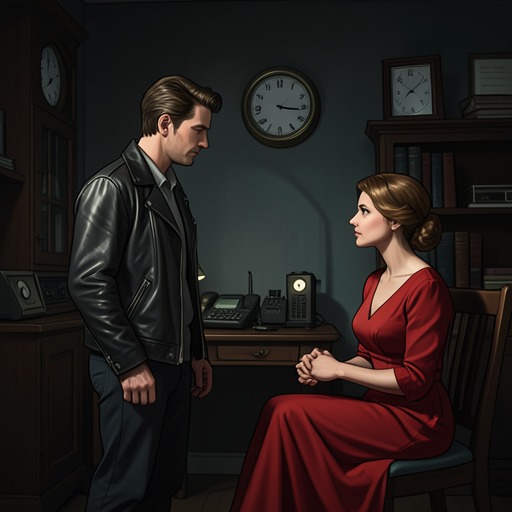
Cliff Booth—Buster Cooley friendship
Once Upon a Time in HollywoodThe friendship between Cliff Booth and Buster Cooley moves from years of informal loyalty to a profitable partnership and, finally, a fatal dispute over Brandy. Cliff’s willingness to lend money without humiliating a struggling friend establishes the trust between them; their success on the dogfighting circuit tests that trust against mounting risk, until Buster’s pursuit of one more payout ends the friendship in violence.
A friendship built on loans and restraint
Buster, a fellow stuntman, had borrowed a total of $3,200 from Cliff over five or six years. The loans came in uneven amounts, including $400 and $550 at a time, and accumulated when Cliff was doing better than usual. His work with Rick Dalton let him double the leading man in studio action movies; for Cliff, who had lived hand to mouth, this was a rare period of having money. He bought a small boat, lived aboard it, and kept it docked in Marina del Rey. Some of what he had went to Buster.
Cliff understood that Buster could be a mooch, but did not regard him as a chiseler. Buster borrowed when he faced immediate expenses: repossession of his car or television, eviction from his apartment, a Union 76 gas-card bill, or the first and last month’s rent for a new place. Cliff believed Buster would repay him if he could. Pressing him would not make the money arrive sooner, Cliff reasoned, and might make Buster avoid him; since Los Angeles was a small town, an encounter could then turn into an ugly confrontation. Cliff had already mentally written off the debt, while remaining glad he had been able to help when he had the means.
The debt becomes a partnership
A little over two years after the loans began to feel irrecoverable, Buster called Cliff at his trailer behind the Van Nuys Drive-In and asked to see him that day. He arrived a little over an hour later in a red 1961 Datsun pickup. After the two men opened cans of Old Chattanooga, Buster brought up the debt. Cliff corrected his initial figure of $3,000: the amount was $3,200. The correction makes their history concrete—Cliff has kept track, but he has not turned that knowledge into pressure.
Buster could not repay the money in cash. Instead, he offered Cliff a half interest in Brandy, a fighting dog he believed had extraordinary potential. His plan was to take her to a bout in Lomita, wager $1,200, and then put their winnings into a dogfighting circuit. He projected that by the sixth fight they could each have $15,000. Cliff listened, but did not accept Buster’s confidence as proof: he distrusted sure things, and dogfighting struck him as both illegal and distasteful, with too much that could go wrong. Buster’s sincerity mattered, but it did not remove the risks.
Cliff studied Brandy through the cage mesh, lowering himself until his face was level with hers. When she growled and snapped, the wire kept her teeth from reaching him. He then asked her name. Cliff, Buster, and Brandy went to the Lomita fight together, beginning the venture that converted an old personal debt into a shared business and a new source of excitement.
Success, escalation, and Brandy’s injuries
Buster’s prediction initially came true: Brandy killed her opponent in less than a minute, and the men won $2,400. Cliff was startled by how thrilling the fight had been. Over the next six months, he and Buster took Brandy across Los Angeles County, Kern County, and the Inland Empire, with bouts in Compton, Alhambra, Taft, and Chino. She won them all, usually without difficulty. When she was hurt in the early fights, the men let her recover before entering her again.
Success changed the terms of their partnership. After Brandy’s first five fights, her apparent toughness drew bigger bets and more formidable opponents. Later bouts took them to Montebello, Inglewood, Los Gatos, and Bellflower. Brandy continued to win, but the fights grew longer and bloodier, her injuries became more serious, and her recovery took more time. The stronger competition also promised larger winnings, binding the men’s financial hopes to the very danger that increasingly threatened the dog. After nine fights, Cliff and Buster had made about $14,000 each. Buster set a new target: $20,000 apiece, then Brandy could retire.
That plan was interrupted in San Diego, where Brandy fought a pit bull named Caesar. She was badly hurt, and the bout was stopped without a declared winner. Cliff believed the stoppage had saved her life: had the fight continued for another twenty minutes, Caesar would have killed her. The episode changes the emotional weight of the partnership. For Cliff, Brandy was no longer simply the means by which he and Buster might settle a debt and make money; watching her take Caesar’s punishment caused an agony he could not bear.
The final fight and the rupture
Despite Brandy’s serious injuries, Buster booked her into another competition in Watts against Augie Doggie, a male dog he described as a monster. Brandy had not fully recovered. Buster insisted that the fight would be the last one and that they were close to their promised $20,000 each. Cliff objected that Brandy could not beat Augie Doggie in her condition. Buster disclosed that winning was not the point: they could enter her to preserve her undefeated reputation while betting on the opposing dog.
That plan marks the break between the friends. Buster’s scheme treated Brandy’s record, and her continued participation, as assets to exploit even after the Caesar fight had shown Cliff what another beating could cost her. Cliff attacked him. They grappled in Cliff’s trailer for about four minutes, until Cliff broke Buster’s neck and killed him. The violence is the decisive reversal in their relationship: the man who had once lent money rather than force a humiliating reckoning now ends the partnership with lethal force.
Cliff remained beside Buster’s body, watching television until about two in the morning. After the drive-in closed, he put the body in the trunk of Buster’s used white 1965 Impala Sport Coupe, a car Buster had bought with Brandy’s winnings. With Brandy in the passenger seat, Cliff drove to Compton and abandoned the car with its keys in the sun visor. He walked with Brandy through the night until daybreak, then the two took a bus back to Van Nuys. The journey closes the friendship’s arc in the same practical, unsentimental register as its beginning: money, a car, and an old debt have become entangled with care for Brandy and the killing of the friend who first brought her into Cliff’s life.