Cliff’s visit to Spahn Ranch
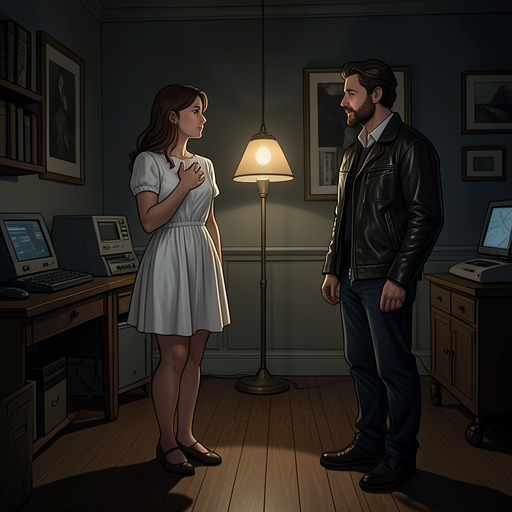
Once Upon a Time in HollywoodCliff Booth’s visit to Spahn Ranch turns a chance encounter with Pussycat into a test of what friendship and care mean when an old acquaintance can no longer reliably recognize the people around him. Cliff arrives worried that George Spahn is being taken advantage of by the Family living on his property. But George’s own words, and Squeaky’s uncompromising defense of their bond, complicate that suspicion and send Cliff back down the hill without intervening.
The Hitchhiker and the Ride
Cliff encounters Pussycat for the third time that day, now standing at a bus stop on the corner of Riverside Drive and Hollywood Way beneath an advertisement for Channel 9 newscaster George Putnam. He recognizes the same hitchhiker he had seen by the Aquarius Theater and elsewhere in Los Angeles. The coincidence strikes him as improbable, though he allows that hitchhiking is common among young people. This time, she is going in his direction.
At first Cliff imagines the ride in sexual terms, anticipating that a quick lift might lead to kissing or other intimacy. He asks whether she is headed to Spahn Movie Ranch. Pussycat says that is where she lives, and Cliff opens the passenger door and offers to take her. His willingness to help is therefore mixed with private expectations; the practical destination also draws him toward a place he knows through his past association with George.
The sexual advance does not happen as Cliff anticipates. With that possibility off the table, Pussycat pulls her pants back on, and the two talk during the drive to Chatsworth. Cliff does not tell her that he knows George personally or disclose his real reason for giving her a ride. The journey thus carries two different purposes: Pussycat is returning home, while Cliff is approaching the ranch with an unspoken concern about its elderly owner.
Pussycat’s Account of Charlie
During the drive, Pussycat tells Cliff that she first met Charlie when she was fourteen and living in Los Gatos, California. Her father had picked Charlie up while he was hitchhiking. The story she recounts is not a simple account of recruitment into the Family: she describes Charlie as turning her father’s hostility into affection during a night together, after which the two men parted as friends.
Pussycat also distinguishes her father’s friendship with Charlie from membership in the Family. Charlie considered it too strange for her father to join, because he was Pussycat’s father; as she explains it, he remained a friend of the Family, not one of its members. The detail presents the group’s connections as personal and improvised as well as hierarchical, and gives Cliff a glimpse of the history Pussycat carries with her to the ranch. It does not, however, settle the separate question that concerns him: whether George is being exploited.
Cliff’s Concern at the Ranch
By the time Cliff reaches the ranch, Charlie and a large group of the young people are away in Santa Barbara. Their absence changes the immediate balance of the visit. From the house on the hill, Snake can see the remains of the old Western set and the main drag where visitors park. She spots Cliff’s vintage yellow-and-cream Cadillac, then watches the ranch’s atmosphere shift after Tex and Lulu drive away: the girls stop laughing and become stiff and defensive as Cliff gestures toward the house.
Snake warns the others that the older man is coming. Cliff climbs the stairs and stands outside the filthy screen door, face to face with Squeaky. She asks when he last saw George. Cliff says he intends to go inside and look at him for himself, refusing to let the screen door keep him out. The exchange establishes the tension behind his visit: he approaches as a former friend concerned about George, while Squeaky meets him as someone challenging the household’s right to govern its own affairs.
Inside, Cliff wakes George, who starts in confusion and asks who he is and what he wants. George does not remember Cliff, despite their having worked together. Even so, he thanks him for visiting. Cliff tries to explain that he is a stuntman and that they used to work together, then voices his worry that the hippies may be taking advantage of George. His concern is sincere, but it rests on an old connection George cannot confirm in the moment and on Cliff’s judgment of the people now around him.
George and Squeaky’s Answer
Cliff asks whether George has given the hippies permission to stay. When George asks about Squeaky, he answers that she loves him. That response does not erase his blindness or confusion, but it supplies a direct expression of trust from the person Cliff came to protect. About six minutes later, Cliff comes back out of the bedroom. Squeaky asks whether he is satisfied, forcing his inspection into the open rather than allowing him to remain an unseen judge of the household.
Squeaky insists that her love for George is complete and that Cliff’s belief or disbelief in her capacity to love him means nothing to her. She then challenges the assumptions beneath his intervention: Cliff had not seen George since the 1950s, yet has arrived intending to save him from marriage and from sex, which Squeaky says they have frequently. She asks whether Cliff was truly George’s friend when he knew him, and whether he makes a habit of rescuing people from marriage or has singled George out.
Cliff listens from the loveseat and concedes that Squeaky has a point. He stands, walks through the house, exits by the screen door, and descends the staircase. Squeaky crosses her ankles and returns her attention to the Dick Clark-produced music show. The ending gives neither Cliff’s suspicion nor Squeaky’s defense a simple victory: George’s affection and his inability to remember Cliff coexist, while Cliff’s concern yields to the limits of what he can claim to know about the life George now leads.
Significance of the Visit
The visit reverses the expected roles of protector and threat. Cliff comes believing the residents may be exploiting George, but his decision to enter and inspect the house makes him the outsider whose authority Squeaky challenges. George’s recognition fails, yet his declaration of love for her gives Cliff evidence that cannot be dismissed as mere appearance. Squeaky, meanwhile, does not answer concern with passivity; she argues that Cliff’s old friendship does not grant him the right to define George’s present relationship.
The encounter also turns on what the characters cannot know. Cliff has history with George but has been absent for years; George cannot place him; Snake watches the arrival from above; and Squeaky must defend a bond that Cliff initially interprets through the possibility of exploitation. Cliff’s departure is therefore not proof that every concern has been resolved. It is a change in his judgment: confronted with George’s expressed affection and Squeaky’s challenge, he accepts that his past connection alone does not authorize him to take control of the present.