Dogs
Once Upon a Time in HollywoodDogs appear not merely as background animals but as companions, combatants, and measures of social rank. Brandy, a reddish-brown pit bull, is the most fully developed canine presence: Cliff Booth loves her, puts her through illegal fights for money, and ultimately resolves to protect her from further harm. At Spahn Ranch, by contrast, dogs figure in a rule that makes The Family’s women subordinate even to animals. Together, these episodes show dogs caught within human arrangements of affection, profit, discipline, and power.
Brandy as Companion
After becoming a widower, Cliff has no further serious relationship with a woman, but Brandy becomes the female he loves and who loves him in return. Their bond is conveyed through repeated domestic gestures. When Cliff is away, she waits by the trailer door for the sound of his car; when he returns, she whines, scratches, and exuberantly jumps against him. He allows her to finish her greeting before telling her to settle. He also leaves the television on while he is gone so that she will not be lonely, making her absence from him part of the household routine rather than a mere detail of his working day.
Cliff’s care is affectionate but disciplined. He describes Brandy as responding to a firm hand, and her training is clearest at mealtimes. On February 7, 1969, he prepares two cans of Wolf’s Tooth dog food with a hand-crank opener and places the food in her dish. Brandy has to remain seated on a chair with a dog pillow, even as she watches the food fall into her bowl, until Cliff gives the signal to eat. The scene makes obedience a visible part of their intimacy: Cliff knows the wait is difficult for her, but expects her to follow the rule he has taught her. The orderly ritual stands in contrast to the violence of her earlier life in the ring.
From Valued Fighter to Fighting Dog
Brandy enters Cliff’s life through Buster Cooley’s offer of a financial stake. Standing in a wire-mesh cage in the flatbed of Buster’s Datsun, she is presented as an exceptionally valuable fighting dog. Buster claims she can defeat a range of opponents, from pit bulls to Dobermans and German shepherds, and proposes that Cliff take half interest rather than receive the cash he has asked for. His plan is to wager $1,200 on Brandy in Lomita, then take her onto the dogfighting circuit and share the winnings. He predicts that by the sixth fight they could each have $15,000.
Cliff is wary of the promise of easy money, and he considers the fights illegal, distasteful, and risky. Yet the first contest changes his view. Brandy kills her opponent in less than a minute, and the men win $2,400. Cliff finds the spectacle thrilling and becomes involved. For the next six months, he and Buster take her to fights across Los Angeles County, Kern County, and the Inland Empire, including Compton, Alhambra, Taft, and Chino. Brandy wins them all. After the first five fights, however, the contests become more demanding: the opponents are tougher, the fights longer and bloodier, and Brandy suffers more serious injuries that take longer to heal. The prospect of larger winnings rises alongside the cost to the dog.
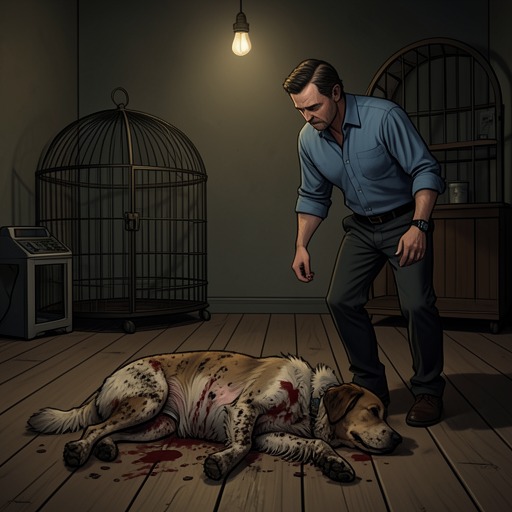
After nine fights, Cliff and Buster have made about $14,000 each. Buster sets $20,000 apiece as the amount that will let Brandy retire, but the tenth fight, in San Diego against a pit bull named Caesar, ends with Brandy badly hurt and the contest stopped without a winner. Cliff believes the stoppage spared her from being killed. Watching her take the punishment is more than he can bear, a response that gives the human stakes of the fights a different weight from their betting returns.
The Breaking Point and Its Aftermath
Despite Brandy’s injury, Buster books her for another fight in Watts against Augie Doggie before she has recovered. His plan no longer depends on her winning: he intends to preserve her undefeated reputation and bet on the opposing dog. Cliff objects that she cannot win in her condition, then attacks Buster. The struggle in Cliff’s trailer lasts about four minutes and ends when Cliff breaks Buster’s neck.
Cliff spends the evening beside Buster’s body, then places it in the trunk of Buster’s used white 1965 Impala Sport Coupe. With Brandy riding beside him, he drives to Compton, leaves the car there with its keys in the sun visor, and walks with her through the night. At daybreak they take a bus back to Van Nuys. The sequence binds Brandy’s safety to the consequence of Cliff’s violence: Buster’s decision to risk her again precipitates the killing, and Cliff’s escape carries the dog with him.
Cliff has killed before and escaped detection, including in Cleveland and in the killing of his wife; Buster’s death is his third murder. He never hears what became of Buster or the abandoned car, and nobody he knows brings Buster up again. Brandy is fought only twice more, when Cliff is badly short of money. After the last of those contests, he promises never to make her fight again. She cannot understand the promise, but Cliff intends to keep it. Her career as a fighter thus ends not with a formal retirement or a public reckoning, but with a private commitment from the man who had helped expose her to danger.
Dogs and the Human Hierarchy
The dogs at Spahn Ranch have a different narrative function. The women of The Family are treated as inferior to the men, and Charlie’s order makes their position still lower by requiring a woman to offer her bowl of food to a dog before eating herself. The rule turns an ordinary act of feeding into a repeated demonstration of subordination. Its force lies in the comparison: the women are placed below animals within the group’s social order, while the dogs become instruments through which that order is enacted.
The contrast with Brandy is significant. Cliff’s attachment grants one dog a distinctive place in his emotional life, but that affection does not initially prevent him from using her as a source of income. At the ranch, dogs are not individualized in the same way; their presence helps define the status imposed on the women. Across these scenes, canine life is shaped by human decisions, but not reduced to a single meaning. Brandy’s eagerness, training, injuries, and recovery give her an embodied presence, while the rule at Spahn Ranch makes dogs part of a human system of control. The book sets companionship beside exploitation and shows how care and domination can exist within the same relationship.