George Spahn’s Near-Total Blindness
Once Upon a Time in HollywoodGeorge Spahn’s near-total blindness is a defining condition of his life at Spahn Ranch: he can no longer see the memorabilia of the ranch’s Hollywood past, and an old friend’s visit depends on explanations he cannot verify by sight. The condition also shapes who controls his household. Squeaky cares for him inside the house, while Cliff Booth’s attempt to check on his former co-worker reveals how little Spahn can see and how uncertain recognition has become.
Condition and setting
Spahn is eighty and has gone nearly blind. His house stands on a hill overlooking the ranch’s old western-town back lot, a setting that preserves traces of a working film location even as the industry has largely moved on. For decades, Hollywood productions used the ranch; the Lone Ranger, Zorro, and Jake Cahill once rode down its main drag. In the present, the site is used only occasionally for magazine or album-cover photography, family horseback rides, dirty westerns, and low-budget exploitation films. Spahn himself is described as forgotten by the industry that once rented his property.
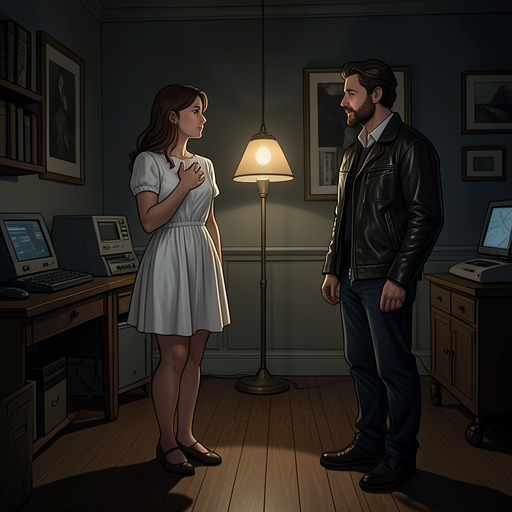
The interior of his house is crowded with objects from that earlier era: framed western-movie posters, sun-faded photographs of actors who filmed there, a collection of western saddles, and cowboy and Indian statues sculpted by George Montgomery. These things preserve the ranch’s former identity, but Spahn can no longer see them. The contrast is concrete rather than abstract: the objects remain on display, while the owner who might once have looked at them has lost most of his sight. The book does not explain the cause of his blindness or describe medical treatment; it establishes the condition through its practical effects and through Spahn’s blunt account of what he can no longer perceive.
Dependence and the household
The Family’s presence at the ranch rests on an arrangement Charles Manson made with Spahn, and Squeaky’s assigned responsibility is to look after the property owner. Her position gives her a degree of authority that the other women living at the ranch do not have. She stays in Spahn’s house and acts as its presiding figure, while the others do ranch work and scavenge for food. Squeaky cooks for Spahn, dresses him, keeps house, and provides company; the arrangement gives her access to real food and a place in the household, though the book also describes sexual services as part of the bargain.
His blindness is central to this arrangement because the care occurs in the space where he lives, among possessions he can no longer see. Squeaky’s responsibilities are practical and intimate, and the narrative presents her authority as growing from that daily role rather than from a formal position. The house may belong to Spahn, but it has become Squeaky’s domain. His impairment therefore has a social consequence: it makes the management of his home and the account of who is looking after him consequential questions, not merely background details about an elderly ranch owner.
Cliff Booth’s visit
When Cliff Booth arrives, Squeaky tells him that Spahn is napping and initially keeps the visitor waiting. Cliff says he is an old friend who has come to say hello. Squeaky eventually directs him toward the bedroom, pointing down the hall with her bare foot and warning that Spahn may need to be shaken awake. She adds that Spahn is blind, so Cliff will probably have to tell him who he is. The warning makes sight’s absence an immediate practical fact: Cliff cannot rely on being recognized when he enters the room.
From her recliner, Squeaky hears Cliff wake Spahn. The old man starts in confusion, asking who is there and what the visitor wants. Cliff identifies himself as a stuntman and a former co-worker, and says he has come to see how Spahn is doing. Spahn still asks, “Who’s that?” His response does not establish whether he has forgotten Cliff, failed to recognize his voice, or simply cannot place the visitor while waking; the scene leaves those possibilities distinct. What it does establish is that a verbal introduction is necessary and does not immediately produce recognition.
Cliff asks what is wrong, and Spahn answers, “I can’t fuckin’ see shit!” Squeaky laughs. When Cliff mentions a “little redhead,” Spahn replies, “I told you I can’t see shit! How the fuck am I supposed to know what color the hair is of the girl who hangs around me all the time?” The exchange makes the impairment specific: Spahn cannot identify the girl’s hair color, even though she is regularly near him. His frustrated repetition turns a general description of near-blindness into an everyday limit, while the humor of the exchange does not erase the dependence it exposes.
Limits, recognition, and narrative role
The visit also shows that care does not make Spahn’s situation transparent to him. Squeaky controls access to the house and supplies the directions Cliff needs; Cliff must explain his identity and concern aloud; and Spahn cannot confirm either the visitor’s appearance or the color of the girl in question. He tells Cliff that he does not remember who he is, thanks him for visiting, and then reacts angrily when Cliff asks whether he has given the hippies permission to stay. Spahn asks Cliff who he is, and Cliff again identifies himself and explains that he wants to make sure the hippies are not taking advantage of him. The exchange leaves the practical question of Spahn’s consent unsettled in this passage, while making clear why Cliff is concerned.
The scene is filtered through Squeaky’s listening position: she hears the bedroom door, the questions, the answers, and the pauses from elsewhere in the house. That structure gives the reader access to Spahn’s condition through the sounds he makes and the explanations he needs, rather than through a view of what he sees. His blindness is not presented as a diagnosis or as a condition he overcomes. It is part of the material circumstances of his life at a deteriorating movie ranch, and it heightens the tension around his dependence on the people who live there. The man whose property once served Hollywood productions now cannot see the objects that recall that past; the people around him mediate his access to the house and to visitors. That contrast makes his vulnerability—and the importance of who speaks and acts on his behalf—plain.