Hollywood
Once Upon a Time in HollywoodHollywood in 1969 is more than a place in this story: it is an industry in transition, where old screen identities can mean both livelihood and limitation. Rick Dalton experiences that change from the precarious position of a once-famous television star whose career has narrowed to villain-of-the-week roles, while the rise of newer stars, directors, and Western styles makes reinvention newly urgent.
Setting and Industry
Hollywood’s professional world reaches into Rick’s daily life through casting, production, and the uncertain availability of work. Once, his projects guaranteed a place for Cliff Booth as his stunt double; now Rick is guesting on other people’s television shows, and Cliff may need Rick to ask a stunt gaffer for a few days’ work. The change in Rick’s status therefore affects not only his own prospects but also the employment arrangements of the longtime partner whose work was once secured by contract.
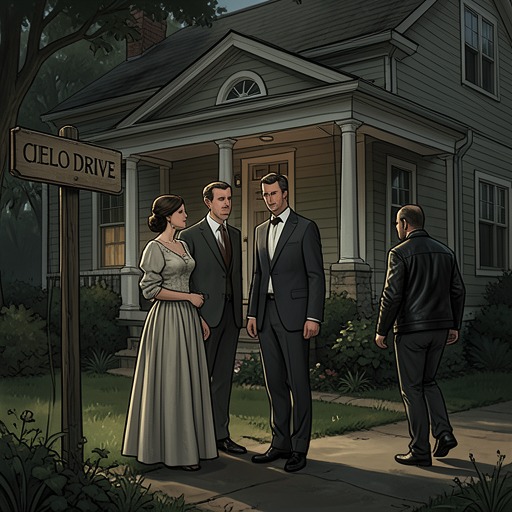
The industry’s hierarchy is visible in the contrast between Rick’s anxious career prospects and the celebrity of his new neighbor Roman Polanski. Rick and Cliff see Roman and Sharon Tate arrive in a vintage 1920s English Roadster, waiting at the bottom of their driveway for an electronic gate to open. Roman’s standing as an exceptionally successful and famous young director makes the encounter a measure of a Hollywood prominence that Rick feels he does not possess. Rick recognizes him at once, despite having lived nearby for a month without seeing him.
Fame, Casting, and Reinvention
Hollywood’s judgments about an actor are built from the roles audiences already know. During Marvin Schwarz’s blunt assessment of Rick’s prospects, Rick feels tears beginning behind his eyes as the agent explains that Italian filmmakers may want him as a substitute for Steve McQueen. The comparison offers work, but it also defines the opportunity through another actor’s unavailable star image. Hollywood can keep a career moving while making its limits unmistakable.
That tension becomes visible on the set of Lancer. Rick initially doubts the costume and makeup for Caleb DeCoteau, but seeing himself reflected in a western-style window helps him recognize a possibility beyond his familiar image. Without his customary pompadour, in a fringe-sleeved jacket, he looks less like an aging actor from the 1950s and more like a contemporary performer. The reflection gives concrete form to Marvin’s description of him as an Eisenhower-era actor in a Dennis Hopper-style Hollywood: Rick begins to understand that changing his appearance may help him escape the role his past has assigned him.
The Western in Transition
The fictional series Lancer, which Rick considers while working on its pilot, reflects Hollywood’s changing tastes. He sees its premise as darker, more violent, and more cynical than Bonanza or The High Chaparral. Murdock Lancer is an uncompromising patriarch rather than a reassuring father figure, while Johnny Lancer is written as a morally uncertain character of the kind that Western television more often reserved for a guest star. Making such a figure the series lead pushes against the familiar conventions of the genre.
The production’s casting and styling turn that shift into a professional contest. Jim Stacy welcomes the decision to cast Rick, known for playing Jake Cahill, as the heavy Caleb DeCoteau: the opposition between a recognizable television cowboy as villain and Stacy’s new hero gives the pilot a pointed way to establish Johnny Lancer. Director Sam Wanamaker favors Rick over another possible casting choice because the subversion of Rick’s familiar image suits the show’s ambition. Stacy and Wanamaker also want Johnny to wear a mustache, but CBS rejects the request and says the heavy can have one instead. Even a small matter of facial hair becomes a negotiation over character, screen presence, and who gets to embody the new Western.
Work, Memory, and Gratitude
Hollywood’s transformations do not erase the value of the work Rick has already done. After a scene with his young scene partner Trudi Frazer, Rick takes in the actors he has worked with, the actresses he kissed, the people and places he encountered, and the stories he lived. The thought of his fine house carries him back to the fact that he earned it by doing professionally what he had loved as a boy: pretending to be a cowboy. His career has brought fame and comfort, even as its decline has made him doubt his place in the industry.
That recognition changes the meaning of his professional uncertainty. Rick tells Trudi that they are lucky, acknowledging not that Hollywood has guaranteed him lasting success but that acting has already given him a life full of experiences he can value. The setting’s decisive significance lies in this double vision: Hollywood is a system that reduces performers to marketable images and makes work insecure, yet it is also the world in which Rick’s old cowboy roles, new opportunities, and accumulated memories can still add up to a life he is grateful to have lived.