Hollywood in the 1960s
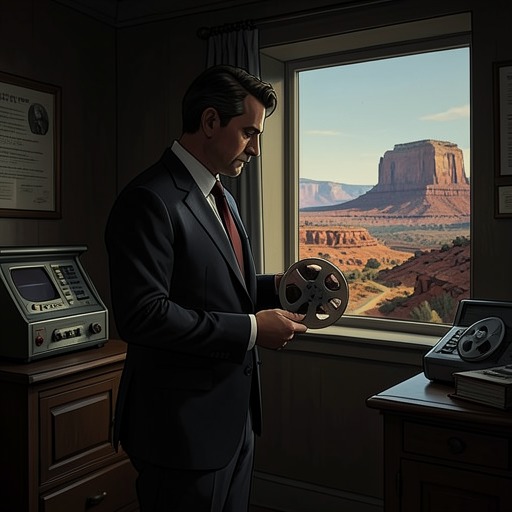
Once Upon a Time in HollywoodHollywood in the 1960s is a decade in transition, where the conventions that made television stars are losing their authority even as a new, rougher popular culture takes shape. The book locates that change in the everyday sounds of Los Angeles, in arguments over casting and appearance, and in the altered Westerns being made for television and film. Rick Dalton’s struggle to understand his place in the new industry gives the period a personal scale: cultural change arrives not as an abstract historical shift but as a question of whether an established actor can still be seen as contemporary.
A city with a changing soundtrack
In the early morning of February 8, 1969, Cliff Booth drives his Karmann Ghia along the nearly empty Sunset Strip on the way to collect Rick Dalton for work. The city’s nocturnal quiet recalls a desert beneath the pavement; a lone coyote rummaging through a public garbage can makes the image concrete. On the car radio, Robert W. Morgan greets the early risers, placing the journey within a Los Angeles increasingly organized around popular radio.
During the sixties and early seventies, KHJ Radio, known as Boss Radio, played a major part in the city’s musical life. Its programming ranged from the Beatles, the Rolling Stones, and the Monkees to the Mamas and the Papas and Paul Revere and the Raiders, alongside groups that later fell from public memory. The station’s exuberant identity was not universal, however: residents of Watts, Compton, and Inglewood listened to KJLH and its soul programming. The contrast complicates the image of one city moving to one beat. Even a widely shared pop culture had distinct local audiences and sounds.
Old star images in a new industry
Rick’s career anxiety comes into sharp focus when his agent, Marvin Schwarz, explains that Italian filmmakers want him partly as a substitute for a star they cannot obtain. As Rick listens to this account of his market value, tears begin to rise behind his eyes. The bluntness hurts because it translates his standing into a hierarchy of replacements: his familiar television image still has commercial use, but it does not make him the first choice for the leading roles he wants.
The change is also visible in the details of appearance. Rick has worn a pompadour for so long that it has become inseparable from his public identity. Marvin points out that the culture has moved on, invoking younger, shaggy-haired leading men and the new dry look promoted in hair-spray advertising. Later, while Rick is dressed as Caleb DeCoteau on the set of Lancer, he studies his reflection in a Western-style shop window. Without the pompadour, and wearing a fringed brown jacket, he can imagine himself as a different kind of actor: less an aging cowboy from an earlier era, more suited to the contemporary films associated with Sam Peckinpah. The reflection does not erase his old image, but it lets him see that the image might be changed.
The Western changes its rules
The television Western provides a concentrated example of the decade’s aesthetic turn. Rick regards the Lancer story as a promising series premise, darker, more violent, and more cynical than familiar ranch dramas such as Bonanza and The High Chaparral. Its patriarch, Murdock Lancer, is no warmly authoritative family figure; Johnny Lancer, meanwhile, is not simply the charming, suspicious visitor who usually appears as a guest character on another Western. He is the series lead, and his capacity for violence and moral ambiguity pushes the genre’s conventions further.
The production’s casting and costume decisions make that change visible. Director Sam Wanamaker considered Joe Don Baker for Caleb DeCoteau but chose Rick in part because recasting a recognized television cowboy as the villain would unsettle the audience’s expectations. Wanamaker wanted Lancer to avoid the familiar appearance of other television Westerns and to take on something of the grittier style associated with Italian Westerns. The newer American Westerns likewise favored younger stars, more distinctive clothes, and protagonists closer to antiheroes. The result was not a complete rejection of the genre’s past: it was a struggle over what its familiar figures could become.
That struggle reaches the level of a mustache. Jim Stacy and Wanamaker wanted Johnny Lancer to wear one, both to emphasize the character’s dubious edge and to distinguish Stacy’s dark-haired lead from Wayne Maunder’s lighter-haired Scott Lancer. CBS refused, directing them to put facial hair on the heavy instead. A small grooming decision thus exposed the limits of experimentation: the series could pursue a new Western style, but the network still drew boundaries around the image of its hero.
Film taste, work, and changing expectations
The decade’s cultural change is not confined to casting. Cliff and Janet Himmelsteen see I Am Curious (Yellow) at the Royal Cinema in West Los Angeles and both enjoy it. Cliff is more adventurous about film than Rick, whose understanding of cinema remains centered on Hollywood. His perspective is shaped by his wartime experience: after World War II, he found many American movies juvenile, with a small group of exceptions standing out against what he regarded as a false normality. The book contrasts this with postwar European filmmaking, sometimes made amid the remaining rubble, for audiences it describes as more adult. The contrast helps explain why Cliff can welcome a foreign film where Rick is inclined to treat non-Hollywood cinema as an inferior version of the real thing.
The entertainment business is also reshaping the work available to familiar performers. Rick’s arrival on Lancer as Caleb gives him a guest role in which his established Western persona can be used against him: the audience knows the actor as a cowboy hero, while the series makes him the antagonist. For Jim Stacy, Rick’s presence promises a meaningful launch for Johnny Lancer, a new hero shown defeating the very kind of celebrated television cowboy Rick once embodied. The old star image is therefore both a liability and a resource. It can restrict an actor to a type, but it can also give a new production a recognizable opponent against whom to define its changing ideals.
The personal weight of the decade
The book also places professional change alongside the drinking that marked many performers’ lives. It describes alcohol as a common burden among members of the acting generation before drug use became widespread among Screen Actors Guild members. Some drank as an escape that gradually became difficult to control; others had served in World War II or Korea and lived with experiences they could not forget. The industry’s tolerance of some on-set drinking reflected this generational context. Rick’s own drinking is not treated as professional mastery: after eight whiskey sours leave him unable to remember how he got to bed, he remains an amateur beside actors who had learned how to function as professional drunks.
By the time Rick reflects on his life with Trudi Frazer, the decade’s transformations have not simply made his earlier career worthless. He remembers actors he worked with, the places he visited, the attention and fan mail, the hotel rooms, and the house he owns—paid for by pretending to be a cowboy, as he had done as a boy. Trudi’s reminder of how lucky they are prompts him, for the first time in ten years, to recognize his own good fortune. That recognition does not undo his career insecurity or restore the culture in which he first became a star. It gives his past a different meaning: an older Hollywood image may be losing currency, but the life built through acting still contains work, pleasure, and reasons for gratitude.