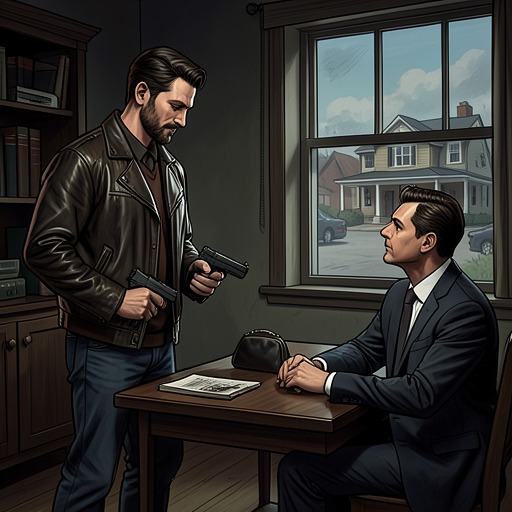
Johnny’s choice between identity and revenge
Once Upon a Time in HollywoodJohnny’s choice between identity and revenge is the moral and practical hinge of the Lancer Ranch conflict: a promise of family wealth gives Johnny Lancer a possible future, while his identity as Johnny Madrid is bound to vengeance against the father he holds responsible for his mother’s degradation and death. The choice is further unsettled by a secret that neither Murdock nor Scott knows: Johnny and Caleb DeCoteau are friends.
The inheritance bargain
Murdock’s offer is no unconditional reconciliation. He proposes dividing his cattle, land, ranch house, and bank accounts equally among himself and his two sons, but only if they help drive Caleb and his armed men from the area and spend ten years working the ranch and managing its business. After that period, they may leave and cash in their shares. The terms make belonging something the sons must earn through labor and danger, rather than a gift that erases the past.
The offer has unusual force because Scott and Johnny have both been living hand to mouth. Scott has survived as a riverboat gambler; Johnny has sold his gun to the highest bidder and kept ahead of posses. Neither has a realistic route to comparable wealth, legally or illegally. Yet the inheritance demands that Johnny protect the man he hates and risk death at the hands of the same gang he has been asked to oppose. The prospect of becoming one of three partners in an empire therefore promises security while making reconciliation an immediate test, not a settled fact.
The inherited wound and the revenge ledger
Johnny’s resistance to the bargain is not simply distrust of a father he barely knows. He believes Murdock Lancer expelled him and his mother into the rain, helped drive her into degradation, and was ultimately responsible for her being in the hotel room where a wealthy man slit her throat. The offer of partnership therefore arrives from the person Johnny regards as the source of the wound that has shaped his life. Wealth might change his circumstances, but accepting it would mean working beside the man he still holds accountable.
The history of Johnny’s revenge gives that hostility a precise, terrible scale. He was twelve when his mother’s killer stood trial and was acquitted; at fourteen, Johnny killed the man. Over the next ten years, he hunted down the thirteen jurors who had acquitted him, slitting their throats as his mother’s had been slit. By the time he reaches Royo del Oro, he considers Marta Lancer avenged—but not fully. Murdock remains, in Johnny’s reckoning, the last person who has not paid for the path that led to her death. The inheritance thus offers more than cattle, land, a ranch house, and bank accounts: it puts the remaining object of Johnny’s vengeance within reach, while requiring him to preserve that man’s life against Caleb’s attack.
Johnny’s concealed friendship with Caleb DeCoteau makes the conflict more unstable still. Neither Murdock nor Scott knows that Johnny and the ranch’s enemy are old friends. After learning that he could receive a third of Murdock’s fortune for killing Caleb, Johnny sees a possible way to reintroduce himself to his former companion and offer his services, perhaps working from inside the enemy’s operation. That approach could serve Murdock’s defense and Johnny’s material future, but only so long as Caleb does not discover that Johnny is Murdock’s son. A mistaken disclosure would make the covert strategy fatal.
The plan also leaves Johnny’s deepest motive unresolved. He recognizes that Caleb is already pushing Murdock toward desperation, doing more to hurt the old man than Johnny has managed himself. For the first time, the possibility of profit enters a plan that had previously been only about killing Murdock. The alternatives are not abstract: he might gain an empire by helping defeat Caleb, or pursue the blood debt against his father; he might secure a future, or satisfy a past that has governed him for years. The choice between Johnny Madrid, the gunman shaped by revenge, and Johnny Lancer, the son offered a place in a family, remains open through the saloon encounter. As he drinks with Caleb, even the toast has no settled meaning: it could mark the success of an undercover maneuver or the beginning of a renewed alliance against Murdock. Johnny has until morning, but the uncertainty is already the point—the inheritance has made revenge and belonging competing possibilities rather than a simple choice between poverty and wealth.
An antihero made the lead
Rick Dalton reads the Lancer pilot as a deliberate break from the familiar western-series pattern. Johnny Lancer arrives in Royo del Oro with the air of a shady guest character: the kind of young, cocky stranger who visits an established ranch, carries a hidden past, and leaves the audience waiting to learn whether he is a villain or a misunderstood man. In the usual episode, that uncertainty is resolved by the third act, through redemption or death. Here the uncertain figure is not a visitor but the series lead. Johnny’s concealed history and divided loyalties therefore cannot be cleared away as a temporary mystery; they become the continuing problem the series is built around.
That design sharpens the difference between Johnny and the other members of the Lancer family. Scott is the more recognizable likable good guy, though his Eastern-dandy clothes and history as a former Bengal Lancer give him an unusual profile. Murdock, by contrast, is no kindly patriarch: Rick sees him as hard, uncompromising, and difficult to love. Johnny’s place between them is more radical. He is not simply the good son or the dangerous stranger, but a gunman whose past as Johnny Madrid puts the family’s proposed future in direct conflict with his own history. The identity choice is consequently embedded in the show’s structure: the audience is asked to follow, rather than merely judge, a character who might still take either path.
The pilot’s casting makes that uncertainty a genre statement as well. Sam Wanamaker considered Joe Don Baker for Caleb DeCoteau, but chose the more provocative possibility of casting the established television cowboy Rick Dalton as the heavy opposite Jim Stacy’s hero. Dalton’s familiar screen identity could be turned against expectation: the recognizable western star would now face defeat at the hands of Johnny Lancer. Wanamaker wanted the series to avoid the look of Bonanza and The Big Valley, drawing instead on the grittier style associated with Italian westerns and the newer American westerns of 1969. The move from conventional hero-and-villain roles toward younger, more stylish antiheroes gives Johnny’s divided identity a cultural setting as well as a personal one.
The network’s refusal to let Johnny wear a mustache makes the negotiation visible. Stacy and Wanamaker wanted the facial hair to reinforce Johnny’s shady character and distinguish the brunette lead from his light-haired half-brother, Scott; the network insisted that a mustache belonged on the heavy, not the hero. The restriction could not settle Johnny’s moral identity. Instead, the pilot’s larger choice—to place a character usually reserved for a guest role at the center of the series—preserves the tension between the role conventionally assigned to a western hero and the violence, secrecy, and revenge attached to Johnny Madrid.
The saloon encounter and the suspended decision
Johnny’s dilemma takes physical shape on Royo del Oro’s main street. Two days earlier, the town had seemed to him like any other; now, after hearing Murdock’s account, he reads its streets as a place held in fear. The men gathered outside the Gilded Lily are not merely local toughs but Caleb DeCoteau’s land pirates, the force Johnny has been recruited to drive away. Passing them, he recognizes an older, sharply dressed gunman among the henchmen, a reminder that the threat is organized and personal rather than abstract.
When Johnny and Caleb enter the saloon together, their ease suggests a history that the people at the ranch do not know. Johnny has not decided what the reunion is meant to accomplish. He can offer his services and work from inside Caleb’s operation, potentially helping Murdock while protecting his claim to a share of the ranch; but that plan depends on Caleb not learning that Johnny is Murdock’s son. The concealed identity that might make Johnny useful as an intermediary could also expose him to deadly danger.
The conversation turns the old grievance into a possible transaction. Johnny had considered killing Murdock without imagining a profit from it; now he signals to Caleb that killing his father would require a much larger payment. The offer is not a resolution of his hatred but evidence that money has entered a revenge plan that once seemed absolute. With one drink, Johnny could be toasting the success of an undercover approach or renewing his alliance with Caleb against Murdock. The scene ends before he chooses: he has until morning to decide whether the future offered by the Lancer inheritance outweighs the revenge that has defined Johnny Madrid.