Lancer Ranch
Once Upon a Time in HollywoodLancer Ranch is the center of Murdock Lancer’s wealth and the contested ground that draws his estranged sons back into his life. Once the largest ranch in the Monterey Valley, it becomes vulnerable to Caleb DeCoteau’s cattle thefts; Murdock’s offer to divide its empire among his sons turns the property into both a family inheritance and the means to fight back.
Setting and Scale
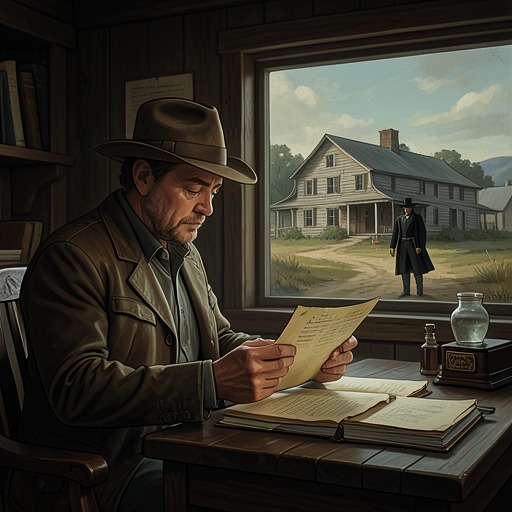
For roughly two hundred miles on the American side of the California-Mexico border, Murdock was the wealthiest man in the region. His holdings included the biggest ranch, the largest home, and more cattle than any other owner in the Monterey Valley. Lancer Ranch was therefore not merely a working property: its concentration of land, livestock, and money made it an empire, and a conspicuous target.
The ranch was also the former childhood home of Murdock’s sons, Johnny and Scott. They had not seen their father since they were children, and each returned from a different place after Murdock offered them a thousand dollars to hear his proposal. The familiar homecoming thus began as a transaction, with both men expecting little interest in what their father had to say; the scale of the ranch and the fortune tied to it would make his offer difficult to dismiss.
The Cattle Raids and the Ranch’s Vulnerability
Caleb DeCoteau’s campaign against Lancer Ranch began with the nightly theft of a few cattle. Murdock Lancer tried to deter the raiders by assigning ranch hands to sleep out on the range as guards. The tactic appeared to work briefly, until eight of Caleb’s men attacked Pedro, beat him bloody, tied him to a tree, and horsewhipped him nearly to death. That night they drove off twenty steers and shot six more, turning a pattern of pilfering into open terror.
The ranch’s size and wealth did not make it easy to defend. Murdock would have needed a private force of armed men to police an assault on this scale, while the nearest federal marshal was more than 150 miles away. Caleb’s gang did not merely take cattle and disappear: it openly sold Lancer-branded steers at pens sixty miles from the ranch. The visible mark of Murdock’s ownership became evidence of how little protection that ownership could command.
The violence spread beyond the range into Royo del Oro, the town nearest Lancer Ranch. Caleb’s men took over Pepe’s saloon and terrorized its owner into serving them. When the mayor tried to confront Caleb, the gang bullwhipped him in the middle of Main Street. They then threatened to burn the town’s schoolhouse and molest its women unless the merchants stayed out of the conflict over Pepe and Murdock’s cattle. With no effective local remedy and the Army three days away, the ranch’s assault became a crisis for the whole community.
The Ranch as Inheritance and Bargaining Power
Caleb DeCoteau’s pressure on the ranch was designed to test how much Murdock Lancer and Royo del Oro would endure. Caleb expected the Army might eventually be summoned, but it was three days away; he counted on leaving before it arrived. Murdock, however, had something the town lacked: money enough to hire men of his own. When Caleb’s sniper killed George Gomez, Murdock’s trusted ramrod, the attack pushed him past the limit he had imposed on himself. The ranch’s wealth, previously a source of vulnerability, now gave him a way to resist.
Murdock’s proposal made the ranch the foundation of a family bargain. He offered to divide his whole empire among himself and his two sons: cattle, land, the ranch house, and bank accounts. In exchange, Johnny and Scott had to help drive Caleb and his thieves out of the area, then work the ranch and manage the cattle business for ten years. At the end of that period, either could leave and cash in his share. The offer bound the immediate defense of Lancer Ranch to a decade of stewardship, making inheritance conditional on both confronting the raiders and sustaining the enterprise they sought to inherit.
Neither son had an easy alternative. Scott had been living from one poker hand to the next as a riverboat gambler; Johnny had been selling his skill with a gun to the highest bidder while staying ahead of a posse. Even so, accepting meant risking more than either expected to gain, since the brothers had little affection for their father. For Johnny, the ranch’s promise was inseparable from the man who owned it: Murdock had cast him and his mother out, and Johnny held him responsible for the circumstances that led to her murder. The wealth attached to the childhood home could therefore offer security and revive an old grievance at the same time.
A Home Entangled with Old Violence
For Johnny, Lancer Ranch represented more than a share in a valuable cattle empire: it was the childhood home from which Murdock had expelled him and his mother, Marta Lancer. Johnny held his father responsible for the chain of events that ended with Marta’s murder. The offer to reclaim a place in the family’s affairs therefore brought material possibility and remembered injury into the same bargain; the ranch could promise wealth, but only through renewed dealings with the man Johnny hated.
That hatred had already shaped Johnny’s life into a private campaign of retribution. At twelve, he watched Murdock stand trial for Marta’s killing and be acquitted; at fourteen, Johnny killed his father. Over the following ten years, he tracked down the jurors who had acquitted Murdock and killed them by slitting their throats, repeating the manner of his mother’s death. The proposed division of Lancer Ranch thus carries a history far more dangerous than an estranged family’s reunion: the land and fortune Murdock offers his sons are bound to a past in which Johnny has already answered the family’s violence with violence.