Los Angeles
Once Upon a Time in HollywoodLos Angeles is more than a backdrop: its freeways, residential hills, commercial streets, and changing street culture shape how Rick Dalton and Cliff Booth move through their lives. The city repeatedly shifts in scale—from a crowded boulevard viewed through a car window to a nearly empty street at dawn—and in character, from Hollywood’s workday routines to the desert-like quiet of early morning. Its geography links Rick’s home on Cielo Drive, Cliff’s home in Van Nuys, and the roads where chance encounters complicate an ordinary drive.
A city crossed by work and home
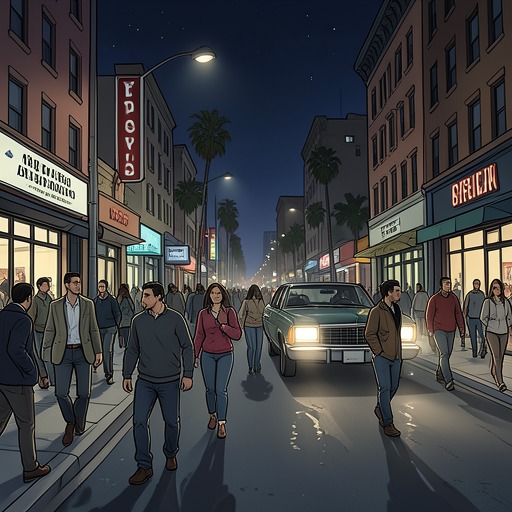
The city’s distances are made tangible through driving. In Rick Dalton’s 1964 Cadillac Coupe de Ville, with Cliff Booth at the wheel, the pair leave the underground parking lot of the William Morris building, come out onto Charleville, and turn onto Wilshire Boulevard. Their route then leaves the busy thoroughfare for calmer residential streets leading back to Rick’s home on Cielo Drive. The movement connects the machinery of Hollywood employment to private life, while the car provides a moving vantage from which Rick watches the city change around him.
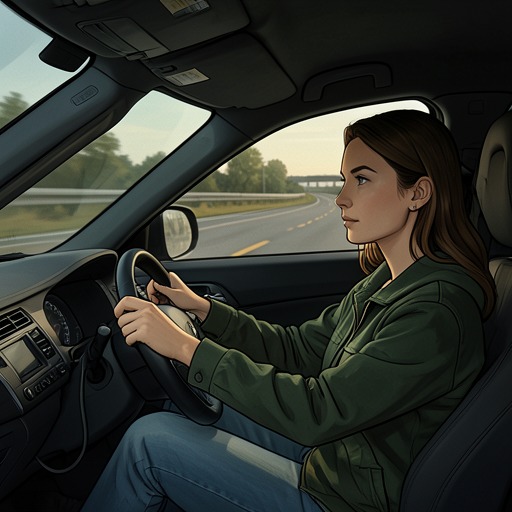
A separate journey carries Cliff from Rick’s driveway to his own home, three freeways away in Van Nuys. In Cliff Booth’s Karmann Ghia, he reverses down Cielo Drive and takes the residential hill’s hairpin turns at breakneck speed. The route makes Los Angeles legible not as one central district but as a city of separated destinations joined by roads and freeways. The same car is a work vehicle when Cliff drives Rick, and a means of getting home when the workday is over.
On the morning of Saturday, February 8, 1969, Cliff again crosses the city to collect Rick and drive him to Twentieth Century Fox Studios for an eight o’clock call time. At six-thirty, he pushes the Volkswagen down the practically deserted Sunset Strip. The route is both routine and atmospheric: a commute through a famous urban corridor at an hour when its usual activity has ebbed.
Streets of cultural change
Rick’s drive down Wilshire places the city’s competing cultures side by side. Hippies parade along the sidewalk in blankets and frocks, barefoot and visibly marked by a subculture Rick regards with disgust. He complains that the town used to be a pleasant place to live and speaks with violent disdain about the newcomers. The scene establishes a fracture in how the city is experienced: for Rick, the sidewalk crowd signifies a Los Angeles he no longer recognizes, while the Cadillac keeps him enclosed and moving past it.
The city’s geography also gives encounters a repetitive, unsettled quality. On Forrest Lawn Drive, Cliff hears Los Bravos on the radio and waits to turn onto Riverside Drive. At the corner of Riverside Drive and Hollywood Way, he sees a hitchhiker he has already encountered elsewhere that day; this time she is alone and appears to be heading in his direction. When she later travels in a Skylark with a red-haired male driver, Cliff sees the pair talking and laughing through the back window, then abruptly leaves Riverside Drive, parks, and crosses the street on foot. The hitchhiker’s repeated appearance makes the city’s separate corners feel connected by coincidence, while Cliff’s detour turns a drive into a walk through a local commercial strip.
That walk takes him past the Money Tree bar and grill and toward the Toluca Lake record store Hot Waxx. Inside, the Monkees’ “The Last Train to Clarksville” is playing; four customers under twenty-five browse, and a Black customer in a dashiki examines a Richie Havens album. The store’s incense-and-body-odor atmosphere, the music, and the customers provide a close-up of the youth culture that Rick has seen from the road. Los Angeles is shown not only as a conflict between generations but as a collection of particular streets and businesses where that culture gathers.
Radio, quiet, and the city’s sound
The car radio supplies a continuous soundtrack to movement through Los Angeles. At dawn, Cliff hears Robert W. Morgan on 93 KHJ, calling out to early risers. KHJ is described as Boss Radio, associated with its Boss Sounds and Boss Jocks, and as a station whose reach did not include everyone: listeners in Watts, Compton, and Inglewood instead heard the soul beat of KJLH. That contrast qualifies the idea of a single citywide popular sound. The radio creates a shared Los Angeles identity, but the account also marks its limits by naming neighborhoods with a different station and musical orientation.
The early-morning city is quiet enough for another sound to stand out. Cliff thinks of Los Angeles in the middle of the night and the early hours as returning to the desert it was before being paved over with concrete. A lone coyote digging through a public garbage pail gives that thought a concrete counterpart. The image sets urban paving against the landscape that preceded it: even on Cliff’s work commute, the city’s built environment does not wholly erase the older desert setting.
A connected landscape of chance
Los Angeles repeatedly changes from destination to route. Cliff is driving to work, driving home, or moving between familiar streets when a sight—a hitchhiker, a car, a record store—redirects his attention. When Debra Jo tells him about Spahn Ranch, he decides that, although the situation may amount to nothing, it would be worth driving to Chatsworth to check on George Spahn. The choice extends the city’s network of roads into a decision to visit an old friend; Cliff knows the way and cuts off her attempt to give directions.
Across these passages, Los Angeles is defined by contrasts that coexist rather than resolve: busy Wilshire and residential Cielo Drive, the Sunset Strip at dawn and the lone coyote, mass-market Boss Radio and KJLH’s distinct audience, familiar routes and encounters that pull a driver elsewhere. The city’s scale makes movement routine, but the roads also keep producing unexpected contact. That combination gives Los Angeles its narrative force: it is at once a working map, a cultural fault line, and the space in which chance can make separate parts of a day converge.