Marvin Schwarz
Once Upon a Time in HollywoodMarvin Schwarz is a William Morris agent whose career advice gives Rick Dalton a blunt account of Hollywood’s changing tastes and the limited prospects of a television cowboy trying to become a film star. He does not offer Rick easy reassurance: he frames the actor’s possible future in foreign films as a matter of typecasting, humility, and reinvention. Later, when Rick hesitates over an Italian film offer, Marvin again argues that adapting to the market is more sensible than waiting for Hollywood to restore the career Rick once had.
Identity and Approach
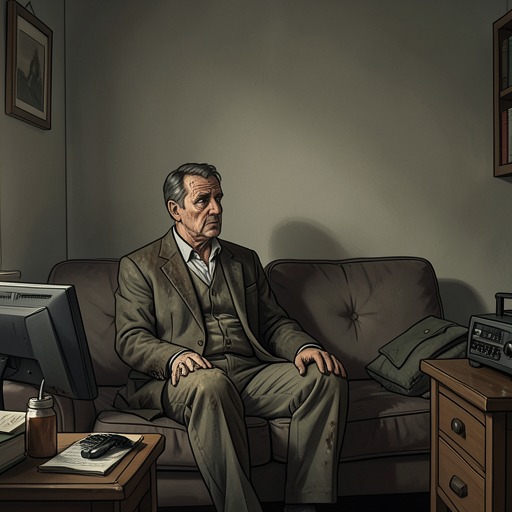
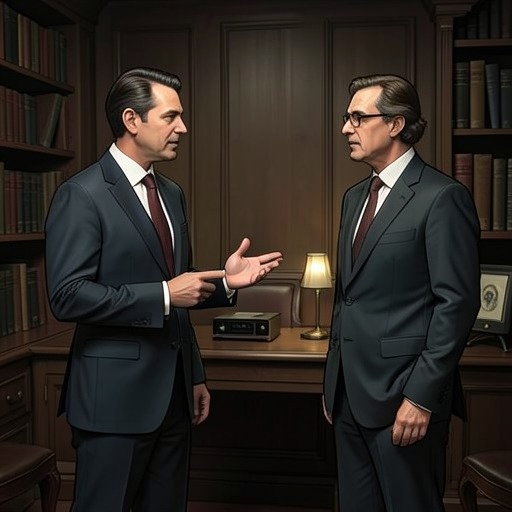
Marvin is introduced in his office through the practical rhythm of an agent’s day. His Dictaphone buzzer sounds; his secretary, Janet Himmelsteen, tells him Rick is waiting outside, and Marvin signals that he is ready. The arrangement places him inside the machinery of representation, where appointments and introductions precede the personal pitch. Rick’s regular agent, Sid, has asked Marvin to meet him, and Marvin makes clear that he is not taking over that role simply by holding the meeting.
Marvin presents his business through the clients he represents. He identifies his central asset as his client list, explaining that it underpins his contacts in the Italian, German, Japanese, and Filipino film industries. He names Van Johnson, Joseph Cotten, Farley Granger, Russ Tamblyn, and Mel Ferrer as examples of the Hollywood standing associated with that list. His boast is also a distinction between two kinds of agency work: he says he does not deal in has-beens, but in Hollywood royalty. The clients’ established prestige is not ornamental to his argument; it is what makes his international connections valuable.
His manner combines theatrical self-presentation with directness. He can deliver a polished account of his business and its contacts, but when Rick’s future is at issue, he is willing to say that the actor may be wanted abroad partly as a substitute for a star the producers cannot secure. Marvin regards this as an opportunity, while Rick feels the sting of being appraised as a second choice. The gap between their reactions establishes Marvin’s practical, market-centered perspective: an offer can be useful even when the reason for it is unflattering.
The Meeting with Rick Dalton
Rick arrives understanding that Marvin places famous American performers in foreign films. Marvin confirms that this is broadly right, then explains that his relationships with overseas industries rest on both the actors he represents and the reputation of the roster itself. Rick’s smoking of Red Apples, a habit he acquired while appearing on Bounty Law, gives Marvin a small opening for teasing him about his brand loyalty; the exchange soon turns back to business. Marvin notes that Sid requested the meeting and asks Rick whether he understands why.
Marvin’s career assessment is severe but specific. He argues that Italian filmmakers will want Rick, but may first have wanted Steve McQueen and failed to obtain him. Rick could therefore be hired as a McQueen-like alternative: an American screen presence they can actually secure. Rick experiences the explanation as painful, with tears beginning to gather as Marvin continues. Marvin, by contrast, sees a promising opening precisely because Rick is not currently a leading man in studio features. The scene makes the opportunity and the insult inseparable: the same comparison that wounds Rick explains why the work is available.
Marvin does not leave Rick with the idea that a foreign offer simply restores his former status. He tells him that the chance requires reinvention, and when Rick asks what he must become, Marvin’s answer is humility. That prescription follows from the meeting’s larger diagnosis. Rick’s previous identity as a prominent American television cowboy cannot by itself guarantee film work; he must be willing to enter the industry without assuming that his old standing will dictate the terms.
A Changing Western and Rick’s Screen Image
The advice acquires a visible counterpart when Rick later plays Caleb DeCoteau in the pilot for Lancer. In the western back lot at Royo del Oro, Rick studies his reflection in a window while wearing the character’s costume. The look includes a brown fringed jacket and a different hairstyle from the pompadour he has worn for years. At first the transformation leaves him wondering whether anyone will recognize him. As he gets used to the clothes and sees the figure against the set’s western surroundings, he begins to consider that not looking like himself may be useful.
Rick connects that image to Marvin’s description of an Eisenhower-era actor trying to work in a Dennis Hopper-style Hollywood. Shaggy hair and a more contemporary appearance suggest that he might be read as a different, more modern performer, rather than simply as an aging cowboy from the 1950s. The change is not only cosmetic: Rick imagines that when Johnny Lancer defeats Caleb, the audience will see the character losing, rather than merely seeing Jake Cahill—the western hero Rick played on Bounty Law—being killed. The role can separate Rick from his established television persona even as it uses that persona’s recognition.
The production’s approach to Lancer also reflects a changing western genre. Its director, Sam Wanamaker, chose Rick over Joe Don Baker for Caleb, preferring the effect of casting a familiar television cowboy as the heavy. The series sought a grittier atmosphere and a less conventional lead in Jim Stacy’s Johnny Lancer, rather than reproducing the familiar patterns of older television westerns. Rick’s reflection in the costume window therefore sits at the intersection of two changes: his own effort to alter his screen image and the genre’s effort to revise its heroes and villains. Marvin’s advice does not cause those changes, but it gives Rick a framework for recognizing their professional implications.
The Later Offer and Marvin’s Case for Adaptation
After Rick is dropped off at home by Cliff Booth following an evening out, he checks his answering service and finds a message from Marvin. He calls back, and Marvin immediately puts an Italian western and director Sergio Corbucci before him: Nebraska Jim. Rick does not recognize either name at first. The quick follow-up makes Marvin’s earlier counsel concrete. Instead of discussing foreign films as a general possibility, he now has a specific project to offer.
Rick resists. He questions the quality of the films and suggests that staying in Los Angeles for the next pilot season may be wiser; perhaps he could still get lucky. Marvin counters with the story of Lex Barker, an American actor who played Old Shatterhand in German films based on Karl May’s novels. Marvin’s account emphasizes how an actor could become strongly identified with a role in a foreign film industry, appear in films that circulated across Europe, and acquire a screen identity so established that later replacements could not simply inherit its name. The example turns overseas work from a fallback into a possible route to sustained recognition, though it does not promise Rick the same outcome.
Marvin then addresses Rick’s career record more directly. He says that Rick’s transition from television to feature films has not worked particularly well, and that this history gives Rick little reason to dismiss leading roles in foreign pictures. He acknowledges exceptions such as Steve McQueen, Jim Garner, and Clint Eastwood, but groups Rick with television performers whose careers were shaped by an earlier star image. In Marvin’s account, the culture changed while they were not looking: shaggy-haired, androgynous performers had become the new leading-man type. His argument is not that Rick can reverse the change by waiting, but that refusing the work will not make the changed market disappear.
Narrative Role and Significance
Marvin functions as a career interpreter for Rick, translating abstract industry shifts into choices with immediate consequences. At their first meeting, his candor makes the foreign-film possibility emotionally difficult to accept; later, when Rick considers declining Nebraska Jim, Marvin’s example of Lex Barker and his account of the changed leading-man ideal sharpen the choice. The advice is both pragmatic and demanding. Rick may have to accept that he is not being hired as the star he once imagined himself to be, while also recognizing that a different role or market could give him room to continue working.
Rick’s later reflection on the good fortune of his acting life gives this advice a wider context. He recalls the actors and actresses he worked with, the places he visited, the stories he lived, and the house he owns through a career that began with pretending to be a cowboy. The novel does not present this gratitude as a direct result of Marvin’s intervention. Rather, Marvin’s unsentimental account of professional change helps define the problem Rick must face: a career is not secured by nostalgia for past status. Its continuation depends on seeing what has changed, accepting an altered position, and finding value in work that may not resemble the role through which an actor first became known.