Murdock Lancer
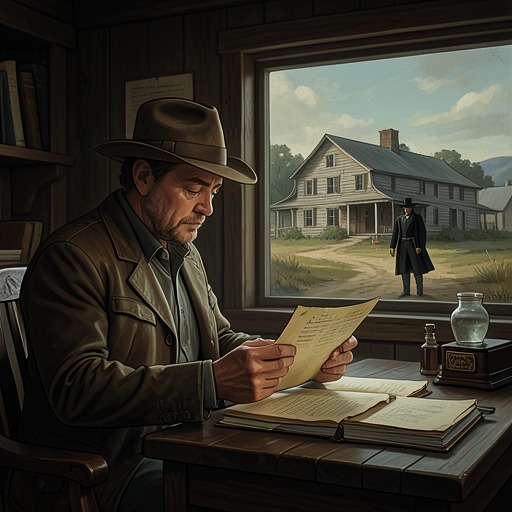
Once Upon a Time in HollywoodMurdock Lancer is the cattle baron and estranged father at the center of Lancer, the television Western being filmed within the novel. His wealth gives him unusual power in the lawless territory around Royo del Oro, but it cannot protect his ranch indefinitely from Caleb DeCoteau’s violence or undo the family divisions of his past. Murdock’s defining choice is to call his sons home and offer them a share of his empire—not as a gift, but in exchange for defending it and helping run it.
Identity and Family Background
Murdock owns the largest cattle ranch in the territory and, for roughly two hundred miles on the American side of the California-Mexico border, is the wealthiest man around. His holdings include extensive land, a substantial ranch house, cattle, and bank accounts. The scale of that property makes him a local power, but the story presents his wealth alongside a family fractured by distance: both his sons were born at Lancer Ranch, neither had met the other, and neither had seen their father since they were small children. Their mothers were both deceased. Murdock’s daughter, Mirabella Lancer, is eight years old when the story begins.
The sons grew up in sharply different circumstances. Scott Foster Lancer was raised by his mother’s wealthy family in Boston, graduated from Harvard, and served with the British Cavalry in India. Johnny Lancer was raised in Mexico by his mother, Marta Conchita Louisa Galvadon Lancer, who had no wealthy family to support them. The narration describes Johnny’s childhood as one in which he understood sex as another service men paid women to provide. The contrast between Scott’s privileged upbringing and Johnny’s precarious one makes the family’s separation material as well as emotional.
Johnny’s account of the past is especially bitter. He believes Murdock rejected him and his mother, and remembers them being sent away into the rain. Long afterward, Murdock learned through a former Pinkerton detective that Johnny was alive and living under the name Johnny Madrid. The news affected him profoundly: he cried for three days, though the people on the ranch did not know why. That private grief precedes his attempt to bring his sons back into his life.
The Ranch Under Threat
Caleb DeCoteau and his men, who call themselves land pirates, have been stealing cattle from Murdock’s ranch in Royo del Oro. The losses begin with a few animals at a time. When Murdock posts ranch hands to guard the herd, Caleb’s men beat Pedro, tie him to a tree, and horsewhip him nearly to death; they drive off twenty steers and shoot six more. Caleb’s attacks are not limited to theft. Nighttime snipers fire on the ranch house, where Mirabella sleeps, and the bunkhouse, killing George Gomez, Murdock’s trusted ramrod and oldest friend. The violence also frightens away a quarter of Murdock’s men.
The town has little practical protection. The nearest federal marshal is more than 150 miles away, and the Army is three days’ march from the area. Murdock’s money gives him an option other residents lack: he could hire gunmen of his own. Yet he resists turning the defense of his property into a private war. He believes his wealth should not finance murder, even to fight Caleb’s men, and judges the killing of people too high a price for cattle. George Gomez’s death pushes him past the limit he had set for himself. The decision to seek help from his sons arises at the point when restraint has become difficult to sustain and the ranch’s losses have become human as well as financial.
The Offer to His Sons
Murdock sends word to both sons and offers each one thousand dollars simply for hearing his proposal. Johnny receives a telegram at the Hotel Felix, along with fifty dollars for travel to Royo del Oro. The payment is presented as an offer to consider a job, with no obligation to accept. For Johnny, the summons has a personal lure beyond the money: it gives him the chance to face the father he has resented for years. Scott and Johnny come from separate lives, and neither initially expects to welcome a proposal from a father they have not seen since childhood.
Murdock’s terms are direct. If his sons help repel Caleb and his killing thieves, he will divide his entire empire equally among the three men. The inheritance includes cattle, land, the ranch house, and bank accounts. In return, the sons must work the ranch and help manage its business for ten years. After that period, they may leave and cash in their shares. The offer therefore couples extraordinary wealth to danger, labor, and a long commitment; the sons are asked to earn the partnership, not simply accept an inheritance.
At the stagecoach stop in Royo del Oro, Mirabella waits with Ernesto, the ranch hand who accompanies her, because the telegram does not say which brother is arriving. She anticipates meeting one of the two half-brothers she has never known. Later, as she leads Scott and Johnny toward the wagon, she tells them that Murdock may not show his feelings at first but is glad they have come. Johnny answers with skepticism, and Scott agrees with him. Their reunion is thus framed by a hopeful younger sister and two wary sons, while Murdock’s offer remains the practical means by which he hopes to draw them into a family.
Character and Narrative Significance
Murdock is portrayed as proud and accustomed to command, but the crisis reveals the limits of wealth and authority. He has the largest ranch and the resources to employ armed men, yet he cannot simply purchase safety without violating his own sense of what money should do. His reluctance is not passivity: after George Gomez is killed, he acts by recruiting the sons whose absence has long marked his household. The choice turns a cattle dispute into a test of his principles and a possible renewal of his family.
The arrangement also makes kinship conditional and practical. Murdock’s proposal gives Scott and Johnny a route from precarious lives toward shared ownership, but requires them to defend the ranch and spend ten years working alongside the father from whom they were separated. The prospective family is bound to the same land and danger that threaten to destroy it. The story establishes the possibility—not the guaranteed outcome—of reconciliation: all three men could become equal partners, and at last a family, if they survive the conflict and carry out the work.
Within the novel, Rick Dalton encounters Murdock as a character in the pilot of Lancer and recognizes the series’ central dramatic engine: a powerful rancher facing violent enemies while trying to bring his long-lost sons home. Murdock’s role thus anchors the Western’s family plot in a concrete struggle over land, cattle, and survival. His importance lies in the conjunction of those stakes: the ranch is both an empire to defend and the proposed basis for a family that has never truly lived together.