Rick Dalton
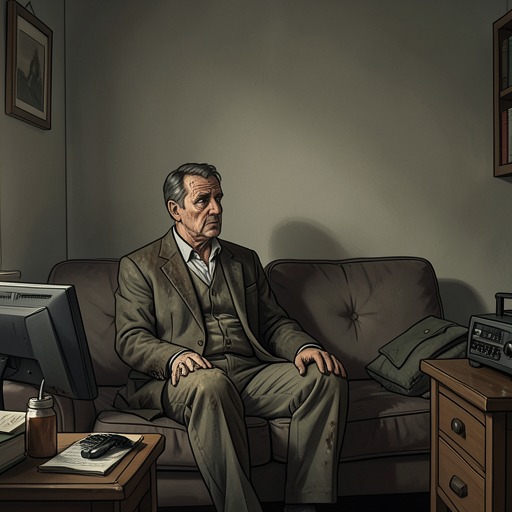
Once Upon a Time in HollywoodRick Dalton is a former television star trying to remain visible in a Hollywood that no longer seems built for him. Once the lead of his own series, he has become a recurring villain of the week, drinking whiskey sours and fearing that his career is over. His role as Caleb DeCoteau on Lancer gives that fear a form: an aging television cowboy is asked to inhabit a new kind of Western, and discovers that playing the heavy may reveal an actor still capable of surprising himself.
Identity and Career
Rick’s public identity is inseparable from Jake Cahill, the cowboy he played on Bounty Law. That part made him recognizable, but recognition has not guaranteed continuing work. By 1969 he is guesting on other people’s television shows, often as a villain, rather than leading a series of his own. The distinction is more than a change in billing. It leaves him dependent on other productions’ schedules and casting decisions, and makes the old success feel like evidence against his present standing.
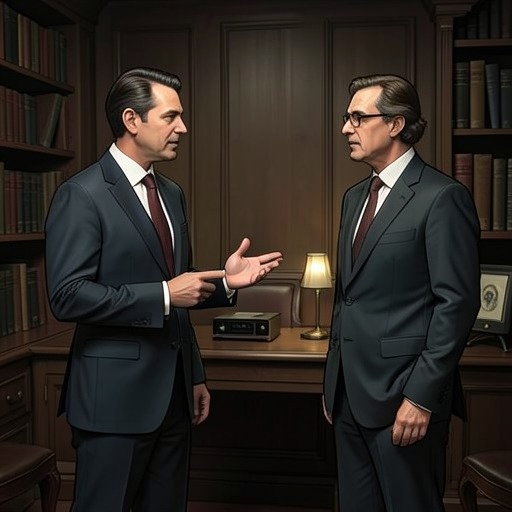
The strain surfaces in his meeting with Marvin Schwarz at the William Morris Agency. As Marvin assesses the state of Rick’s career, Rick feels tears beginning to burn behind his eyes. He gathers himself, takes a breath, and admits that after more than ten years in the business it is difficult to face what he sees as his own failure and the damage he believes he has done to his career. His distress is not simply about fewer roles; it is the painful conversion of a professional decline into a judgment on himself.
Rick’s work and his dependence on it are also material realities. His 1964 Cadillac Coupe de Ville carries him through Hollywood, with Cliff Booth driving. Rick owns a house in town, and when his mood lifts after seeing Roman Polanski, he turns that fact into a declaration of belonging. He recalls the advice to buy rather than rent and takes pride in living beside a successful filmmaker: he is not merely passing through Hollywood, even if his career has made him feel like an outsider to its present moment.
A New Role on Lancer
Rick’s part on Lancer places him in a changing professional position. The series is being filmed on the 20th Century Fox back lot, where he arrives wearing dark glasses against the sun and smoking a Capitol W cigarette to mask the taste in his mouth. The production is not simply another job: its script gives him a role with substance, and asks him to play Caleb DeCoteau, a forceful antagonist rather than the familiar hero Jake Cahill.
Rick reads the pilot as a story with strong characters. He sees Murdock Lancer as a hard, uncompromising patriarch, and Scott Lancer as a more likable Western good man whose Eastern-dandy clothes and former service with the Bengal Lancers distinguish him from familiar cowboy types. Most striking to him is Johnny Lancer, whom he regards as an unusually distinctive lead for a Western television series. His attention to these contrasts shows him engaging with the material as a viewer and analyst, not merely as an actor waiting for his lines.
Caleb, meanwhile, is more than a routine heavy. Rick recognizes that the character has some of the script’s strongest dialogue. As he walks through the deserted streets of the Royo del Oro set, rehearsing his lines, he catches his reflection in a shop window. The costume has remade him: a brown Indian wig cut to shoulder length, a drooping mustache, and a fringed rawhide jacket make him look like Caleb rather than the star of Bounty Law. In the reflected image he glimpses the point Marvin had made about an Eisenhower-era actor in a Dennis Hopper Hollywood. The costume is comic and conspicuous, but the recognition it prompts is serious: the industry’s change is visible on his own face.
Work, Status, and the People Around Him
Rick’s professional standing also affects Cliff Booth. There had been a time when Cliff’s work as Rick’s stunt double was secured by contract; on Rick’s Universal films, Cliff had a named chair on set. By the time Rick is reduced to guest appearances, that guarantee has disappeared. Television stunt teams generally work with their own crews, so Cliff only gets occasional days on shows such as Tarzan or Bingo Martin when Rick persuades a stunt gaffer to hire him. Rick’s decline therefore alters not only his own access to work but the practical terms of the long partnership between actor and stunt double.
After the Bruce Lee Incident, Cliff has, for practical purposes, ceased to be Rick’s stunt double and become his gofer. The shift marks a loss of professional status for Cliff, even as Rick continues to rely on him: Cliff drives the Cadillac and accompanies him through the routines of work and home. Their relationship persists, but its occupational form has changed. Rick’s own precarious position means he can no longer reliably provide the protection or employment that once came with being a series lead.
On the Lancer set, Rick is also alert to the small courtesies that establish standing between performers. Jim Stacy has not yet introduced himself, though both men have been there long enough for him to have done so. Rick is prepared to excuse the omission because this is Stacy’s first day on his first series and he may be nervous; that patience has a limit, however, and Rick thinks Stacy will have an enemy for life if he does not soon get himself together. The moment reveals a performer who knows the customs of a set and still measures others by them, even while his own place in the industry is unsettled.
Rehearsal and Renewal
At home, Rick continues preparing rather than assuming experience will carry him through. On the evening before a scene with the young performer Trudi Frazer, he waters his roses in the garden while running dialogue on a tape recorder. He wears a red silk kimono bought on a trip to Japan, and follows advice from a Japanese gardener to water at night so the plants can take in nourishment before the sun evaporates it. The domestic scene joins care and rehearsal: he tends the house he has earned through acting while laboring over tomorrow’s lines, determined not to be caught unprepared by the child performer.
A knock interrupts another rehearsal on set. Later, after an earlier temper tantrum, Rick wipes cold cream from his face, combs his hair back into a rough version of his usual pompadour, changes into street clothes, and cleans the trailer. He is preparing to tell the first assistant director that he accidentally broke a window when Jim Stacy appears at the door instead. These details keep his professional anxiety concrete: Rick is managing not only the performance but the aftermath of losing his temper and the story he will have to give about the damage.
The decisive change comes in the kitchen, where Rick is still wearing the red kimono. During the exchange around the scene, Trudi asks whether he is learning their lines. Her delivery, together with the young Mirabella Lancer, presses the actor and the outlaw Caleb into the same moment. Rick transforms back into Caleb’s snarling, murderous intensity, an eruption that makes his performance feel less like a costume imposed from outside and more like a force he can summon. When the scene is over, he lies on the kitchen floor and explains that he acted as though he had been shot in the face. The physical comedy of the aftermath does not erase the intensity; it gives it somewhere to land.
For the first time in ten years, Rick recognizes how fortunate his life has been. His recollection moves through the actors he worked with, the actresses he kissed, the affairs and places, the hotel rooms, the attention, the fan mail he never read, and the stories he accumulated. He looks around the house paid for by doing what he had loved as a boy: pretending to be a cowboy. That realization does not promise a revived career or undo his fear of failure. It changes the measure by which he judges the career he has already had.
Narrative Role and Ending
Rick’s story makes the work of acting both his livelihood and his means of understanding himself. Jake Cahill is the role through which Hollywood remembers him; Caleb DeCoteau is the part that forces him to see how an older screen identity sits uneasily in a changing industry. Yet the Lancer performance is not merely a symbol of decline. Rick studies the script, learns the lines, accepts the transformation of costume, and gives the scene his full force. The distinction between actor and character briefly collapses, then allows him to recognize the pleasure and good fortune contained in the work.
The ending returns him to the set rather than resolving his career in the abstract. The next day, on the 20th Century Fox back lot, Rick and Trudi knock them dead. The successful scene is a modest but concrete answer to his despair at Marvin’s office: Rick may no longer possess the security of a leading television series, but he remains capable of preparation, connection, and a performance that lands.